BE THE FIRST TO GET PRODUCT UPDATES
Get notified about new features & special offers......


Individualised baseline screening, conducted in under 5 minutes per player, allows large professional rosters to track mobility changes in-season without disrupting training, and turns test data into actionable coaching conversations.
In professional sport, time is the most precious resource. When a player arrives for spring training or the season begins, you have limited windows to assess their physical readiness, track changes, and inform training decisions.
For teams managing 200+ athletes across multiple levels, from young Latin American and High School prospects to major league rosters, the traditional approach creates a dilemma: conduct comprehensive testing once per year and lose the ability to monitor change, or sacrifice valuable training time every few weeks to retest.
Thomas Gentile, Affiliate Strength and Conditioning Coordinator for the Texas Rangers, framed the problem clearly: "In professional sports, the perfect time to test is also the perfect time to train. You don't want to sacrifice an opportune training time just to get numbers."
This tension led the Rangers to reconsider how they approach movement screening. Rather than static, annual assessments, they needed a system that could run frequently, produce repeatable data, integrate into existing workflows, and, crucially, work anywhere from their Arizona complex to a dugout bench on the road during amateur draft scouting.
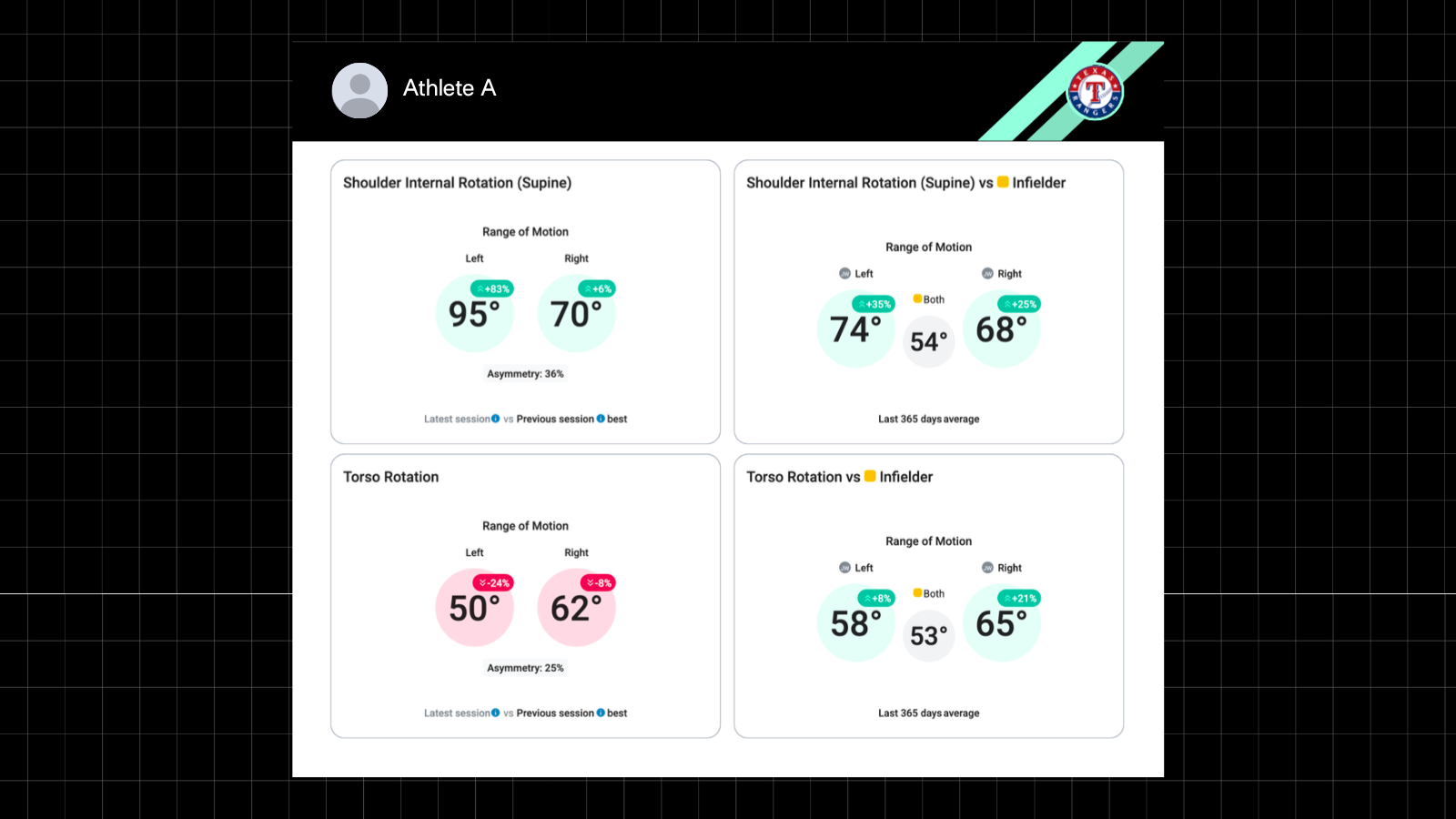
One of the biggest shifts the Rangers made was moving away from population-based norms and arbitrary "green flag" ranges.
"We have some general guidelines based on historical data," Gentile explained, "but comparing the person to themselves is more important. You have so many different body types in baseball. A 5'10" pitcher and a 6'7" outfielder will present very differently. You can't apply the same standards to both."
This is fundamentally different from how many teams approach screening. Instead of asking "Is 30 degrees of hip internal rotation good?" the Rangers ask "Is this player's mobility changing? And if so, why?"
This approach does two things:
First, it reduces false alarms. A player might show a 10-degree decrease in shoulder external rotation, but if they've also gained 10 pounds of muscle mass in the off-season, that's context, not pathology. It tells a story rather than triggering panic.
Second, it enables real-time decision making. When you have a baseline for each athlete, you can spot meaningful changes quickly, not through annual testing, but through frequent checks. If a player's hip internal rotation drops 15 degrees over two weeks, that's a signal worth investigating. It might be fatigue. It might be a technique breakdown. It might be nothing. But you have the data to ask the right question.
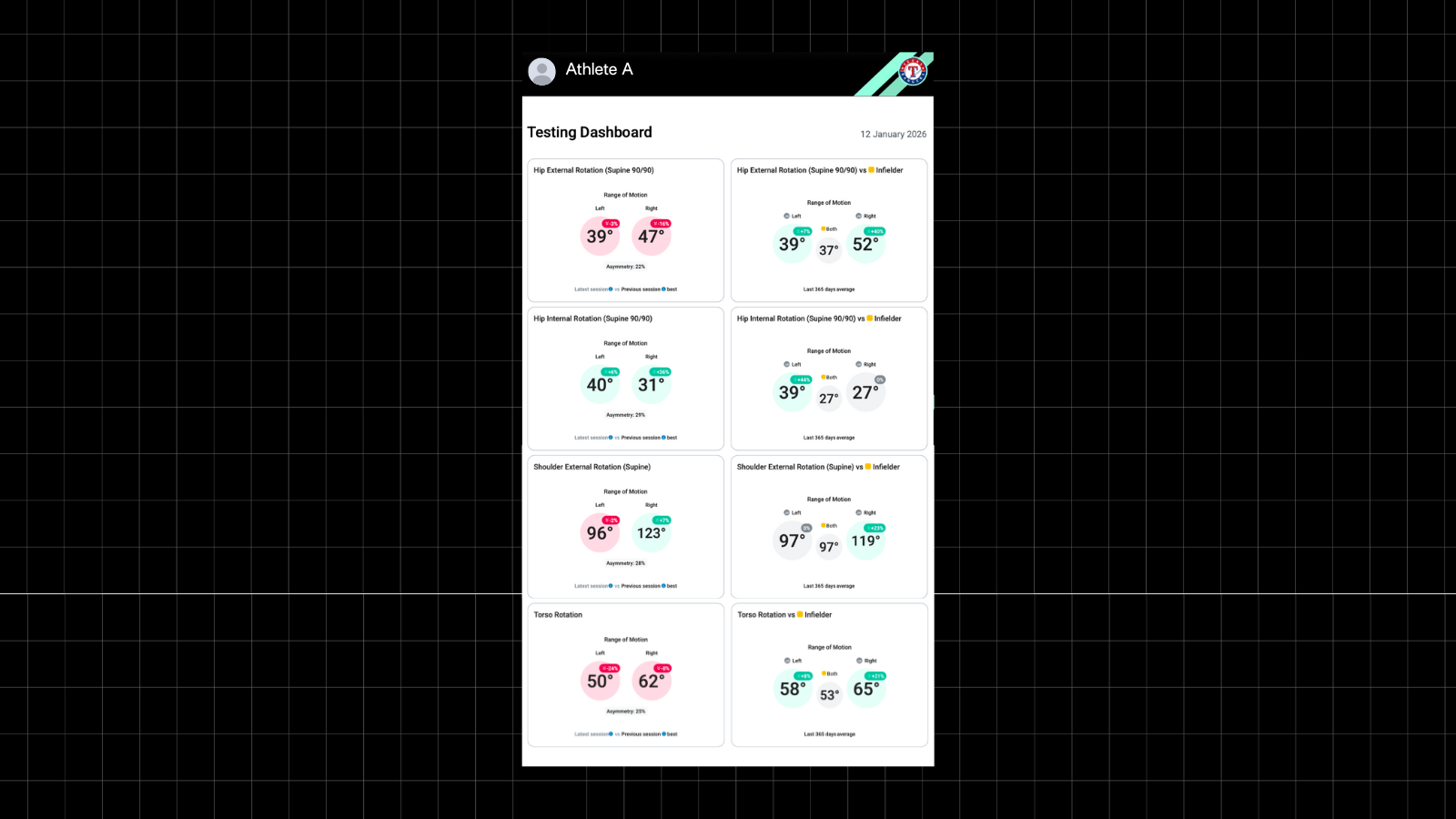
The Rangers keep their movement assessment straightforward and passive, administered in under 10 minutes per player:
All measurements are taken passively, the athlete relaxes while the coach moves the limb through its range. Gentile explained why: "When you test actively, you get muscle contraction, which can mask true joint capability. Passive testing shows you what the joint can actually do when there's no muscular tension involved."
Each player progresses through the same sequence every time. This consistency, combined with Output's ability to flag percentage changes between tests and highlight personal bests, creates quality control built into the process.
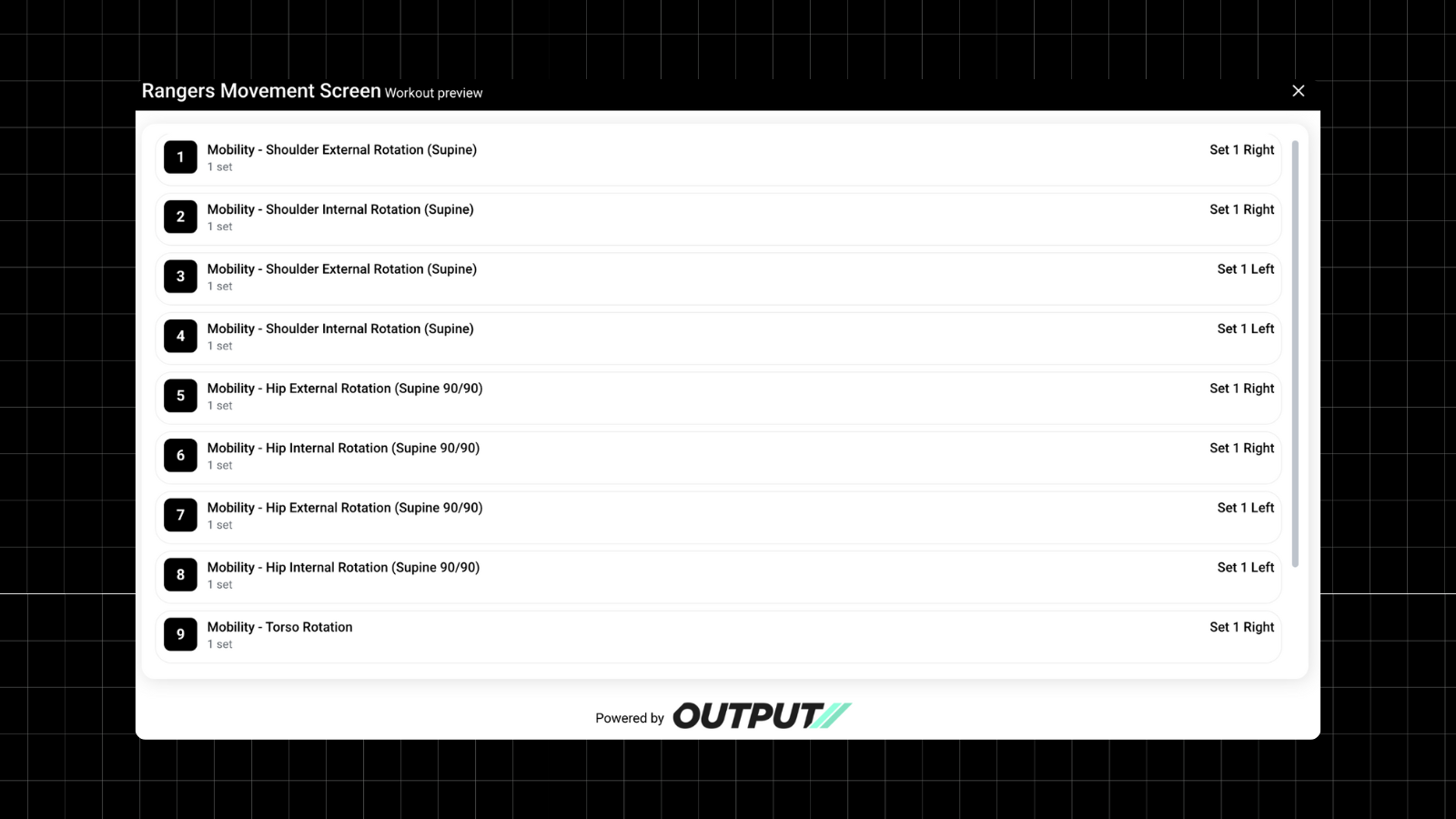
"I can see if there's a 30% difference from my last test," Gentile said. "If that seems too large, I can immediately check my technique, redo the rep, and verify. It saves you from recording errors on the spot."
Here's where efficiency matters most. During amateur draft workouts, the Rangers' three-person team (Gentile, Arizona coordinator Adam Noel, and sports scientist Kevin Varitek) often screens 50+ players in a single session.
With two Output sensors running in parallel and a standardized dashboard protocol, they can move players through as a station while other activities, hitting, throwing, defensive work, happen simultaneously. Start to finish: about 5-6 minutes per player.
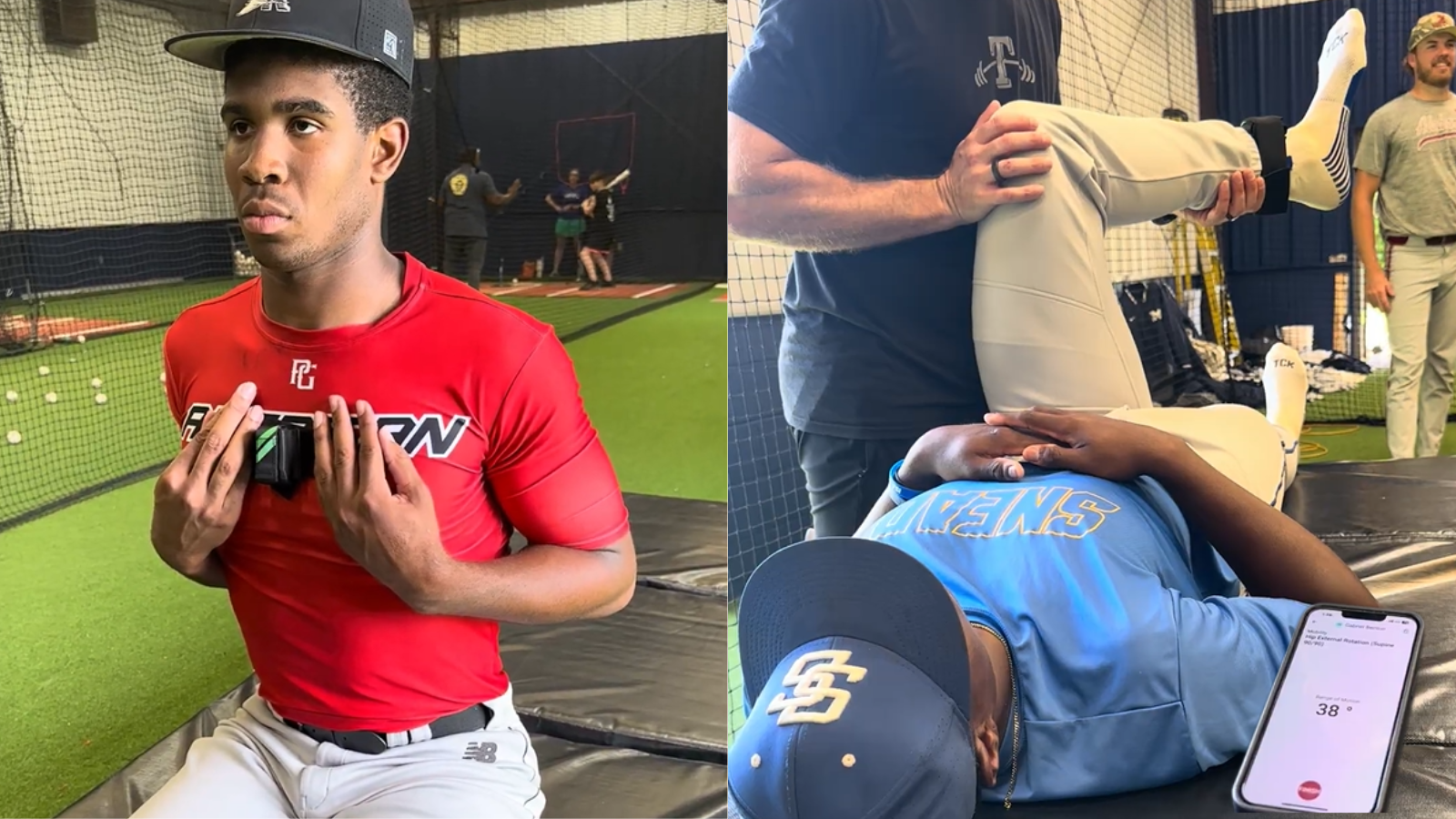
"We've got it down pretty well," Gentile noted. "We're able to get 65 players through a screening in two hours or less. And we're doing this everywhere, dugouts, public parks, university fields, private facilities. The versatility of the system means we can standardise our tests regardless of location."
This speed doesn't compromise data quality. The Output dashboard auto-populates results in real time, and the API integration means data flows directly into the Rangers' internal database. No double entry. No delays. By the time the last player finishes, the full data set is ready for analysis.
Screening data only matters if it changes what you do in training.
The Rangers use mobility screening to make two key decisions:
1. Exercise selection and positioning. If a player shows restricted shoulder flexion, a pull-up might not be the best starting point. Instead, Gentile might prescribe a cable row at 45 degrees to load the shoulder in a position they can actually control. Once mobility improves, they progress.
"The goal is to not put joints in situations where they're required to do more than they're capable of," Gentile explained. "It's about finding the right exercise for the right person at the right time."
2. Sport-specific conversation starters. Mobility data becomes evidence in conversations between strength coaches, athletic trainers, and sport-specific coaches.
For example: a hitter lands with their front foot closed, limiting hip internal rotation on the front side. This manifests as ground balls pulled to second base instead of line drives to right field. Without data, it's a coaching cue. With screening data showing limited hip internal rotation, it's a targeted intervention: land more open, access better hip rotation, improve barrel path and launch angle.
"We're able to reverse engineer problems," Gentile said. "We see what's happening on the field, look at the mobility data, and work backwards to find positions or exercises that might help them access better mechanics."
One of the Rangers' biggest advantages is integrating Output screening into their entire player development system.
Prospects might be screened during amateur draft workouts in January. They're screened again at the MLB Combine in June (where the Rangers observe). They're screened a third time when they arrive at the complex post-draft in July. And once in the major league system, they're screened every 6-8 weeks during the season.
"Some guys have three or four data points before they even step in the door," Gentile said. "It tells a story. Over a calendar year, you start to see maturation, development, and change."
This continuity means nothing is lost in translation between amateur workouts, spring training, and the season. Medical staff, strength coaches, and performance staff all use the same protocol, same measurements, same dashboard. Consistency across 200 athletes becomes feasible.
In-season screening happens in small groups, early in the day, before training sessions begin. Two or three players per day get tested, ensuring the full roster cycles through every 6-8 weeks without disrupting preparation.
If a player shows a notable change, velocity drops, mechanical issues appear, or mobility shifts, the Rangers can flag it immediately and dig deeper. Is it fatigue? Poor sleep? An early sign of dysfunction? The data becomes a conversation starter with medical staff, hitting or pitching coaches, and the player themselves.
"We're able to see changes in real time and course-correct before they become bigger problems," Gentile noted. "If something's off, we can make an adjustment and still have months left in the season to get back on track."
Perhaps the most important insight from the Rangers' approach is this: screening data doesn't replace coaching judgment or medical expertise. It supports it.
"Data is objective," Gentile said. "But interpretation depends on context, athlete history, and what's actually happening on the field. We use this alongside motion capture, force plates, exit velocity, spin rate, everything. It's all part of the conversation."
A player might show excellent mobility but poor force production. Or high mobility but low deceleration strength. Each combination tells a different story and requires a different response.
The goal isn't to find the perfect range or follow a checklist. It's to understand each athlete individually, track changes meaningfully, and make better decisions about training, positioning, and risk management.
The Rangers' greatest ability is availability. Players who stay healthy play. And players stay healthy when their training is informed by frequent, objective data and individualised interpretation.
By screening movement efficiently, scaling across 200+ athletes, and turning data into coaching conversations, the Rangers have built a system where technology supports, rather than complicates, their core mission: develop athletes and keep them in the game.

.png)
Monthly performance insights, product updates, and sports science — straight to your inbox.
No spam, ever. Unsubscribe anytime.
No thanks, I'm not interested