BE THE FIRST TO GET PRODUCT UPDATES
Get notified about new features & special offers......


If you are looking for a training split that builds muscle efficiently without burning you out, the push pull legs routine is one of the most reliable options available. It groups exercises by movement pattern rather than by body part, which allows for better recovery, more training frequency, and steady progress over time.
This guide breaks down exactly what a push pull legs routine is, why the research supports it, who it suits, and how to structure one for muscle growth, whether you are training three days a week or six.
The push pull legs routine, often shortened to PPL routine, organises your training week around three categories of movement:
Instead of splitting workouts by individual muscle groups (chest day, back day, arm day), a push pull legs workout groups muscles that work together during the same lifts. Since the chest, shoulders, and triceps are all involved in a bench press, they recover together and can be trained together. The same logic applies to the back and biceps during rows and pull-ups.
This structure makes the push pull legs routine easy to scale. You can run it three days a week for a straightforward split, or six days a week for higher volume and frequency.
A push pull legs workout routine is popular for a reason. Some of the main benefits include:
The frequency benefit is not really about frequency in isolation. A later meta-analysis found that higher frequencies tend to track with better hypertrophy largely because they make it easier to fit more total sets in without any one session running too long [2]. Frequency is the delivery mechanism, weekly training volume is the actual driver.
Push day covers every push pull legs exercise that involves pressing movements. The main muscles trained are the chest, front and side shoulders, and triceps.
Start push day with a compound lift like the bench press or overhead press while you are fresh, then move into isolation work for the shoulders and triceps. This order lets you lift heavier on the exercises that recruit the most muscle mass.
Pull day targets the muscles used to pull weight toward the body: the lats, mid-back, rear shoulders, and biceps.
As with push day, lead with the heaviest compound movement. If you deadlift on pull day, keep the volume elsewhere in check so recovery does not become an issue, particularly on a 6-day push pull legs workout routine where legs day follows soon after.
Legs day is often the part of training push pull legs that gets skipped or shortened, but it is essential for overall muscle growth, core strength, and hormonal response to training.
Prioritise a squat or hinge pattern first, then follow with unilateral and isolation work. Consistent leg training also supports better performance on push and pull days, since a stronger lower body improves stability during heavy compound lifts.
.png)
PPL is flexible, but it is not equally suited to everyone. The right version of the split depends on training experience and the specific goal.
The 3-day push pull legs routine is the most common starting point. It trains each muscle group once per week and fits well around a standard work schedule.
This version delivers each muscle group's weekly volume in one sitting rather than splitting it across two sessions, which suits lifters who are still building the work capacity to recover from higher frequency [1].
For lifters who want higher frequency, the 6-day push pull legs workout routine repeats the push, pull, legs sequence twice in one week.
Splitting the same, or greater, weekly volume across two sessions per muscle group instead of one is a more efficient way to accumulate sets without any single workout becoming excessively long or fatiguing, which is the mechanism behind the volume-hypertrophy relationship identified in dose-response research [4]. To avoid overtraining, the two sessions for each category should differ slightly, for example a heavier, lower-rep push day followed a few days later by a lighter, higher-rep push day.
Following the push pull legs routine structure is only half the equation. Progression is what actually drives muscle growth over time. A few principles to apply:
Sets and reps tell you what you did. They do not tell you how much that set actually cost you, and that gap is where most PPL plans fall short, especially on the 6-day version where fatigue builds up across two sessions per muscle group instead of one.
Bar speed on your main lift each day fills that gap. As a set gets harder, the bar moves slower before it shows up as a missed rep or a grinding lift, and this relationship between rep-by-rep velocity loss and neuromuscular fatigue is well established in the resistance training literature [5]. This is the basis of velocity based training (VBT), and the framework used within the Output system builds on this to define velocity loss zones, a simplified way of reading how much speed has dropped from the fastest rep in a set.
.png)
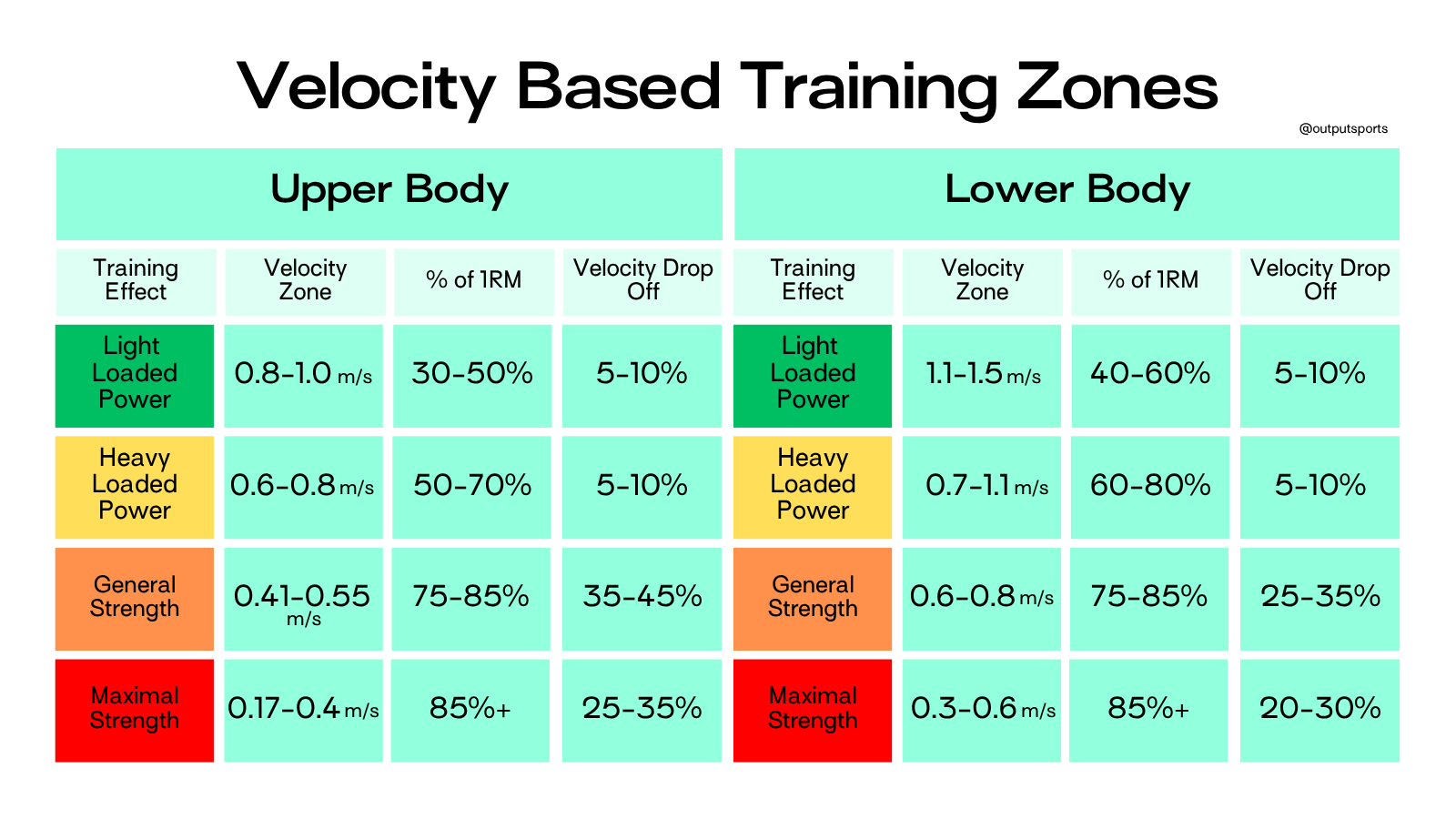
Whilst there is no separate hypertrophy row or range, hypertrophy training sits within the General Strength zone, using moderate loads roughly 75-85% of 1RM.
What actually drives growth at that load is not time under tension in the way it is often described. Time under tension is really a proxy for total volume and effort, not a mechanism in its own right. The variable that matters is mechanical tension, the force applied to the muscle fibre during the lift. Current models identify mechanical tension as the primary driver of hypertrophy, with muscle damage and metabolic stress playing secondary, largely indirect roles rather than independent drivers [6]. That same review notes exercise-induced muscle damage is probably not essential for growth at all, which cuts against the older idea that chasing soreness or long, grinding sets is doing extra work [6].
Practically, this points back to the same load range and the same logic already established here: sufficient mechanical tension needs a load high enough to matter, which is why hypertrophy work sits in the General Strength band rather than the lighter power zones, and sufficient volume across a set and across the week, tracked and progressed over time, matters more than stretching any single set out.
Once the load is set within a zone, velocity drop-off (how much bar speed falls from the fastest rep in the set) is a separate decision that shapes what that load actually delivers. A tighter drop-off cap keeps the set closer to peak intent, preserving the quality the zone is meant to train. A looser cap lets the set run further into fatigue, which shifts the training effect toward more accumulated, hypertrophy-type stress, even at the same starting load. This is why the drop-off allowance narrows at the top of the load spectrum: Maximal Strength caps drop-off lower than General Strength does, specifically so heavy sets don't drift past the quality they're meant to train and start behaving like fatigue-driven hypertrophy work instead.
Practically, for a push pull legs routine built around muscle growth, this means the main lift each day is typically loaded in the General Strength band, and staying toward the upper end of that zone's drop-off allowance (rather than the tightest end, which is closer to a pure strength emphasis) is what pushes the set into the fatigue range associated with hypertrophy.
Applied across a full PPL week, this turns a fixed number of sets and reps into something that adjusts to how you are actually recovering that day. On a squat day where you slept badly, velocity loss tells you sooner than your reps will. Across a 6-day split in particular, this kind of session-by-session read is useful for deciding whether the second push or pull day of the week needs backing off before fatigue turns into a missed session.
This sits on top of programming, not in place of it. Output is built around a simple loop, test, program, train, monitor, brought together in connected coaching software, and velocity tracking within a PPL routine is really the train and monitor part of that loop working in real time. It is a decision-support layer: it gives you or your coach better information on the day, it does not decide the workout for you. For anyone wanting to go deeper on the method itself, Output has a full VBT guide covering the fundamentals.
Here is a sample weekly plan combining both the 3-day and 6-day approaches, so you can see how the split can flex around your schedule.
Whichever schedule you choose, the underlying push pull legs workout routine stays the same. What changes is frequency and total weekly volume, so pick the version that matches your recovery capacity and time available for training.
Is push pull legs good for building muscle?
Yes. Training frequency research supports hitting each muscle group at least twice a week for hypertrophy [1], and the PPL structure makes that frequency easy to build a schedule around without overloading any single session.
[1] B. J. Schoenfeld, D. Ogborn, and J. W. Krieger, "Effects of resistance training frequency on measures of muscle hypertrophy: a systematic review and meta-analysis," Sports Medicine, vol. 46, no. 11, pp. 1689-1697, 2016.
[2] B. J. Schoenfeld, J. Grgic, and J. Krieger, "How many times per week should a muscle be trained to maximize muscle hypertrophy? A systematic review and meta-analysis of studies examining the effects of resistance training frequency," Journal of Sports Sciences, vol. 37, no. 11, pp. 1286-1295, 2019.
[3] G. W. Ralston, L. Kilgore, F. B. Wyatt, D. Buchan, and J. S. Baker, "Weekly training frequency effects on strength gain: a meta-analysis," Sports Medicine - Open, vol. 4, no. 1, art. 36, 2018.
[4] B. J. Schoenfeld, D. Ogborn, and J. W. Krieger, "Dose-response relationship between weekly resistance training volume and increases in muscle mass: a systematic review and meta-analysis," Journal of Sports Sciences, vol. 35, no. 11, pp. 1073-1082, 2017.
[5] L. Sánchez-Medina and J. J. González-Badillo, "Velocity loss as an indicator of neuromuscular fatigue during resistance training," Medicine & Science in Sports & Exercise, vol. 43, no. 9, pp. 1725-1734, 2011.
[6] H. Wackerhage, B. J. Schoenfeld, D. L. Hamilton, M. Lehti, and J. Hulmi, "Stimuli and sensors that initiate skeletal muscle hypertrophy following resistance exercise," Journal of Applied Physiology, vol. 126, no. 1, pp. 30-43, 2019.

.png)
Monthly performance insights, product updates, and sports science — straight to your inbox.
No spam, ever. Unsubscribe anytime.
No thanks, I'm not interested