

BE THE FIRST TO GET PRODUCT UPDATES
Get notified about new features & special offers......


The best exercises to get faster combine three things: strength work that builds force, plyometrics that convert that force into explosive power, and sprint drills that express it as actual speed, all performed with real intent rather than half-effort reps.
Most people looking for "exercises to get faster" end up with a list of drills and no idea how they fit together. That's the gap this blog fills.
Speed isn't one skill. It's built from three trainable qualities stacked on top of each other:
Miss any one of these and progress stalls. Plenty of athletes have plenty of raw strength but never learn to apply it quickly. Others sprint constantly but never build the underlying force to sprint from. The exercises below are grouped by which quality they target, but how you train them matters just as much as which ones you pick, which is where most programmes quietly go wrong.
Here's the part nobody puts on the workout sheet. A broad jump done at 70% effort barely resembles the same exercise done flat out. Research on contraction intent backs this up directly: the deliberate attempt to move as explosively as possible drives adaptations that a slower, disengaged rep simply doesn't produce, even when the exercise looks the same on video [1].
This hits plyometrics and sprint drills hardest, since they look automatically "fast" whether or not the athlete is actually trying. A set of box jumps performed on autopilot trains almost nothing. The same set done with everything the athlete has trains explosive power.
In practice, this means:
Skip this and the exercise selection barely matters.
.png)
Real sprint programming, the kind used by coaches working with elite sprinters, doesn't split a week into "strength day, power day, speed day." It's organised around which quality of sprinting is being trained, with strength and power work running underneath that structure rather than occupying separate days [2].
Objectivity matters at every stage of this process, not just the heaviest lifts.
On acceleration and strength days, velocity feedback on the barbell during squats, deadlifts, and hip thrusts gives an immediate read on whether an athlete is training with the intent this article keeps coming back to. Feedback during resistance training has been shown to improve outcomes compared to training without it [10], and a rep that looks the same on video can be a completely different rep on the velocity readout.
.png)
On maximal velocity days, jump testing (CMJ, reactive strength index, peak and mean power) captures how well force is being converted into explosiveness. RSI in particular reflects how quickly an athlete produces force during a jump, the same underlying quality plyometric training is trying to build.
On every day, tracking load-velocity profiles and testing metrics over a training block shows whether the qualities underpinning speed are trending the right way, without needing to measure sprint times directly.
None of this replaces the exercises themselves, or the coach's eye on technique. What it does is give an objective, repeatable answer to the question every phase of this article depends on: was that rep actually fast, or did it just look fast? The sensor measures, the coach interprets.
Stronger athletes tend to be faster ones, particularly over short distances. In a study of Division I-AA football players, squat strength relative to bodyweight correlated with 10-yard and 40-yard sprint times: athletes squatting more than twice their bodyweight were significantly faster over those distances than athletes below 1.9 times bodyweight [3]. Strength doesn't guarantee speed on its own, but it raises the ceiling, provided it's trained properly rather than on autopilot.
Plyometric training uses the stretch-shortening cycle, the rapid stretch-then-contract action seen in jumping and sprinting, to build explosive power. A meta-analysis of adolescent soccer players by Zheng et al. found plyometric training produced a small but real improvement in sprint speed, alongside a bigger jump in vertical jump height and change-of-direction ability [5]. A separate review across adolescent team sports by Zhang et al. found similar sprint gains over 10, 20, and 30 metres [6].
Both studies are looking at exercises most coaches already use. What separates a session that works from one that doesn't is whether each jump is done at genuine full effort, since the stretch-shortening cycle responds to speed and force, not distance covered or reps ticked off [1].
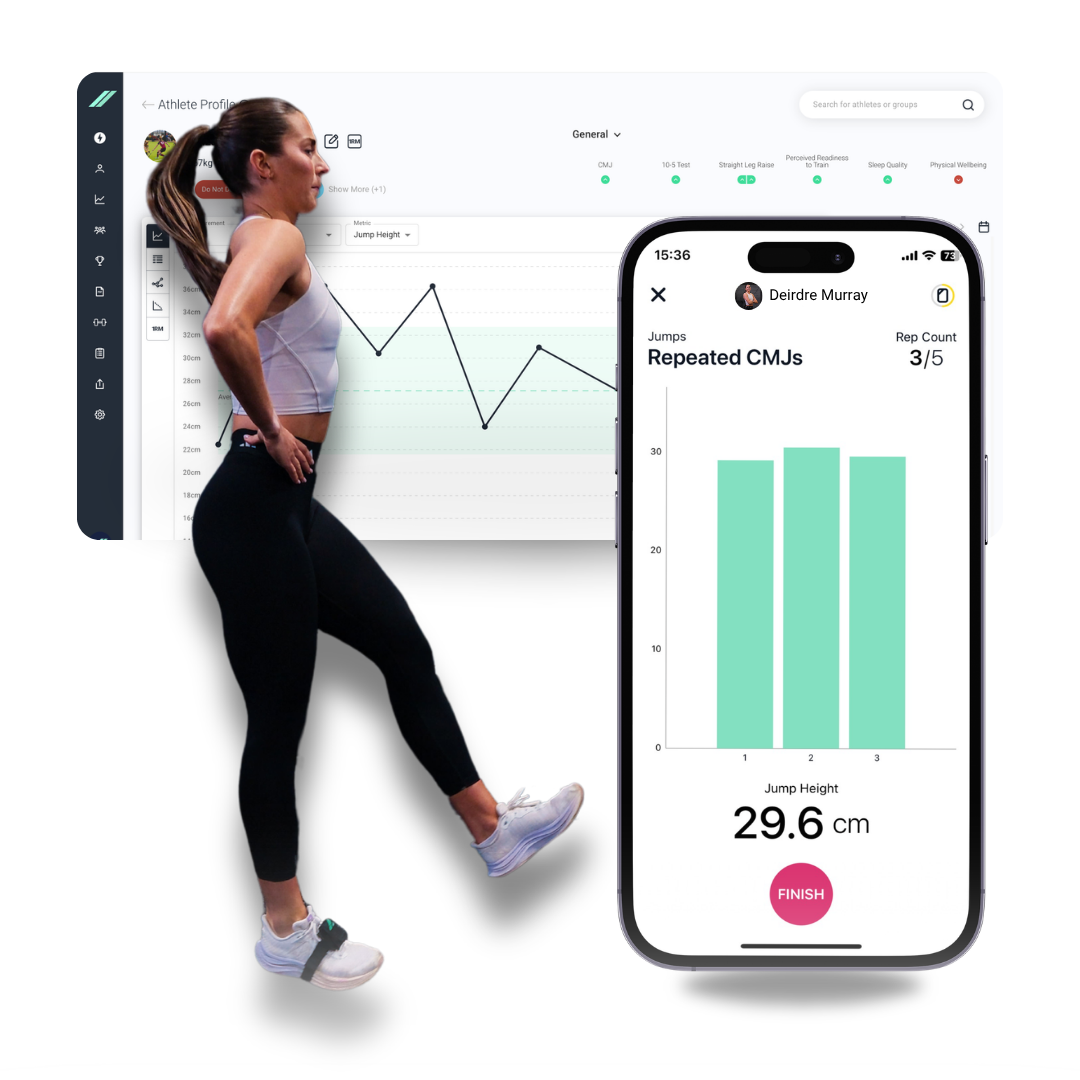
Strength and power give you the raw materials. Sprint drills teach the body to spend them in the actual sprinting pattern, and this is where effort and recovery matter most of all.
Going through the motions. Jumps, sprints, and lifts done without real effort train almost nothing. The adaptation follows the effort, not the exercise on the page [1].
Skipping the strength work. Plyometrics and sprint drills without a strength base means training power output you haven't actually built yet.
Cutting rest short. Full recovery between sprints and jumps is a defining feature of how elite sprint training is actually structured [2]. Tired, half-speed reps train a different quality than genuinely fast ones, and it's not the one you're after.
Training in the grey zone. Sitting at 70-95% effort on sprints trains neither the quality nor the recovery you need. Go hard or go easy, and try to avoid the middle [2].
Overusing agility ladders. They're fine for foot coordination, but the steps are short, choppy, and low-force. On their own they won't build the acceleration or top speed most people are chasing.
Letting technique slip when tired. Posture (bent ankles, knees, hips, chest up) tends to break down as fatigue sets in. Keep coaching it through the whole rep, not just the first few strides [7].
[1] "A narrative review of velocity-based training best practice: the importance of contraction intent versus movement speed," Appl. Physiol. Nutr. Metab., 2024. https://pubmed.ncbi.nlm.nih.gov/39366003/
[2] T. Haugen, S. Seiler, Ø. Sandbakk, and E. Tønnessen, "The training and development of elite sprint performance: an integration of scientific and best practice literature," Sports Med. Open, vol. 5, no. 1, art. 44, 2019. https://doi.org/10.1186/s40798-019-0221-0
[3] J. M. McBride, D. Blow, T. J. Kirby, T. L. Haines, A. M. Dayne, and N. T. Triplett, "Relationship between maximal squat strength and five, ten, and forty yard sprint times," J. Strength Cond. Res., vol. 23, no. 6, pp. 1633–1636, 2009. https://doi.org/10.1519/JSC.0b013e3181b2b8aa
[4] N. Harris-Fry, "10 exercises to make you a faster runner," Coach, 2021 (updated 2022). https://www.coachweb.com/running/6938/ten-exercises-to-make-you-a-faster-runner
[5] T. Zheng, R. Kong, X. Liang, Z. Huang, X. Luo, X. Zhang, and Y. Xiao, "Effects of plyometric training on jump, sprint, and change of direction performance in adolescent soccer player: A systematic review with meta-analysis," PLoS ONE, vol. 20, no. 4, e0319548, 2025. https://doi.org/10.1371/journal.pone.0319548
[6] F. Zhang, Y. Liu, J. Liu, O. Yeremenko, and L. Shi, "The effects of plyometric training on physical fitness in adolescent team sports: a systematic review and meta-analysis," Front. Physiol., 2026. https://doi.org/10.3389/fphys.2026.1760239
[7] C. Marshall, "Need for speed: Three exercises to make you faster," NFL.com. https://www.nfl.com/news/need-for-speed-three-exercises-to-make-you-faster-0ap3000000392504
[8] P. E. Alcaraz, J. Carlos-Vivas, B. O. Oponjuru, and A. Martinez-Rodriguez, "The effectiveness of resisted sled training (RST) for sprint performance: A systematic review and meta-analysis," Sports Med., vol. 48, no. 9, pp. 2143–2165, 2018.
[10] A. D. Randell, J. B. Cronin, J. W. L. Keogh, N. D. Gill, and M. C. Pedersen, "Effect of instantaneous performance feedback during 6 weeks of velocity-based resistance training on sport-specific performance tests," J. Strength Cond. Res., vol. 25, no. 1, pp. 87–93, 2011. https://doi.org/10.1519/JSC.0b013e3181fee634

.png)
Monthly performance insights, product updates, and sports science — straight to your inbox.
No spam, ever. Unsubscribe anytime.
No thanks, I'm not interested