

BE THE FIRST TO GET PRODUCT UPDATES
Get notified about new features & special offers......


The University of Colorado (CU) uses Output, a velocity-based training and athlete monitoring platform, to run programming, wellness, mobility testing and progression tracking for its men's basketball and Olympic sports teams in one system. Strength coach Steve Engelhardt uses that data to individualise training, adjust sessions day to day and keep a clear record of what every athlete has done.
Key results:
• Strength: one player improved his bench press from 165 lb to 225 lb over a summer and preseason.
• Daily habits: mobility compliance rose from 23% to 100% as athletes took ownership of their work.
• Return to play: a next-day mobility retest caught a 36% plantar flexion deficit after an ankle sprain.
• Periodisation: five custom velocity zones phase training across the whole season.
Steve has spent 15 years at CU, 11 of them with men's basketball in the Big 12. His aim is to develop bigger, faster, stronger athletes who, above all, stay available to compete, and everything he does is built on three principles.
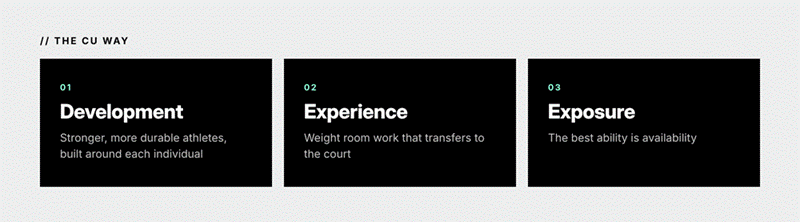
Development: every athlete leaves stronger and more durable. Limb length, height, training age and injury history are understood before a programme is written.
Experience: weight room work has to transfer to the court. These are basketball players, not powerlifters or bodybuilders, and training is judged on that basis.
Exposure: the best ability is availability. Athletes aiming for the professional game need to be on the court, and the weight room exists to keep them there.
CU had tried several platforms. None were bad, but none did everything. Steve did not want to jump between apps, or write velocity numbers down and enter them into Excel, a workflow he knew well from the days of tethered units and hand-recorded sets.
Men's basketball athletes are away for only four or five weeks a year, so home training has to count. Any system also had to be simple enough for athletes to use on their own phones and for coaches to teach on the road.
• One platform for the whole athlete. Readiness, screening, training and testing data sit in a single profile.
• Objective numbers. No more guessing or getting lucky. The data is in front of him every session.
• Simple to run. One sensor on the bar, wrist, forearm or foot, guided by video, on iPad, iPhone or Android.
• Data that becomes programming. Session data feeds straight back into training decisions, supported by a team that listens to feature requests.
In season, when games and minutes vary, Steve builds sessions in the workout view and drags them where they fit. In summer, with fixed lifting days, he lays out full blocks in the program view and checks every exercise week by week in the progression view.
Coach notes and instructional videos appear on the athlete device, so tempo cues and whole mobility sessions travel with the athlete.
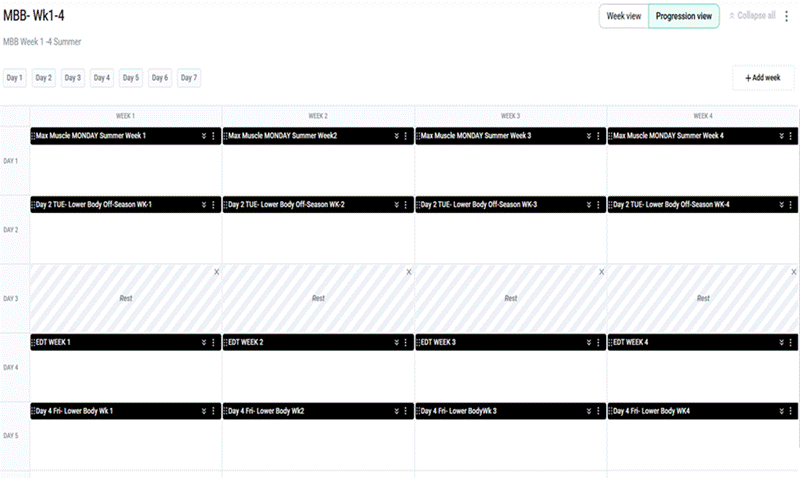
Every programme feeds the athlete calendar. Steve can open any day, see what was prescribed and completed alongside that day's wellness check-in, and export for an athlete or a team. That record has built trust with medical staff, who now ask to see programmes for athletes returning from injury.
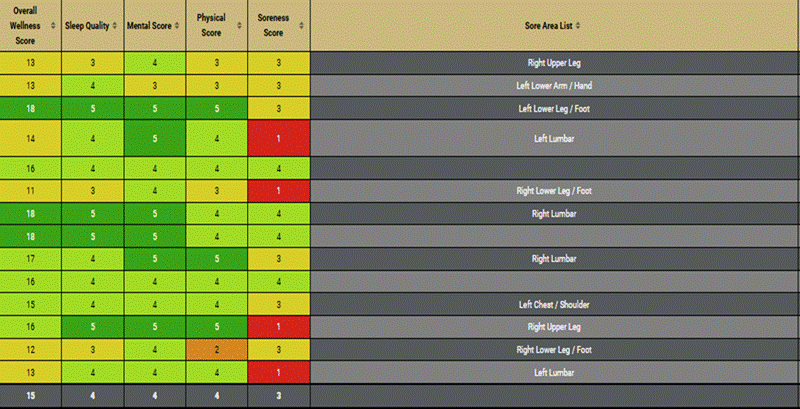
A daily check-in covers readiness to train, physical wellbeing, mental state and sleep, with a green, amber or red status. Steve sees strength and conditioning as a relationship business, and this is where the conversation starts.
A key player reporting high soreness two days before a game might swap the lift for mobility and recovery. A player with poor sleep and high stress two days running was given space to focus on an exam first. When an easy practice turns hard, velocity and RPE let Steve cut the load straight away, and persistent issues go to the right specialist.
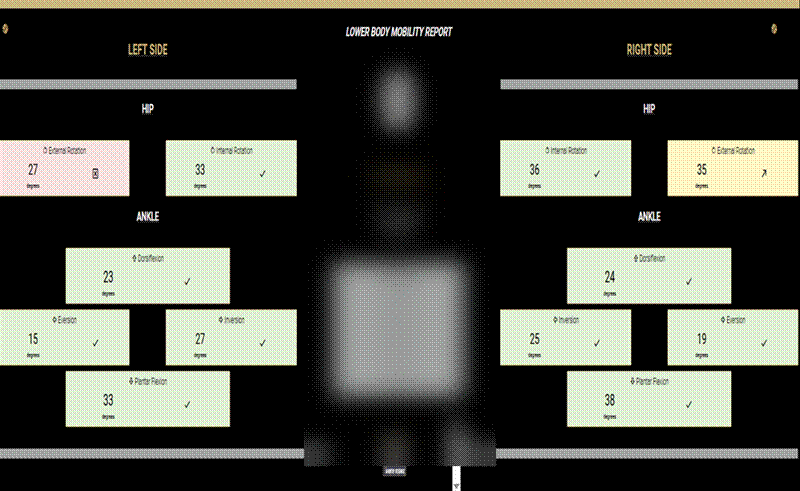
Every player is baselined from day one on hip internal and external rotation and ankle dorsiflexion, plantar flexion, inversion and eversion, against target ranges CU set from research on Division I and professional stop-and-go athletes. The sensor has replaced the goniometer and made testing far quicker.
After an ankle sprain, a next-day retest once showed plantar flexion down 36% while every other measure was on target, telling medical staff exactly what still needed restoring before a return to court.
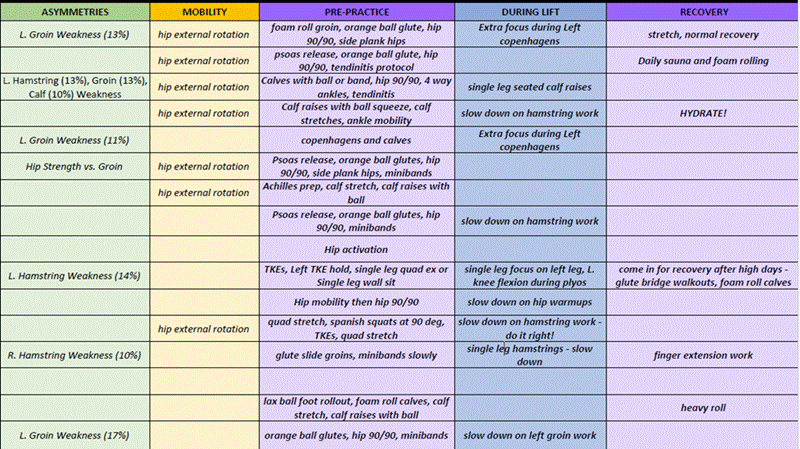
Screening also feeds a daily habits board on the weight room TVs. As compliance climbed from 23% towards 100%, athletes reported feeling much better. Individual gaps carry into the lift and recovery too, such as two extra sets of left-side Copenhagens with a 20-second hold, while the team programme stays intact.
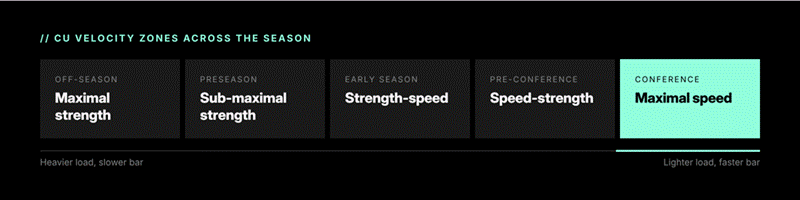
CU builds on the three general Output zones with five of its own, phased across the year: maximal strength in the off-season, sub-maximal strength in preseason, strength-speed at the start of the season, speed-strength before conference play and maximal speed during conference. Live feedback on every rep confirms each set lands in the intended zone.
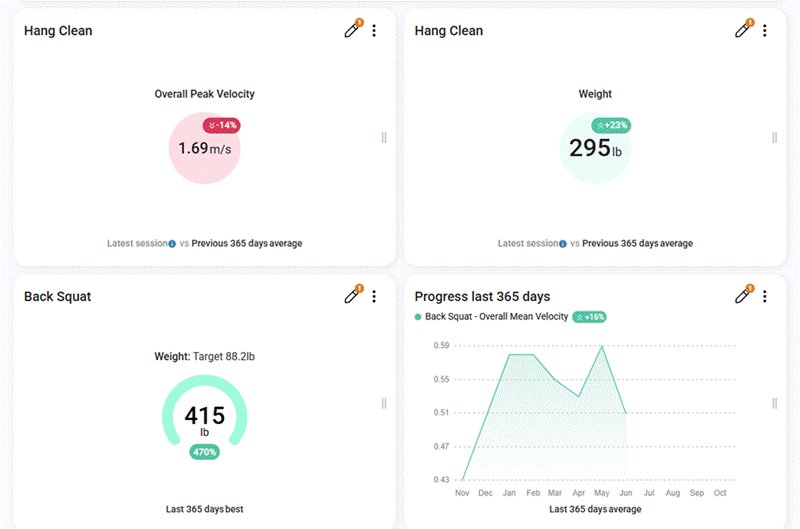
Load moves with bar speed, using APRE-style 5 lb adjustments, though Steve expects coaches to push and cue athletes before they take weight off.
Results stream to the weight room TVs, showing the top six from a squad of 16. Every athlete has a clear target, and seeing their numbers live makes them want to push harder.
Trends can be viewed by year, month, day, set or rep, across weight, mean or peak velocity and power, with nothing written down by hand. That time goes back into coaching.
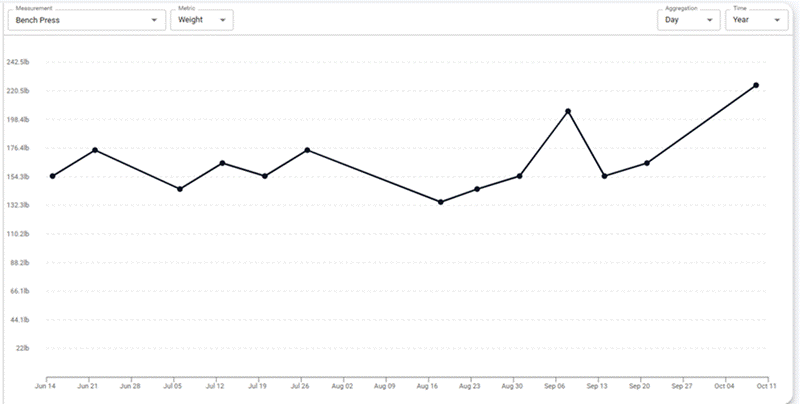
One player with a low training age started at an estimated 165 lb bench press and reached 225 lb by the end of preseason, against a goal of 185. When another regressed while the rest of the team improved, the data prompted a conversation that got to the root of his poor sleep.
Readiness tests rotate between reactive strength index (RSI), med ball throws and grip strength, compared against individual baselines set each August. The sensor travels with the team for RSI checks and post-sprain mobility retests, and results sync back to the athlete profile.
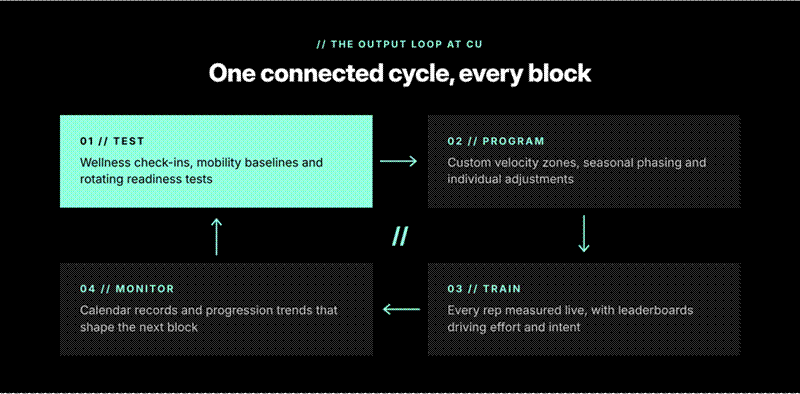
At CU, testing covers daily wellness, mobility baselines and readiness checks. Programming turns that data into custom velocity zones, seasonal phases and individual adjustments. Training measures every rep live, and monitoring through the calendar and progression trends shapes the next block.
Output gives Steve one view of each athlete, from the morning check-in to the last rep. He can individualise within a team programme, adjust sessions to how athletes are actually responding, and keep a record that coaches, athletes and medical staff all rely on.
That frees him to build relationships, educate athletes and hold high standards. For Steve, data only matters if it develops the athlete, and that is how CU measures success.
Steve walks through each part of the CU system in detail, followed by a Q&A with coaches.


Monthly performance insights, product updates, and sports science — straight to your inbox.
No spam, ever. Unsubscribe anytime.
No thanks, I'm not interested