BE THE FIRST TO GET PRODUCT UPDATES
Get notified about new features & special offers......


Most people who fall off a fitness routine do not fail because of a bad workout plan. They fail because they cannot see the plan working. The scale barely moves, the mirror looks the same as last month, and without any other evidence of progress, motivation runs out.
Tracking fitness progress fixes that problem. It gives you objective proof that the work is paying off, even in weeks where nothing feels different, and it tells you when something in the plan actually needs to change rather than guessing. This guide covers how to track your fitness progress effectively, the best metrics to focus on, and the tools that make it easier.
Fitness progress tracking is not just a record-keeping habit. It is one of the more consistently supported behaviours in the research on successful, sustained training and weight management. A systematic review of self-monitoring in weight loss found that people who consistently logged their weight, food, or exercise achieved significantly better outcomes than those who did not track at all [1].
Beyond the numbers, tracking gives you three practical advantages:
Without some form of tracking, progress becomes a feeling rather than a fact, and feelings are a poor way to judge whether a training plan is working.
Effective fitness progress tracking comes down to three principles, regardless of which specific method or app you use:
Most people do not need all 10. Picking two or three that match your goal, and using them consistently, works better than trying to track everything at once.
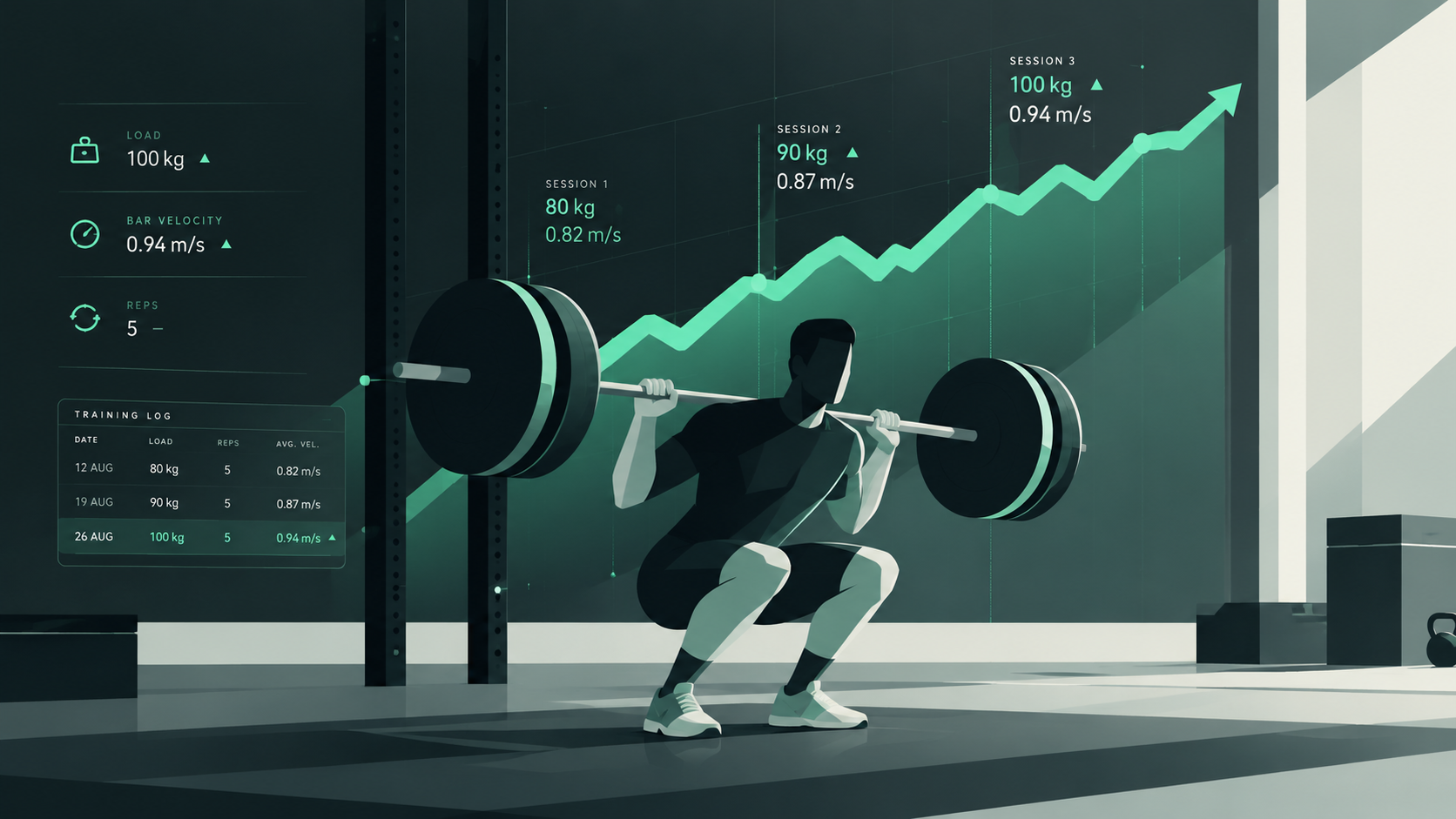
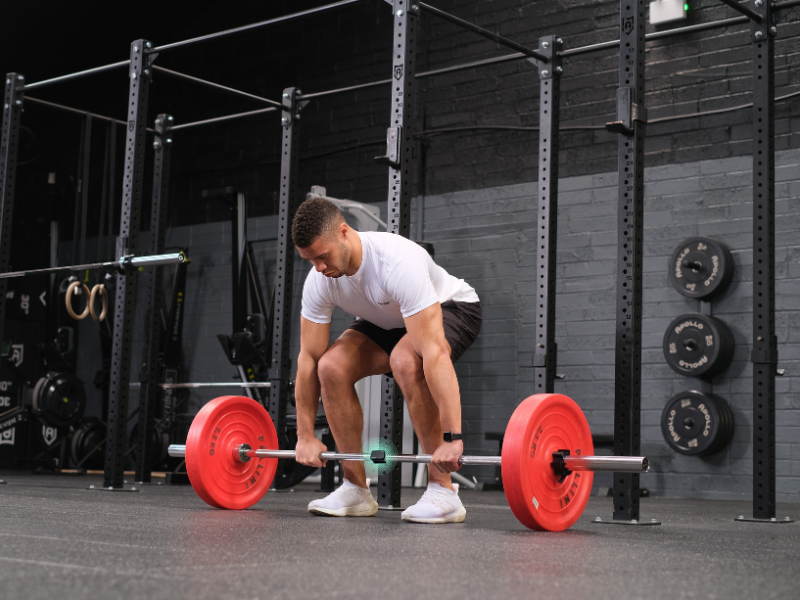
A workout log tells you what you did. It does not tell you how much that set actually cost you, which is where subjective effort ratings tend to break down, two people can call the same set "hard" and be in very different places physiologically. Velocity based training fills that gap by tracking the speed of the bar on a lift, giving an objective read on effort and fatigue rather than a felt sense of it, a relationship that is well established in the resistance training literature [3]. Paired with regular strength testing, it turns "I think that set was harder than last week" into an actual number to track.
Not every metric matters equally for every goal. Broadly, fitness progress tracking metrics fall into four categories:
Strength and performance
Body composition
Cardio and recovery
Consistency
Progressive overload, gradually increasing weight, reps, or volume over time, is the underlying driver of most strength and muscle gains, which is why training volume and load are the metrics with the strongest direct link to actual results [2]. Body composition and cardio metrics matter, but they respond more slowly and are more easily confused by short-term noise like water retention or a single bad night of sleep.
Tracking frequency should match how quickly a metric actually changes:
Tracking too frequently on slow-moving metrics like body weight or measurements tends to create noise and discouragement rather than useful information. Tracking too infrequently on fast-moving metrics like training load means missed opportunities to progress the plan.
The right tool depends less on personal preference and more on the goal behind the tracking:
With the goal established, the tools themselves:
For strength and performance goals specifically, most spreadsheets and apps still rely on estimating effort by feel, how many reps you had left in the tank, whether a set felt heavy. That works, but it is subjective, and two people rating the same set as "hard" can be in very different places physiologically.
This is where velocity based training closes a gap that a workout log alone cannot. Tracking the speed of the bar on your main lift each session gives an objective number for how a set actually went, and how much that speed drops within a set is a well-established indicator of fatigue during resistance training [3]. Paired with regular strength testing, this turns a training log from a record of what you did into a record of how hard it actually was, which is a more reliable basis for deciding whether to progress the load next session.
This kind of tracking sits inside a wider performance hub rather than a spreadsheet, so the historical data, trends, and comparisons build automatically rather than being something you have to chart yourself, and the underlying measurement approach is validated against gold-standard methods rather than a rough estimate.
This same logic extends to the readiness side of tracking. Output is built around a simple loop, test, program, train, monitor, and the monitor stage includes a self-reported wellness questionnaire covering factors like soreness, mood, and perceived readiness to train, alongside the objective testing data. It is a decision-support layer, not something that replaces a training log, but it fills in the recovery and readiness side of progress tracking that reps and sets alone do not capture.
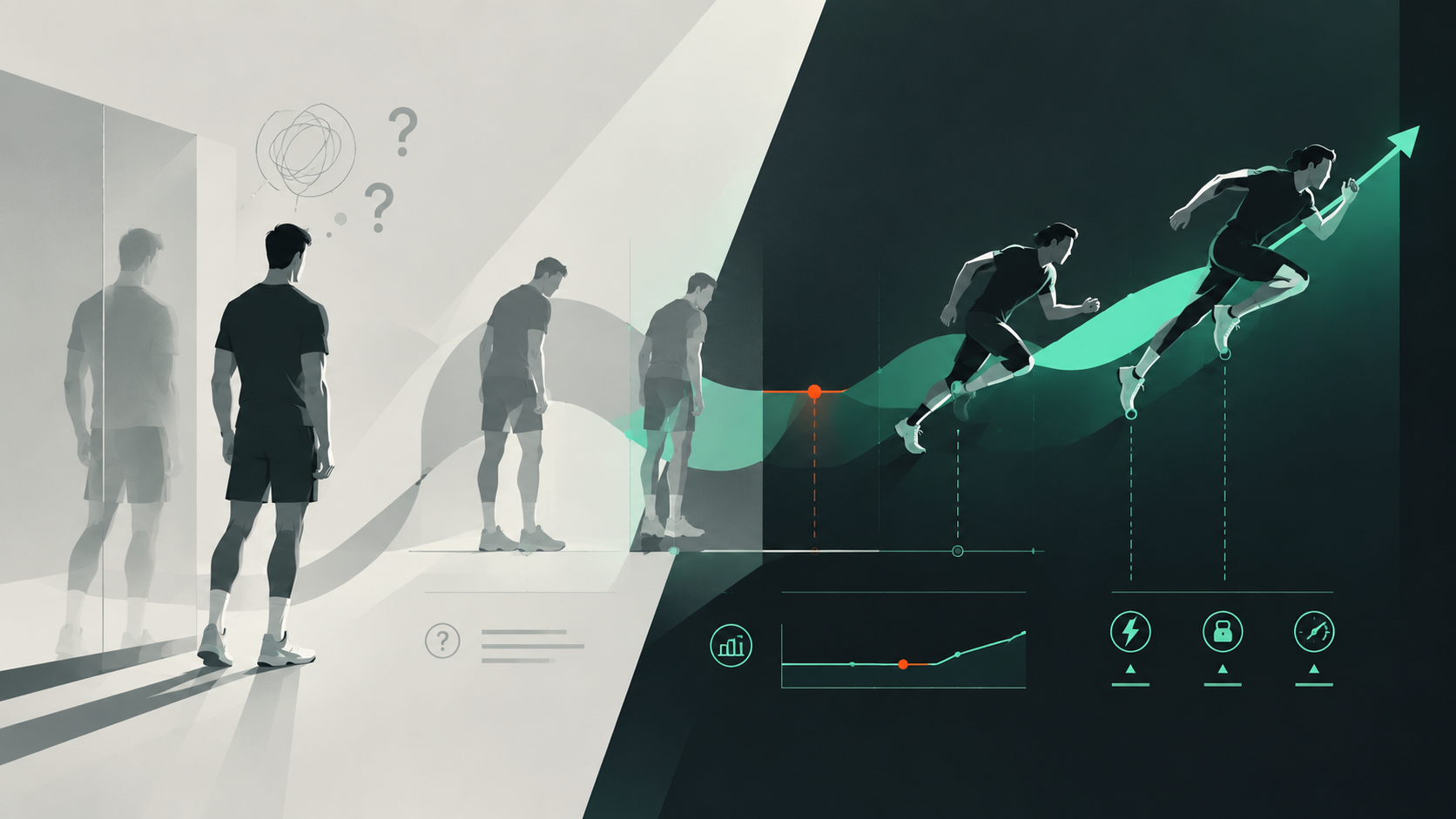
Scale weight is the single most-tracked metric and one of the least reliable on its own, since it does not distinguish between fat loss, muscle growth, or simple water retention. If the scale has stalled, these are the signs worth checking before assuming the plan has stopped working:
Scale weight is one data point among several, and it is often the noisiest one. A workout log, body measurements, and photos, tracked consistently, will usually show progress well before the scale confirms it.
How often should I track my fitness progress?
It depends on the metric. Track training load and reps every session, weigh in weekly at most under consistent conditions, and take measurements and photos every 2 to 4 weeks. Fast-moving metrics need frequent tracking, slow-moving ones do not.
[1] L. E. Burke, J. Wang, and M. A. Sevick, "Self-monitoring in weight loss: a systematic review of the literature," Journal of the American Dietetic Association, vol. 111, no. 1, pp. 92-102, 2011.
[2] N. A. Ratamess, B. A. Alvar, T. K. Evetoch, T. J. Housh, W. B. Kibler, W. J. Kraemer, and N. T. Triplett, "Progression models in resistance training for healthy adults," Medicine & Science in Sports & Exercise, vol. 41, no. 3, pp. 687-708, 2009.
[3] L. Sánchez-Medina and J. J. González-Badillo, "Velocity loss as an indicator of neuromuscular fatigue during resistance training," Medicine & Science in Sports & Exercise, vol. 43, no. 9, pp. 1725-1734, 2011.

.png)
Monthly performance insights, product updates, and sports science — straight to your inbox.
No spam, ever. Unsubscribe anytime.
No thanks, I'm not interested