
.png)
BE THE FIRST TO GET PRODUCT UPDATES
Get notified about new features & special offers......


Strength and conditioning training for young athletes looks nothing like training for adults. They differ across three fundamental layers: physical development (AMSC not yet established), cognitive maturity (shorter attention spans, play-based learning), and coaching methodology (disguised training versus performance-focused).
Is it safe? Yes. Properly supervised strength training is 3 to 4 times safer than multisport and 10 times safer than football. Youth resistance training injury rates: 0.0017 to 2.9 per 1000 hours, compared to 5.5 (multisport) and 15.4 (youth football) [1], [2], [3].
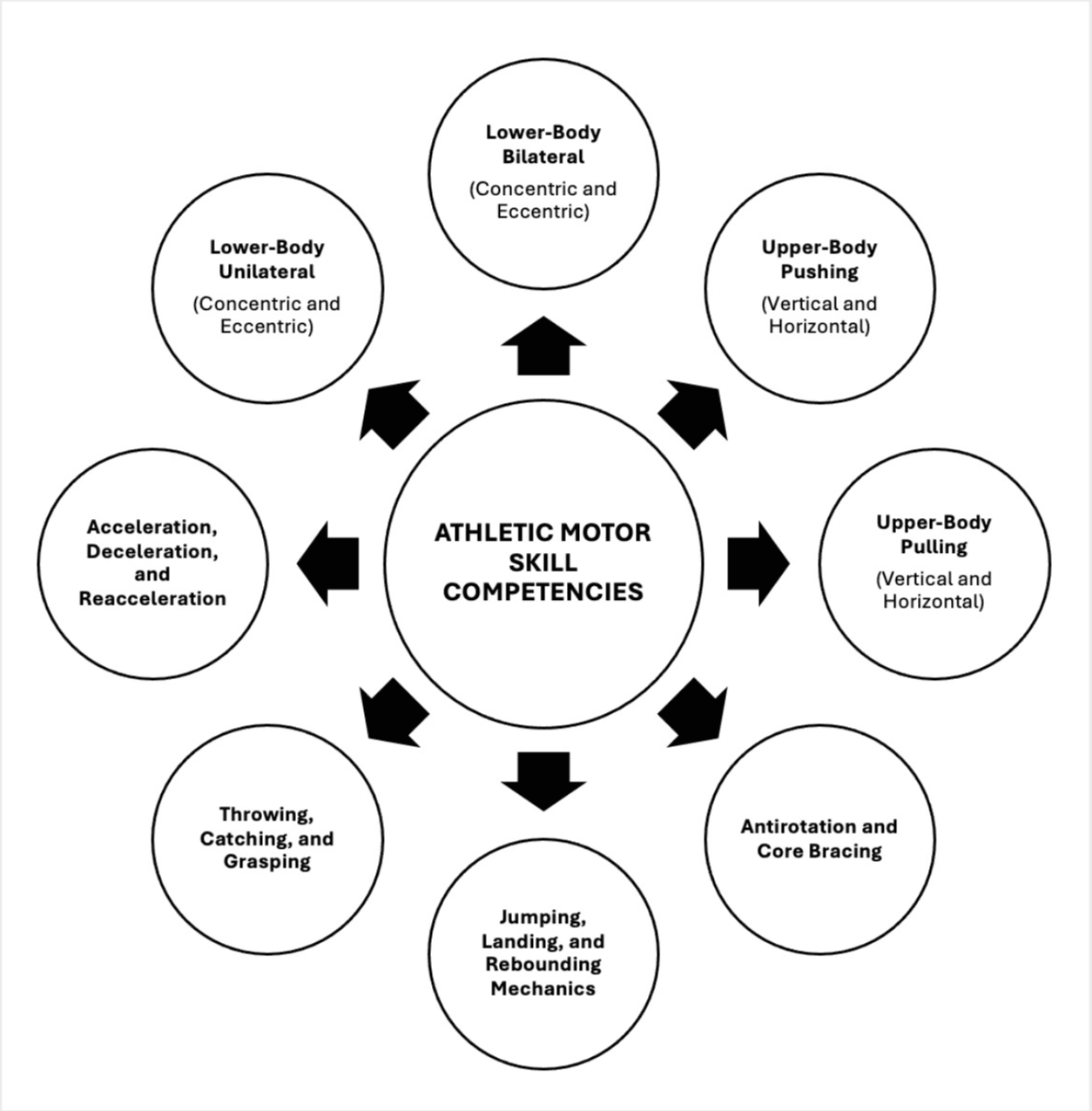
Young athletes have not yet developed their Athletic Motor Skill Competencies (AMSC) across eight categories: unilateral lower body strength, upper body pushing and pulling, acceleration/deceleration, jumping/landing mechanics, rotational control, and throwing/catching [4]. Teaching proper movement patterns is foundational to injury prevention [5]. You can't build advanced training on poor movement mechanics.

Younger children process information differently. They need concrete, play-based learning with disguised training as games [6]. Older adolescents understand training intent and can follow technical cues [6].
Young athletes thrive on movement variety and play. Adults thrive on specificity and measurable progression. Coach both groups the same way and you lose one of them.
A 10-year-old trained with adult methods quits or gets hurt. Rigid sets and reps, minimal variation, constant technical correction, this switches a young athlete off before they've built any real relationship with training. Competence should be smuggled in through games, not announced through drills.
An adult trained with youth methods gets bored and stalls. They want to know why a session is structured the way it is and how this week connects to the next. Take away the specificity and the measurable feedback and they lose trust in the programme.
The coaching skill is reading which mode the athlete in front of you needs. Chronological age is a rough guide, not the answer.
A competent 16-year-old with solid AMSC can handle more advanced training than an incompetent 25-year-old. Biological maturity and competency determine progression, not the calendar.
Youth athletes can start strength training as soon as they're ready to follow instructions and demonstrate basic movement competency, typically from age 7 or 8, not at a fixed age tied to puberty or sport. Readiness matters more than age: a competent 12-year-old can begin back squat progressions, while an uncoordinated 16-year-old just starting out needs to build Foundation-level competency first. As a general guideline, formal resistance training with external load tends to suit ages 12–14, but the years before that should already be full of bodyweight strength and movement work [11].
Good strength and conditioning training for young athletes is organised around three developmental phases, not a fixed programme applied at every age.
Goal: broad AMSC across eight competency categories.
Programming: bodyweight exercises, athletic games, balance work, dynamic warm-ups, plyometric play. Load is irrelevant because the nervous system hasn't learned efficient patterns. Multilateral exposure reduces long-term injury risk [5].
Peak height velocity (PHV) creates a critical window: rapid growth plus temporary neuromuscular disruption. Athletes struggle with simple motor tasks because their body proportions have changed [11], [12], [13]. Modified training load with emphasis on balance, coordination, and landing mechanics reduces injury rates by 84% [14].
Sport-specific movement patterns layer on top of AMSC foundation at moderate loads. Deceleration and landing work intensify because they're foundational to sport safety, not because they look sporty.
Monitoring maturation status is essential. Growth velocity, maturity status, and pain response guide training decisions [15]. Velocity drops on familiar exercises signal nervous system compromise [15].
The critical shift: as kids get older, training volume naturally increases: more sessions per week, less time spread across sampling many different sports, and a more dialled-in focus on one. This extra volume creates the opportunity to advance physical development further, applying consistent progressive overload to get stronger and more powerful. The fundamentals don't change, they get pushed harder.
Alongside this, a little more sport and movement-specific work starts to layer on top. It's about training the skill quality to apply these physical qualities when it matters most, in the dynamic, unpredictable movements seen in the game.
Approximately 80% of training should still be progressive overload of foundational strength and physical qualities. Sport-simulation and movement-specific work comprise the remaining 20%, the icing on the cake, valuable only on top of solid foundational work. The increased volume means athletes can push the fundamentals harder while adding more of the icing.
The Development and Performance phases largely fall within the teenage years, and this is where strength and conditioning for teens looks meaningfully different from programming for younger children.
Two things shift. First, load: teens can safely handle progressively heavier external resistance as technique and AMSC competency solidify, whereas younger children are almost entirely bodyweight and movement-based. Second, focus: teens move from broad, general athletic development toward a gradual, partial narrowing into their primary sport, without ever abandoning the general physical qualities that got them there.
This is also the age range where school sport and structured strength and conditioning most often overlap. Whether it's a school programme or a dedicated facility, high school athletes benefit from the same principle that runs through every phase: strength training organises existing athletic activity rather than adding another demand on top of it. Coaches working with this age group typically find that consistent, moderate-load strength work alongside sport participation produces better long-term outcomes than either extreme, sport-only training with no strength base, or strength training that ignores what the sport actually demands.
Strength training is 3 to 4 times safer than multisport, 10 times safer than football. Competency-based, supervised strength training is genuinely protective [9].
Weak muscles can't stabilise joints. Poor movement patterns load the body in unoptimal ways. Untrained athletes get injured more than their trained counterparts [9]. A 2022 umbrella review of ACL injury prevention programmes found neuromuscular training reduced non-contact ACL injuries in youth female athletes by 64% [10].
"Doesn't it stunt growth?" No. Well-designed programmes have not been shown to have a negative effect on growth [11], [12].
"Doesn't it damage growth plates?" Growth plate injuries are rare in youth strength training. The real threat is untrained, uncoordinated movement under load [9].
"Isn't it more dangerous than sport?" No. Strength training (0.0017 to 2.9 per 1000 hours) is vastly safer than football (15.4 per 1000 hours). The safety difference is qualified supervision in a controlled environment [9].
Safe training: qualified coach supervision, competency gates before progression, movement quality prioritised over load.
Unsafe training: unsupervised loads, skipped progressions, poor technique, intensity mismatched to competency.

Sport-specific work ≠ sport-simulation drills (agility ladders, cone patterns). These are valuable for engagement but secondary.
True sport-specific training targets movement patterns and loading demands that appear in the sport, with progressive overload. A back squat is sport-specific because triple flexion/extension occurs in running, jumping, and change of direction. Deceleration is sport-specific because every sport requires athletes to slow down and absorb force. Medicine ball rotation is sport-specific for rugby because rotation under load happens in play.
The principle: load applied to sport-specific patterns creates sport-specific adaptation. A footballer's foundational plyometrics (box jumps, bounds) develop power. A rugby player's foundational strength work (loaded patterns) develops scrum mechanics. A sprinter's foundational training (acceleration drills) develops sprint qualities. Sport-simulation (agility work, sport-specific drills) layers on top once the foundation is solid.
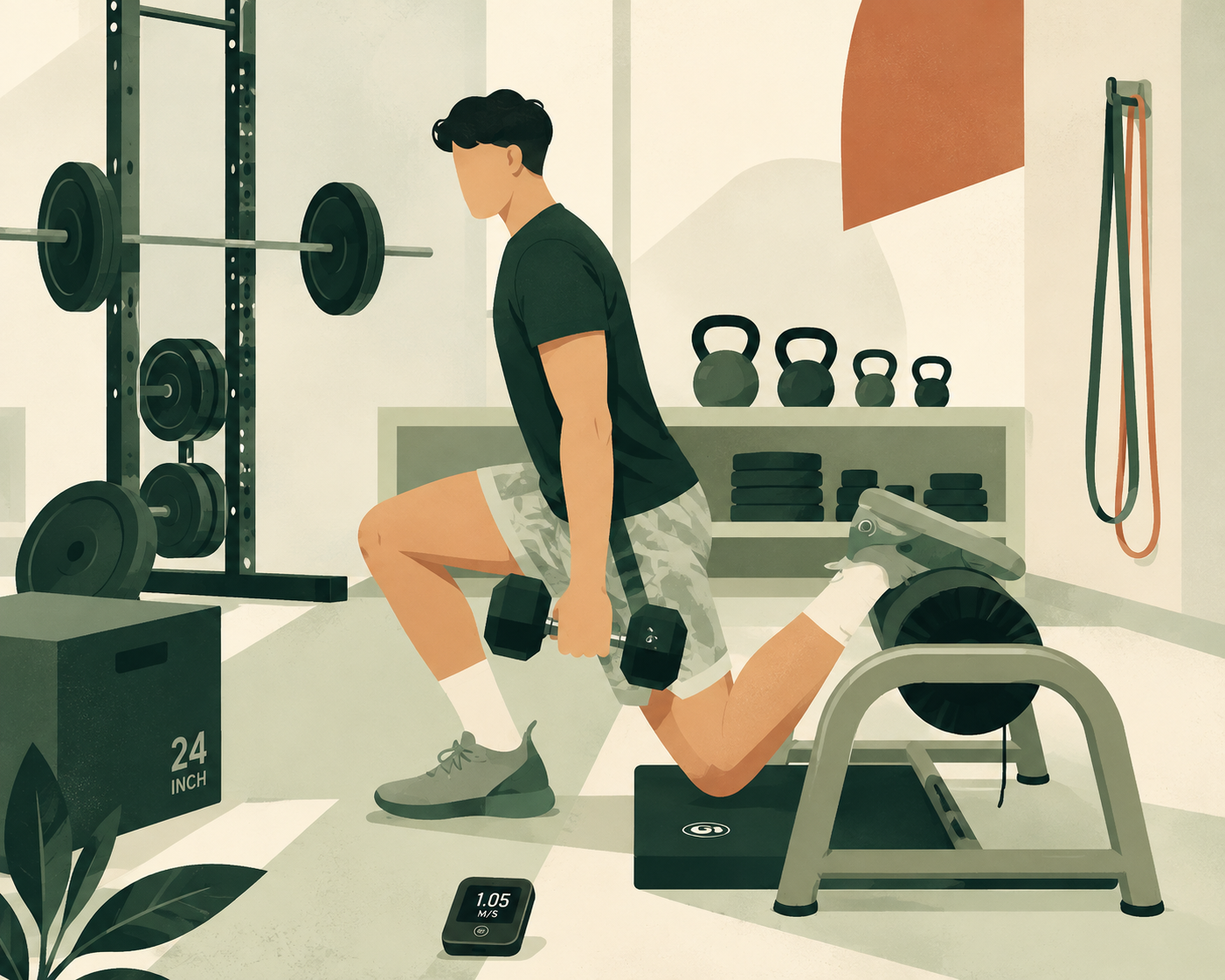
Bodyweight lunge → Single-leg step-up → Goblet squat → Dumbbell squat → Back squat.
Development Phase: Introduces triple flexion/extension as foundational sport-specific training (occurs in running, jumping, change of direction).
Performance Phase: Back squat becomes sport-specific overload (rugby player emphasises forward drive and deceleration; footballer emphasises rapid direction change; sprinter emphasises explosive extension).
Pushing patterns: Elevated push-up → Full push-up → Dumbbell bench press → Barbell bench press.
Pulling patterns: Inverted rows → Band-assisted pull-ups → Strict pull-ups.
Performance Phase: Rugby player's pressing emphasises deceleration; cricketer's pulling emphasises rotational power; footballer's pressing emphasises explosive stability.
Double-leg hops → Single-leg hops → Box jumps → Lateral bounds. Movement quality before intensity.
Performance Phase: Footballer's emphasises direction change under load; rugby player's emphasises vertical power and deceleration; volleyball player's emphasises maximal height.
Pallof presses, anti-rotation holds, dead bugs, bird dogs, carries, sled pushes.
Performance Phase: Medicine ball throws with sport-specific timing, weighted rotational carries, loaded anti-rotation under sport-specific loading.
Linear sprinting from varied positions, lateral bounds with controlled stops, multi-directional drills.
Performance Phase: Trained entirely in sport context (acceleration from sport starting positions, deceleration under sport-specific loading, reacceleration with sport timing).
The growth-rate and maturity-status thresholds above (7.2 cm/year and 88–92.8% of predicted adult stature) reflect the risk factors used to flag at-risk players in the academy football study cited above [8]. Red zones signal heightened sensitivity and warrant modified training load, football-specific skills, balance, coordination and landing drills [8].
For female athletes, menarche is worth tracking alongside growth velocity and maturity status as another marker of training sensitivity, similar in effect to PHV in males. Alongside this, deceleration, landing mechanics, hip stability, and single-leg balance work deserve a standing place in every session, not an optional extra bolted on when time allows. Injury rates in adolescent female footballers can run comparably high to their male counterparts across a season, which is exactly why this work belongs in the programme by default [7].
"Today we're building AMSC" ≠ "today we're developing sport-specific deceleration" ≠ "today we're overloading sport-specific power." Use velocity feedback: real-time feedback after each rep has been shown to produce small to moderate improvements in jump and sprint performance over a training block [13].
Foundation AMSC → sport-specific movement patterns at moderate load → sport-specific overload.
Overuse injuries in youth athletes commonly progress from distal to proximal, foot and ankle first, then shin, knee, and hip. Early intervention prevents progression [2].
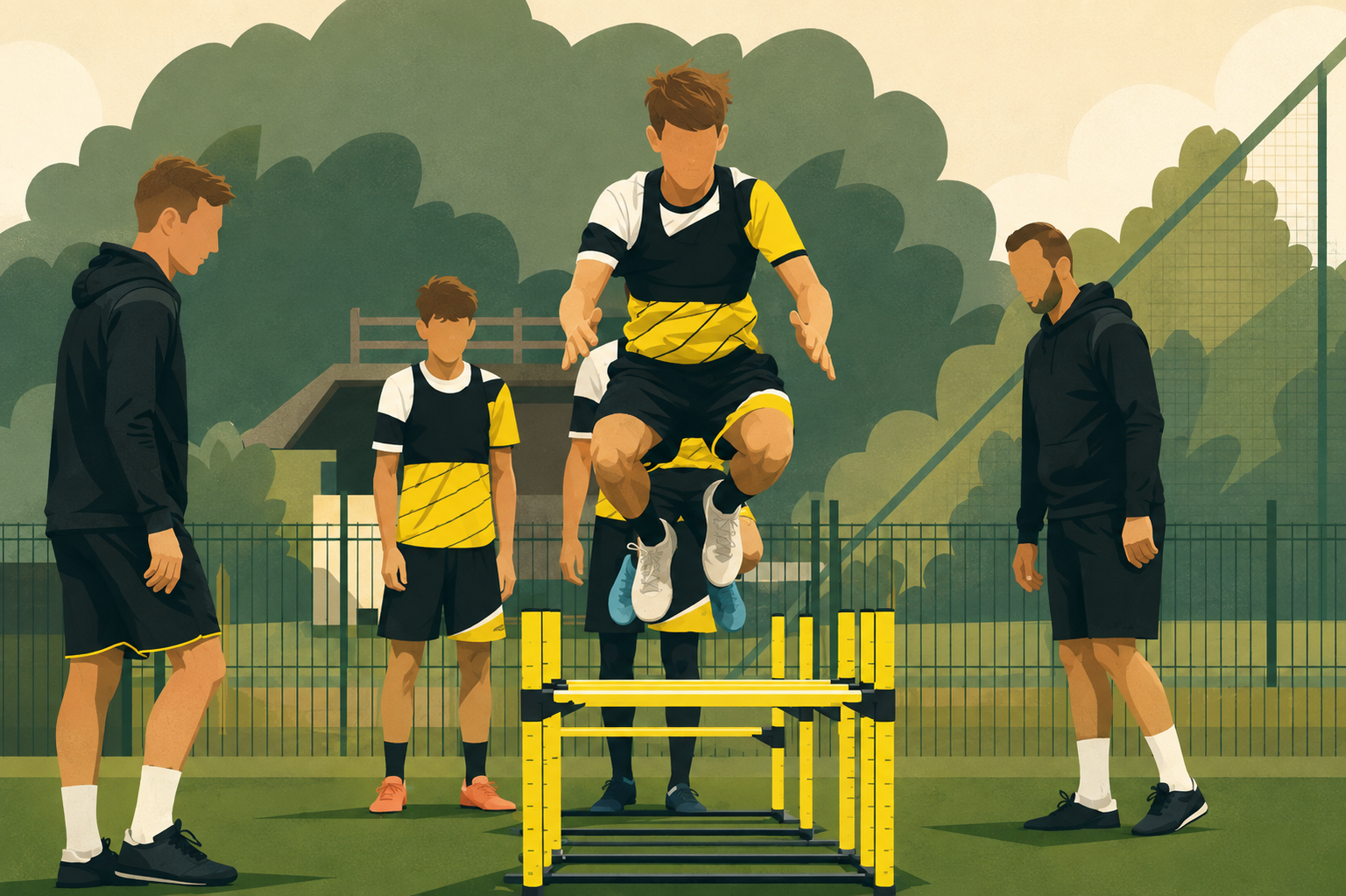
Youth athletes benefit from 2 to 3 sessions a week in the Foundation and Development phases, rising to 4 to 5 in the Performance phase as recovery capacity and training age increase. Quality beats frequency throughout: a well-coached 30-minute session most weeks builds more genuine competency than a rushed daily routine.
Youth athletes in the Foundation and Development phases are best assessed with submaximal, velocity-based strength testing rather than true maximal lifts, since these give a clear read on progress without the risk profile of 1RM testing at a young training age. Jump testing (reactive strength, peak and mean power) is a useful complement here, since it captures explosiveness without loading the spine the way a heavy squat test would. In the Performance Phase, testing can shift toward sport-specific measures: power output in sport-relevant patterns, and velocity maintenance under fatigue, which reflect what the athlete actually needs on the field.
Youth athletes should progress based on AMSC competency and readiness, not a fixed timeline. Some athletes master a progression in 4 weeks; others need 8 or more, and both are normal. Ignore the calendar and follow the competency: can they hold the movement quality under increasing load or complexity? In the Performance Phase, the same principle applies to sport-specific markers: can they handle increased load, maintain velocity, and show the improvement in sport performance that justifies moving on?
Youth athletes should sample multiple sports through the Foundation and Development phases and delay specialising in one until the Performance Phase, from around age 15 onward. Multi-sport exposure in the early years builds a broader base of AMSC, reduces overuse injury risk, and gives athletes a wider movement vocabulary to draw on later. Early specialisation trades this long-term base for short-term results, and the research consistently favours the athlete who samples widely first [5]. Single-sport focus only starts to make sense once that base is in place and the athlete is training with enough volume to justify it.
Young athlete development isn't about hitting arbitrary benchmarks at arbitrary ages. It's about building AMSC systematically, then progressively overloading sport-specific demands in competent athletes.
The principle: the best training overloads and causes adaptation of the specific physical attribute the sport demands. In Foundation and Development Phases, training is almost entirely general and competency-focused. In Performance Phase, training remains 80% foundational work with 20% sport-simulation (the icing on the cake).
Safe strength training isn't about avoiding resistance; it's about progression matching AMSC development and maturation, monitoring that catches problems early, and clarity about what each phase does. By Performance Phase, athletes train almost entirely in sport context with overload applied to sport-specific movement patterns, energy systems, and physical attributes. Sport-simulation and skills are the final refinement layer on top of solid overload training. That's what good strength and conditioning training for young athletes is building: a foundation that supports decades of development, with the specificity added in Performance Phase driving elite performance.
[1] H. Inasaku et al., "High injury incidence among youth in the world's largest football tournament," Inj. Epidemiol., vol. 9, no. 1, p. 47, 2022. https://www.ncbi.nlm.nih.gov/pmc/articles/PMC12083556/
[2] J. Distefano et al., "Distal-to-proximal progression of apophyseal injuries in male youth academy footballers," Br. J. Sports Med., vol. 57, no. 22, pp. 1426–1433, 2023. https://www.ncbi.nlm.nih.gov/pmc/articles/PMC12772586/
[3] E. Cuff et al., "Association between shoulder rotation strength and injury incidence in competitive adolescent tennis players," Sports Health, vol. 15, no. 2, pp. 161–168, 2023. https://www.ncbi.nlm.nih.gov/pmc/articles/PMC12640280/
[4] R. Evans, F. Pietzsch, and J. Wallis, "Developing athletic motor skill competencies in youth populations: Theoretical foundations and practical applications," UKSCA Prof. Strength Cond. J., no. 85, 2026. https://www.uksca.org.uk/blog/85/developing-athletic-motor-skill-competencies-in-youth-populations-theoretical-foundations-and-practical-applications
[5] A. Bompa and G. Haff, Periodization: Theory and Methodology of Training, 5th ed. Champaign, IL: Human Kinetics, 2009.
[6] J. Piaget, The Origins of Intelligence in Children. New York: International Universities Press, 1952.
[7] F. Le Gall, C. Carling, and T. Reilly, "Injuries in young elite female soccer players: An 8-season prospective study," Am. J. Sports Med., vol. 36, no. 2, pp. 276–284, 2008. https://doi.org/10.1177/0363546507307866
[8] D. Johnson, S. Williams, B. Bradley, and S. P. Cumming, "Can we reduce injury risk during the adolescent growth spurt? An iterative sequence of prevention in male academy footballers," Ann. Hum. Biol., vol. 50, no. 1, pp. 452–460, 2023. https://pubmed.ncbi.nlm.nih.gov/37823577/
[9] A. D. Faigenbaum and G. D. Myer, "Resistance training among young athletes: safety, efficacy and injury prevention effects," Br. J. Sports Med., vol. 44, no. 1, pp. 56–63, 2010. https://pubmed.ncbi.nlm.nih.gov/19945973/
[10] A. T. Mattu, B. Ghali, V. Linton, A. Zheng, and I. Pike, "Prevention of non-contact anterior cruciate ligament injuries among youth female athletes: An umbrella review," Int. J. Environ. Res. Public Health, vol. 19, no. 8, art. 4648, 2022. https://pubmed.ncbi.nlm.nih.gov/35457516/
[11] American Academy of Pediatrics, "Strength training by children and adolescents," Pediatrics, vol. 121, no. 4, p. 835, 2008. https://publications.aap.org/pediatrics/article/121/4/835/70927
[12] P. R. Stricker, A. D. Faigenbaum, T. M. McCambridge, and AAP Council on Sports Medicine and Fitness, "Resistance training for children and adolescents," Pediatrics, vol. 145, no. 6, e20201011, 2020.
[13] A. D. Randell, J. B. Cronin, J. W. L. Keogh, N. D. Gill, and M. C. Pedersen, "Effect of instantaneous performance feedback during 6 weeks of velocity-based resistance training on sport-specific performance tests," J. Strength Cond. Res., vol. 25, no. 1, pp. 87–93, 2011. https://pubmed.ncbi.nlm.nih.gov/21157389/

.png)
Monthly performance insights, product updates, and sports science — straight to your inbox.
No spam, ever. Unsubscribe anytime.
No thanks, I'm not interested