
.jpg)
BE THE FIRST TO GET PRODUCT UPDATES
Get notified about new features & special offers......


Strength and power are often used interchangeably. They are not the same physical quality, and they do not produce the same adaptations. Understanding the difference between strength and power matters because it changes how you programme, how you test, and what your athletes actually develop.
This article breaks down strength vs power training, what each one builds, and how to decide where to focus.
Quick definition: Strength is the ability to produce force against resistance. Power is the ability to produce force quickly. Strength training builds the ceiling of force you can express. Power training trains how fast you can express it.
The simplest way to separate the two sits inside one equation:
Power = Force x Velocity
Strength training prioritises the force side. Power training prioritises the velocity side. Both qualities live on the same force-velocity curve, but they target different ends of it.
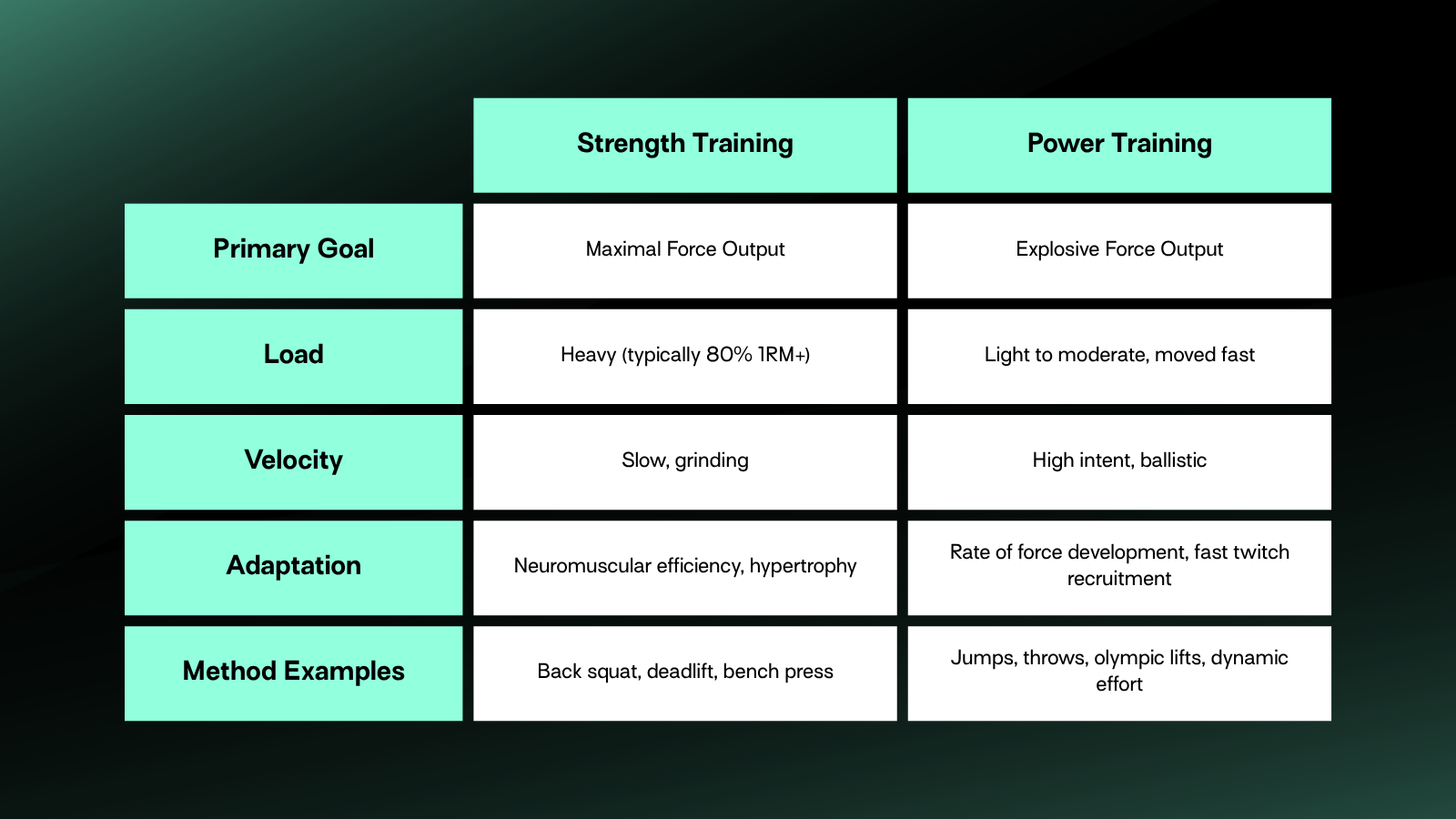
The difference between strength and power is not a debate. It is a continuum. Where you train on that continuum determines the adaptation you get.
Strength training is heavy resistance training built around one goal: increasing the maximum force you can produce in a single effort. Sometimes called max strength training, it relies on heavy loads, lower reps, and full recovery to drive neuromuscular adaptations and build the foundation for everything else, including hypertrophy, athletic performance, and explosive power output.
Maximal strength itself is task specific. It shows up in slow, grinding actions at 85 to 100% of 1RM, where force matters more than speed.
The adaptations are well established:
Research consistently shows that greater maximal strength is associated with improved force-time characteristics, better performance in jumping, sprinting, and change of direction, and reduced injury risk [1].
This ceiling matters. Every fast action sits on top of an athlete's maximal strength. Without a strong base, there is less force available to express quickly.
Programming usually centres on compound lifts, low to moderate rep ranges, longer rest, and progressive overload tracked through load and volume.
Power training develops the ability to apply force fast. Where strength training is about how much you can lift, power training is about how quickly you can move it, whether that is a barbell, a medicine ball, or your own bodyweight.
This is where rate of force development (RFD) becomes the central quality. RFD describes how quickly force can be produced inside short time windows, often under 300 milliseconds. Most sporting actions, sprinting, jumping, changing direction, striking, happen inside windows that short. Maximal strength is irrelevant if it cannot be expressed in time. The neuromuscular system's ability to generate maximal power is shaped by the force-velocity relationship, motor unit recruitment, firing frequency, and muscle fibre type [2].
Power training methods include:
The adaptations sit on the high-velocity side of the force-velocity curve:
Power output sits at the intersection of force and velocity. Maximum power typically falls toward the middle of the load spectrum, which is why training to maximise power output usually involves moderate loads moved with full intent.
Hypertrophy and power training are not the same conversation.
Muscle growth is driven primarily by three mechanisms: mechanical tension, metabolic stress, and muscle damage [3]. All three are best stimulated by accumulated volume of meaningful, fatiguing repetitions, which sits much closer to traditional strength and bodybuilding rep ranges than it does to power work.
Power training keeps reps low, loads moderate, and recovery long, all to preserve velocity. Volume is intentionally limited. That makes it a poor primary driver of hypertrophy.
In practice:
If muscle growth is the target, strength training with appropriate volume does the job. Power training supports performance, not size.

Most sports do not reward maximal strength in isolation. They reward how much of that strength an athlete can express in the time available.
A rugby player breaking a tackle, a sprinter driving out of the blocks, a basketball player elevating for a rebound, none of these actions allow a full second to produce force. They demand high force, fast.
This is why elite programming rarely treats strength vs power as either/or. Strength raises the ceiling. Power training teaches the athlete to access more of that ceiling, sooner.
The general pattern across long-term athlete development:
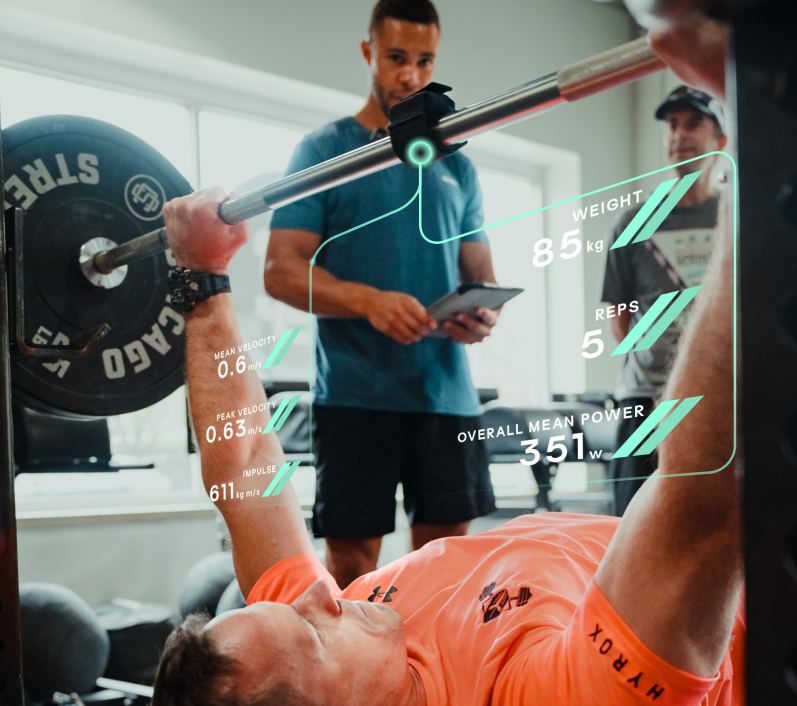
Velocity-based training tools like Output make this separation testable. By measuring bar velocity at a fixed load over time, coaches can track whether strength is improving without repeated max testing. By profiling load against velocity, coaches can identify each whaathlete's individual power zones and prescribe accordingly.
The honest answer is contextual. It depends on the athlete in front of you.
Strength gains and explosiveness are not competing. They are sequenced. The most effective programmes use objective testing to decide which quality needs attention, in what proportion, and at what time of year. That decision should be data informed, not assumed.
Output supports that decision by quantifying both force and velocity qualities in one system, so coaches can see exactly where each athlete sits on the force-velocity curve and programme with intent.
[1] T. J. Suchomel, S. Nimphius, and M. H. Stone, "The importance of muscular strength in athletic performance," Sports Medicine, vol. 46, no. 10, pp. 1419–1449, Oct. 2016. [Online]. Available: https://link.springer.com/article/10.1007/s40279-016-0486-0
[2] P. Cormie, M. R. McGuigan, and R. U. Newton, "Developing maximal neuromuscular power: Part 1 – Biological basis of maximal power production," Sports Medicine, vol. 41, no. 1, pp. 17–38, Jan. 2011. [Online]. Available: https://link.springer.com/article/10.2165/11537690-000000000-00000
[3] B. J. Schoenfeld, "The mechanisms of muscle hypertrophy and their application to resistance training," Journal of Strength and Conditioning Research, vol. 24, no. 10, pp. 2857–2872, Oct. 2010. [Online]. Available: https://journals.lww.com/nsca-jscr/fulltext/2010/10000/the_mechanisms_of_muscle_hypertrophy_and_their.40.aspx

.png)
Monthly performance insights, product updates, and sports science — straight to your inbox.
No spam, ever. Unsubscribe anytime.
No thanks, I'm not interested