
.png)
BE THE FIRST TO GET PRODUCT UPDATES
Get notified about new features & special offers......



You can log sessions, hit your wall ball targets, and build your SkiErg splits. But at the end of a training block, a fundamental question remains: are you actually race-ready? And if not, which stations are holding you back?
This is the problem that HYROX benchmark testing exists to solve. Not to add another session to an already full programme, but to give coaches and athletes a structured, repeatable picture of conditioning status. Something that can be tracked, compared, and acted on.
The HYROX Conditioning Score (HCS) does exactly that. It provides an objective, sport-specific benchmark grounded in the demands of the HYROX race format, scored from beginner to elite, with a station-by-station breakdown that tells coaches and athletes where preparation stands and where it does not.
The HYROX Conditioning Score (HCS) is a benchmarking system designed to measure race readiness for HYROX athletes.
It combines two inputs:
Together, these results generate a score from 0 to 100, categorised from beginner to elite, alongside a station-by-station breakdown of performance across key HYROX movements.
For coaches, the score provides more than a number. It offers a structured conditioning profile that highlights where athletes are currently strong and where specific development is required in preparation for race day.
Before unpacking the Conditioning Score, it helps to understand what HYROX actually demands.
HYROX is a standardised global fitness race. Every event, in every city, follows the same format: eight one-kilometre runs, each immediately followed by a functional workout station. Across all eight runs, athletes cover a total running distance of eight kilometres, with the additional distance through the Roxzone transition area pushing total movement closer to 8.7 kilometres.
The eight stations, in order, are:
• 1,000m SkiErg
• 50m Sled Push
• 50m Sled Pull
• 80m Burpee Broad Jumps
• 1,000m RowErg
• 200m Farmers Carry
• 100m Sandbag Lunges
• 100 Wall Balls (men) / 75 Wall Balls (women)
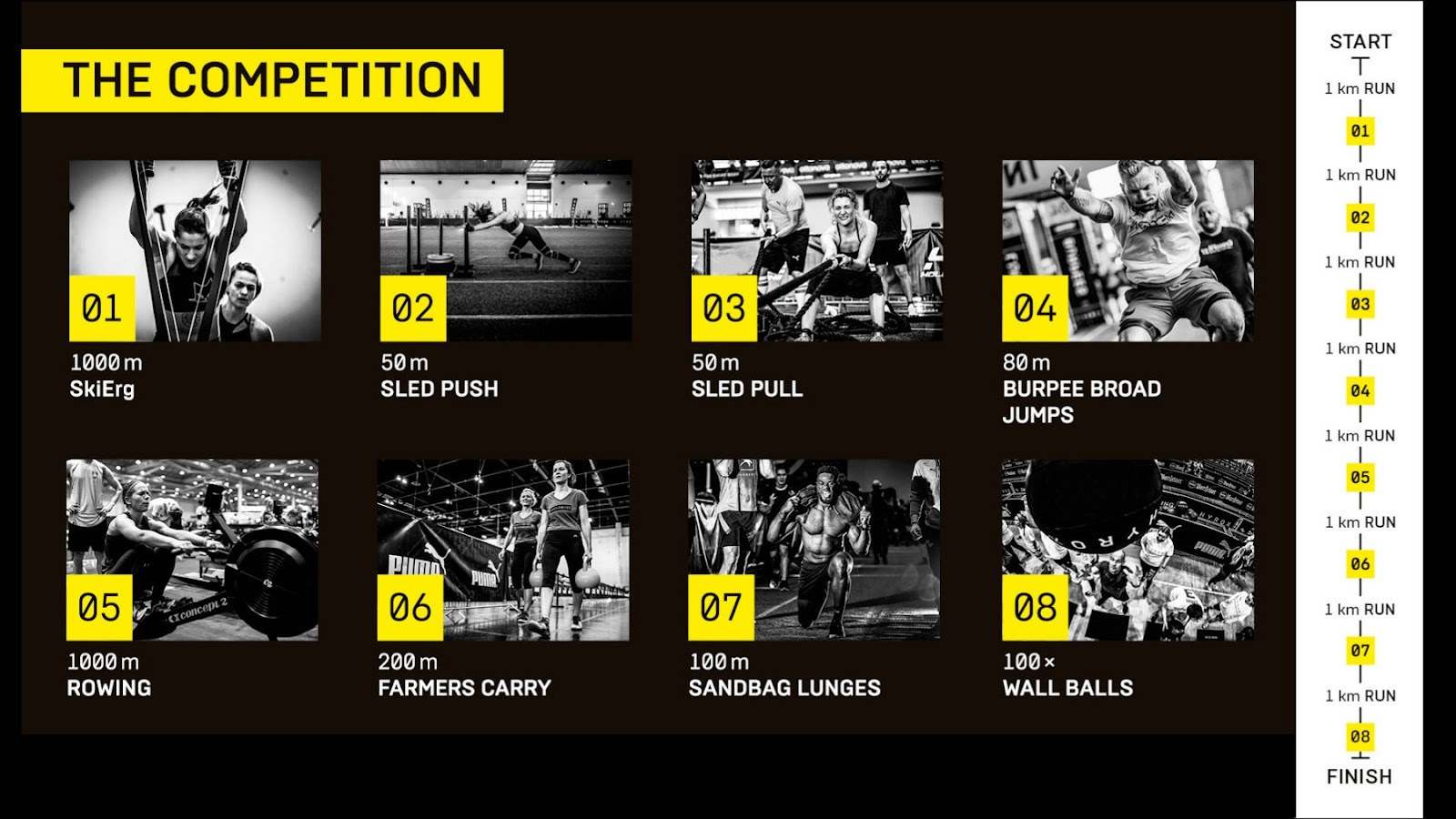
Weights and repetitions vary across divisions. The Open division is designed for accessibility, while the Pro division carries heavier loads. All participants complete the same distances.
Finish times for beginners typically fall in the 1:30 to 2:00 range. Well-prepared first-timers often come in around 1:35 to 1:45. Elite men dip under one hour, with the current world record sitting at 53:22.
The key physiological demands are running endurance, muscular endurance across multiple movement patterns, erg-based aerobic capacity, and the ability to sustain work output under accumulating fatigue. This combination is what makes HYROX uniquely difficult to prepare for, and uniquely difficult to benchmark.
The majority of fitness testing protocols were not designed for athletes training across simultaneous endurance and strength demands.
VO₂ max tests tell coaches something about aerobic ceiling but nothing about how an athlete moves through a burpee broad jump set at the 45-minute mark of a race. Isolated strength assessments reveal maximal capacity but not muscular endurance under accumulated running fatigue.
HYROX athletes need a benchmark that reflects the race itself. Not a lab metric extrapolated to race performance, but a test built from race movements, race pacing demands, and the specific physical qualities that determine how athletes perform on the day.
The HYROX Conditioning Score (HCS) combines two components: the HYROX Conditioning Test (HCT) and the athlete's recent best 5km run time.
Each component contributes to an overall score from 0 to 100. Scores are categorised as follows:
• Beginner: 0 to 25
• Intermediate: 26 to 60
• Advanced: 61 to 84
• Elite: 85+
The result is not just a single number. The HCS provides a station-by-station breakdown, giving athletes and coaches a clear profile of strengths and weaknesses across the specific movements that matter on race day.
The HCT consists of four stations and five movements, each selected for its direct relationship to HYROX race demands. It is structured on an 8:00 work / 2:00 rest interval, with the exception of the final station, which stops at the 4:00 mark.
The test opens with an eight-minute maximal rowing effort. This measures erg capacity and pacing discipline simultaneously.
A split time of 2:00 per 500 metres held consistently will bring an athlete to 2,000 metres, a standard benchmark widely used in HYROX training environments. Athletes who understand pacing will fare better here than those who go out hard and fall apart.
The HYROX rowing distance in the race is 1,000 metres, coming at station five after four preceding runs. This eight-minute test gives coaches a richer picture of sustained erg output than a flat 1,000-metre effort.
This is a back-to-back effort: four minutes of burpee broad jumps immediately followed by four minutes of bodyweight reverse lunges.
For the burpee broad jumps, completing the 80-metre race station in four minutes or less places an athlete in approximately the top 30% of competitors. At roughly one metre per jump, that equates to about 40 reps. An athlete hitting 40 reps in this test can be confident of executing the race station at that level.
The reverse lunge test that follows measures single-leg strength endurance and coordination under fatigue.
In the race, completing 100 metres of sandbag lunges in four minutes places an athlete in approximately the top 20% of competitors. Completing 100 reverse lunges in four minutes represents a similar performance standard.

Positioned in the second half of the HCT, the SkiErg station is deliberately placed after the athlete has accumulated fatigue.
In the race, the SkiErg appears first but follows an opening kilometre run. Its placement here creates a more accurate picture of true SkiErg capacity and technique under fatigue, revealing whether it is a strength or a station that requires further development.
The SkiErg is typically five to ten seconds per 500 metres slower than the RowErg for most athletes. This difference becomes more pronounced under fatigue and can expose technical inefficiencies.
Wall balls close the HCT, mirroring their position as the final HYROX race station.
Four minutes represents a significant challenge. An average unbroken set of 100 wall balls takes approximately 3:30. Advanced athletes may approach this number in the time domain, while beginners establish a benchmark that reflects their current capacity.
This station is as much a mental challenge as a physical one, which is exactly why it closes both the test and the race.
Alongside the HCT, athletes input their recent best 5km running time. This accounts for the running dimension of HYROX, which is not fully captured by the conditioning stations alone. Approximately 50% of race time is spent running. An athlete's aerobic base and running economy are primary determinants of overall race performance. The 5km time brings this into the score.
What the Score Actually Tells Coaches and Athletes
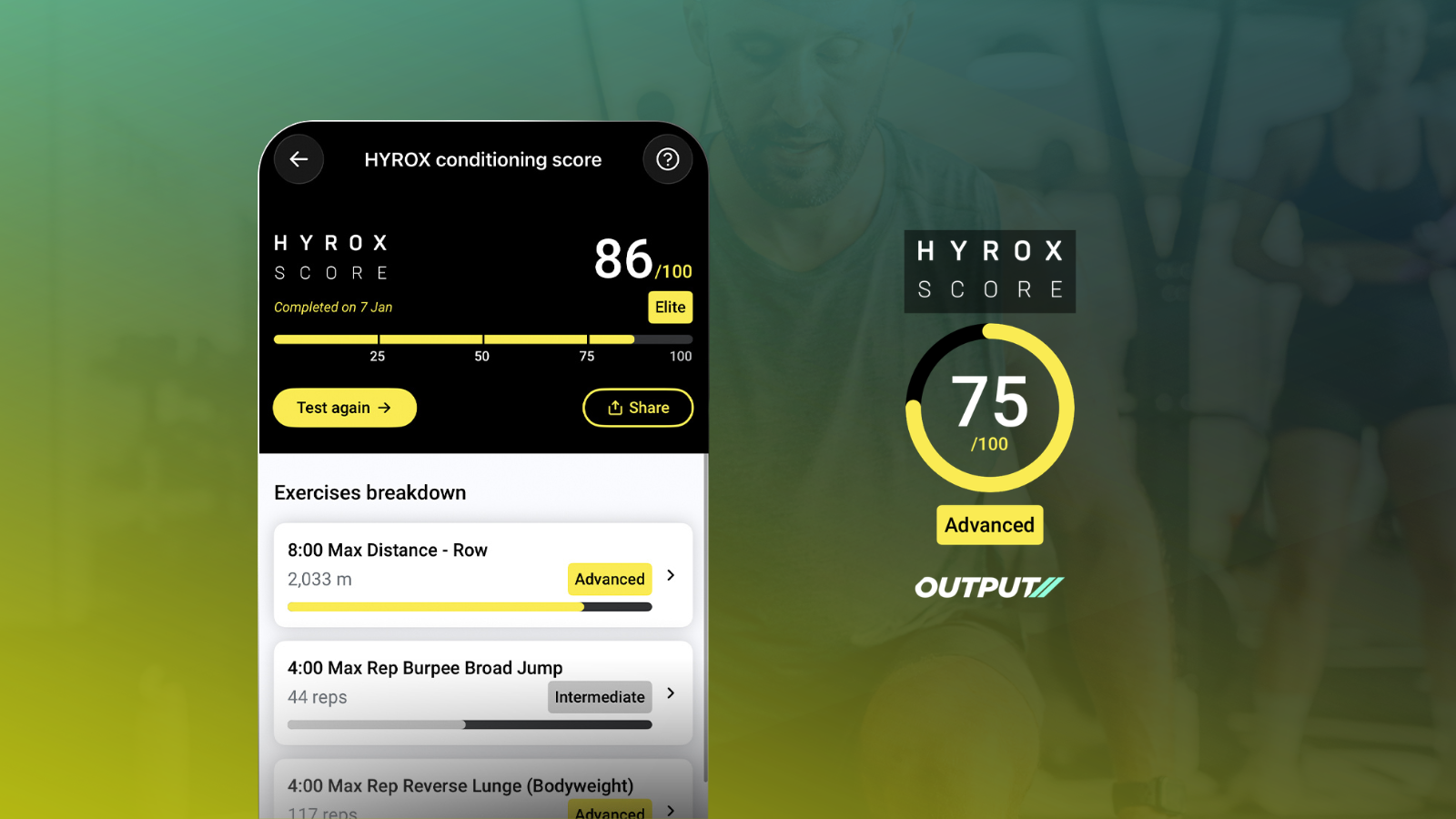
The overall HYROX Conditioning Score provides athletes with a benchmark. The station breakdown provides coaches with a training roadmap.
A coach reviewing the results may see an athlete scoring strongly on the RowErg but poorly on burpee broad jumps, immediately identifying where race time is likely being lost. Another athlete may demonstrate strong conditioning station results but present with a slower 5km run time, highlighting the need for increased running volume.
This is the purpose of objective testing: not simply to produce a number, but to generate actionable information that informs programming decisions.
One of the most common questions coaches receive from athletes preparing for their first race.
The honest answer depends on starting fitness, available training time, and competitive goals.
As a general guide:
The HYROX Conditioning Score changes how coaches approach this timeline. Rather than guessing at readiness, they can run the HCT at the start of a training block, identify the lowest-scoring stations, and prioritise development accordingly.
A repeat test midway through preparation provides objective feedback on whether the programme is working.

All HCT results and 5km run times are entered directly into the Output Capture App. The HYROX Conditioning Test workout is built into the platform, and the overall score with per-station breakdown is automatically generated on completion.
Access to the HYROX Conditioning Test and Score is available to HYROX-affiliated customers. For coaches and facilities looking to bring structured performance benchmarking into athlete preparation, the HCT provides the infrastructure to do this efficiently at scale.
HYROX rewards athletes who prepare specifically.
The race does not favour generalist fitness. It rewards erg efficiency, muscular endurance under volume, running economy, and the capacity to sustain work output across prolonged fatigue.
The HYROX Conditioning Score is built to reflect those demands. It gives coaches and athletes a starting point, a direction, and a way to measure whether training is translating to the qualities that actually matter on race day.
That is what benchmark testing is for.
[1] HYROX, "The Fitness Race," hyrox.com, 2025.
[2] HYROX, "25/26 Single Rulebook," hyrox.com, 2025.
[3] Output Sports, "Introducing the HYROX Conditioning Score," help.outputsports.com, 2025.
[4] PureGym, "Free HYROX Training Plan," puregym.com, 2025.
[5] Speediance, "How Long Does It Take to Train for HYROX?," speediance.com, 2025.

.png)
Monthly performance insights, product updates, and sports science — straight to your inbox.
No spam, ever. Unsubscribe anytime.
No thanks, I'm not interested