
.png)
BE THE FIRST TO GET PRODUCT UPDATES
Get notified about new features & special offers......


The force-velocity curve is not wrong. It has just become one of the most misunderstood ideas in sports science.
Over the last few years it has become common to hear that the curve is outdated, oversimplified, or simply broken. The argument usually points to movements like sprinting, jumping and throwing, where athletes appear to produce high force and high velocity at the same time. If force and velocity are supposed to trade off against each other, shouldn't those movements be impossible?
Not quite.
The problem is not the force-velocity relationship. The problem is that two different ideas have been bundled together under one label, then applied well beyond what either was built to describe.
At its core, force-velocity is a property of muscle. As concentric shortening velocity rises, the force a muscle can produce falls. That relationship has been shown again and again, and it remains one of the foundations of muscle physiology.
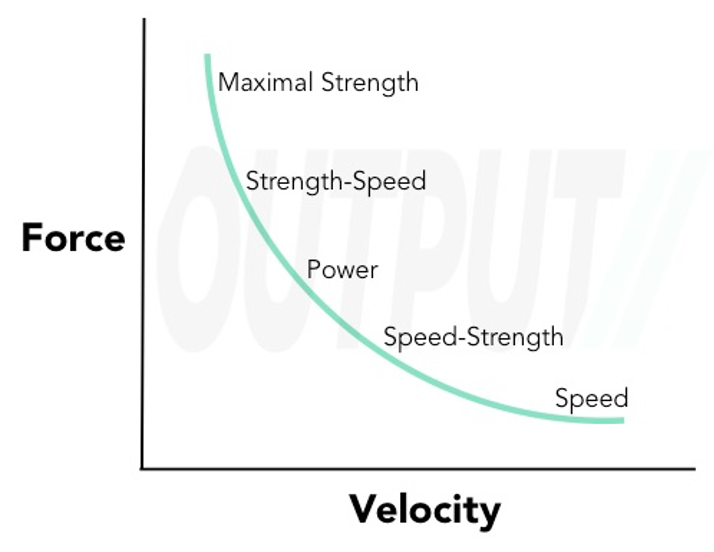
Coaches, though, usually meet the relationship in a different form. Lift a weight and heavier loads move slowly while lighter loads move fast. The link between load and bar speed is so consistent that bar velocity can estimate relative intensity and even predict load. That is the basis of velocity-based training, and what most practitioners now call the load-velocity relationship.
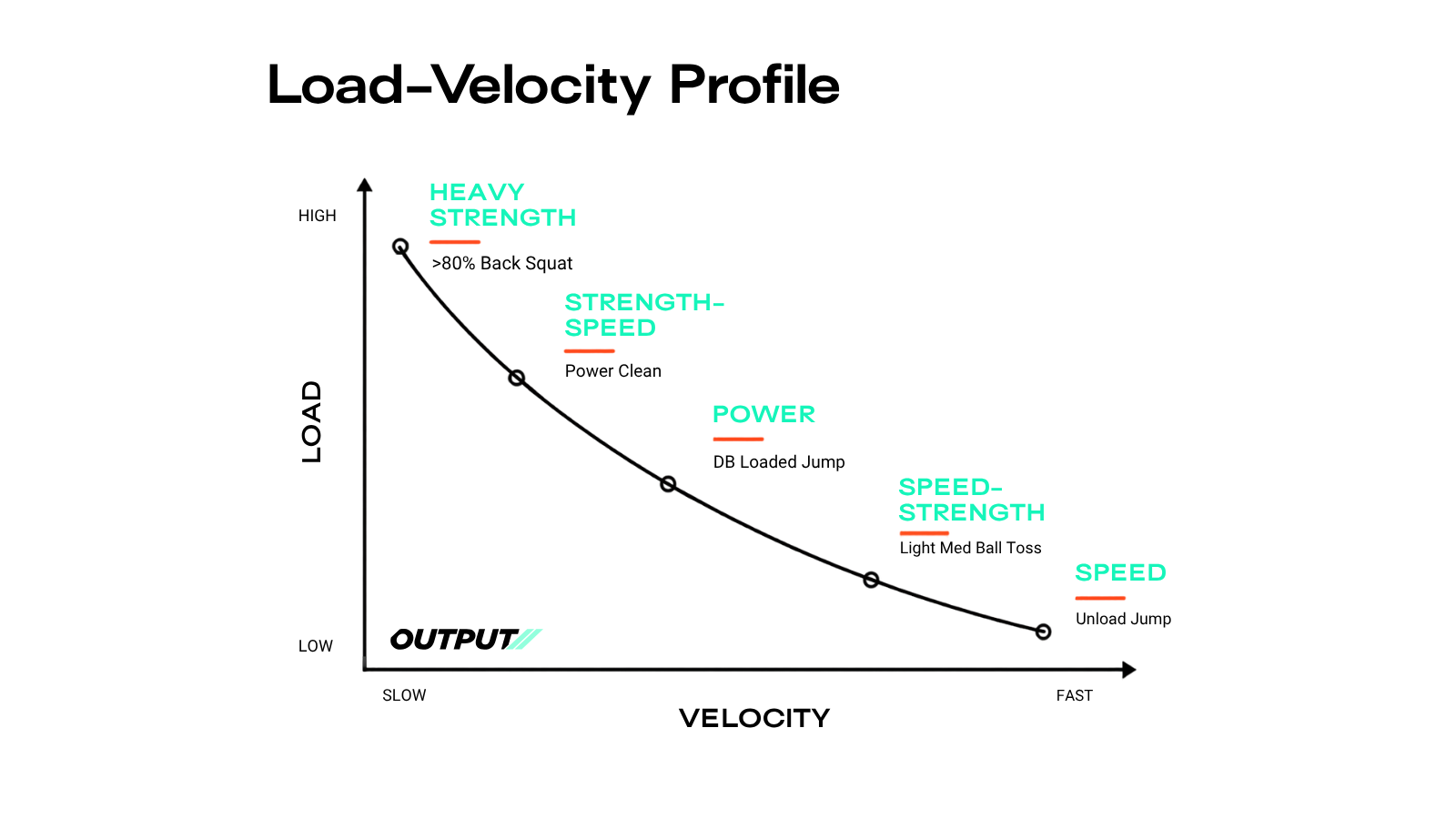
Here is the part that matters. Load-velocity and force-velocity are not the same thing. One describes how external load changes movement velocity. The other describes how a muscle's force capacity changes as it shortens faster. Because the two show up together in the gym, they have been treated as interchangeable. They are not, and that difference is the whole story.
The short version
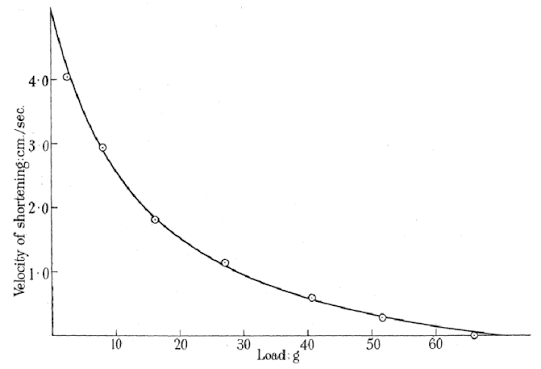
The relationship traces to A.V. Hill, in 1938, working on an isolated whole muscle: the frog sartorius. Whilst in frogs his finding was simple and has held up ever since: the faster a muscle shortens, the less force it can produce, with maximum force at zero velocity and maximum velocity at zero load.
In plain terms, picture grabbing a rope as it slides past you. Move it slowly and plenty of hands can grip it. Whip it past and only a few can hold on.

Muscle works the same way. Force comes from tiny cross-bridges, like hands, gripping the filaments and pulling. The faster the muscle shortens, the less time each one has to grab on, so fewer are holding at any moment and the force drops. That is the sliding filament theory at work, and it is why a fast muscle produces less force than a slow one.
That tells you exactly what the curve is, and is not. It is one muscle, shortening, in controlled conditions. It was never a description of a sprinting athlete, and it was never meant to be.
There is a second issue, and it sits in the diagram itself. As it usually reaches coaches, the curve is concentric only: the shortening half.
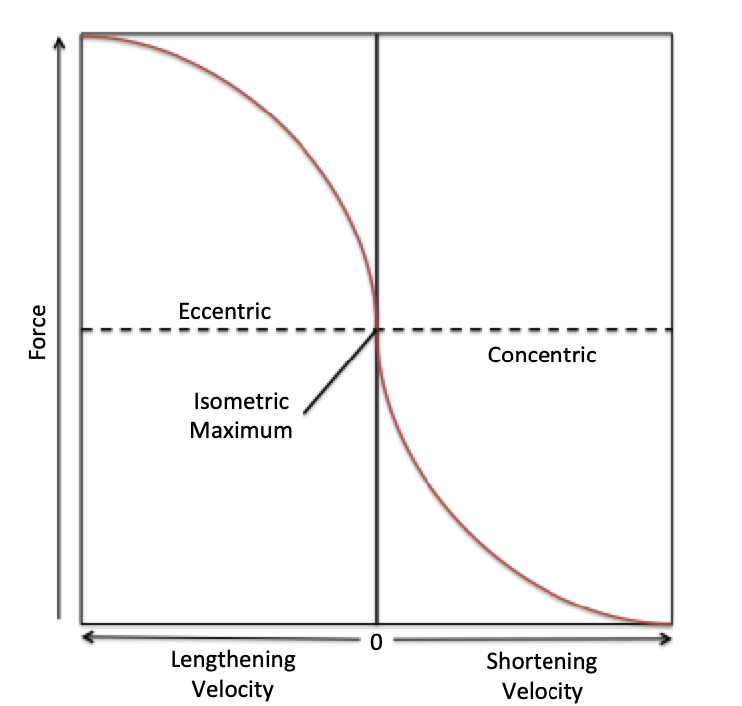
Muscle does more than shorten. Lengthen it under load, eccentrically, and it produces more force than it can hold isometrically, not less. The line does not stop at zero velocity; it keeps climbing to the left of it.
Draw the whole relationship and you do not get the tidy one-sided curve on the wall. You get something closer to an S-shape through the origin, with the eccentric side on one half and the concentric side on the other. The familiar poster shows half the picture and calls it the whole thing.
The strongest challenge comes from sprinting, and it sounds convincing. Sprinting is one of the fastest actions in sport, yet it is clearly not a low-force one. Ground reaction forces in maximal sprinting run to several times body weight, and internal loads go higher still, with patellar tendon forces around seven times body weight reported in fast running. If force and velocity trade off, how can sprinting produce so much of both?
The answer is in what the curve actually describes. It refers to muscle behaviour, not whole-body movement velocity.
At high running speeds, the muscles are not necessarily shortening fast while producing peak force. Studies of the plantar flexors during sprinting show the fascicles often shorten slowly and can work close to isometrically during the period of highest force. Rather than driving everything through fast concentric shortening, the muscle-tendon unit uses elastic energy. Tendons stretch under load, store it, and return it during propulsion. Think of a pogo stick: the spring stores and returns the energy while the rider stays relatively still. In sprinting the tendon is the spring, and the muscle is closer to the rider. That stretch-shortening cycle lets the body produce large external forces while easing the demand on contractile tissue.
So sprinting does not violate the force-velocity relationship. It leans on mechanisms the concentric curve was never built to describe: eccentric action, quasi-isometric muscle function and tendon elasticity. Apply a concentric-only model to a movement that runs on elastic return, and of course it looks broken.
The relationship is not wrong. Stretching a model of concentric muscle behaviour to explain every form of human movement was.
Strip the theory back and the practical value comes down to one thing: the load-velocity profile. And that holds up.
Within the loads an athlete trains, the load-velocity profile does real work. It estimates strength without a maximal test, and peak power, with the load it occurs at, points to where an athlete may be deficient and gives you somewhere to start.
That is the testing and programming side of the picture. It also feeds monitoring: track the same lifts over time and a meaningful drop in bar speed flags fatigue before it costs you a session. The number describes the athlete. The coach decides what to do with it.
The middle of the curve takes its own criticism, and some of it lands. Spotting that an athlete is force-deficient or velocity-deficient is one thing. Assuming a block of training aimed at that zone will move them is another. Loaded jumps are the classic example, often carrying too little load to drive a strength adaptation and too little speed to drive a true speed one.
The evidence backs the caution. Two 2025 meta-analyses, one in Scientific Reports and one in the Journal of Human Kinetics, found that training toward an optimal force-velocity profile can shift the profile on paper but rarely beats good ordinary training for jump height or power. The slope you would prescribe from is also among the least reliable numbers you can measure. Identifying a zone to improve is the easy part. Assuming it will respond to the obvious training is not.
So, were we wrong? No. The model was over-applied.
Force-velocity is a sound description of muscle, concentric and eccentric portions and all. It was never a law of whole-body performance, and it was never a prescription. Load-velocity is the relationship you programme with, and it holds up well. How to build and use that profile in practice, from setting velocity targets to estimating strength without maxing out, is a subject in its own right.
Measure the velocity an athlete moves real loads. Track it over time. Compare the athlete to themselves rather than to a population or an idealised line. Data is objective; interpretation is contextual. Let the data inform the decision, and let the coach make it.
Is the force-velocity curve wrong? Not really. It is a sound description of muscle, across its concentric and eccentric portions. The errors came from confusing it with load-velocity and leaning on a concentric-only version of it. As a muscle property it is fine. As a universal law or a training prescription, it was over-applied.
Why can a sprinter produce high force and high velocity at once? Because the high force is not coming from fast concentric shortening. In sprinting the muscle fascicles work close to isometrically while the tendon stores and returns elastic energy through the stretch-shortening cycle. Force stays high, but the muscle is not shortening fast against it, so the concentric curve does not apply.
Is the force-velocity curve concentric only? As it is usually drawn, yes. The eccentric side keeps producing force above isometric, so the complete picture is closer to an S-shape through the origin. The standard diagram leaves that half out.
Should I train to my force-velocity imbalance? The evidence is weak. Recent meta-analyses show profile-based training can move the profile but rarely beats ordinary training for jump height or power. Use the profile to understand the athlete, not to prescribe the fix.
What is the difference between force-velocity and load-velocity? They are two different relationships. Force-velocity is a property of muscle: how its force changes with shortening velocity, across concentric and eccentric action. Load-velocity is a training relationship: how fast a given load moves, heavy slow and light fast. They were used interchangeably, but they are not the same thing, and load-velocity is the one you programme with.
The force-velocity curve was never wrong. It was over-applied.
Keep the part that works. Measure load against velocity, track it over time, and compare the athlete to themselves. Let it inform your decisions, not make them.

.png)
Monthly performance insights, product updates, and sports science — straight to your inbox.
No spam, ever. Unsubscribe anytime.
No thanks, I'm not interested