

BE THE FIRST TO GET PRODUCT UPDATES
Get notified about new features & special offers......


How long you need to train for HYROX depends on where you are starting from. Most people can be HYROX ready in six to sixteen weeks. If you already run and lift regularly, eight to twelve weeks of focused work will get you ready. From a low training base, give yourself twelve to sixteen weeks, sometimes longer. A trained hybrid athlete can sharpen up in six to eight.
The number of weeks, though, is the easy part. What you do inside them decides whether you reach the start line ready or simply turn up on the day. The rest of this guide covers how to set your timeline by starting point, what a sound training block looks like week to week, and the fatigue trap that quietly undoes most HYROX plans.
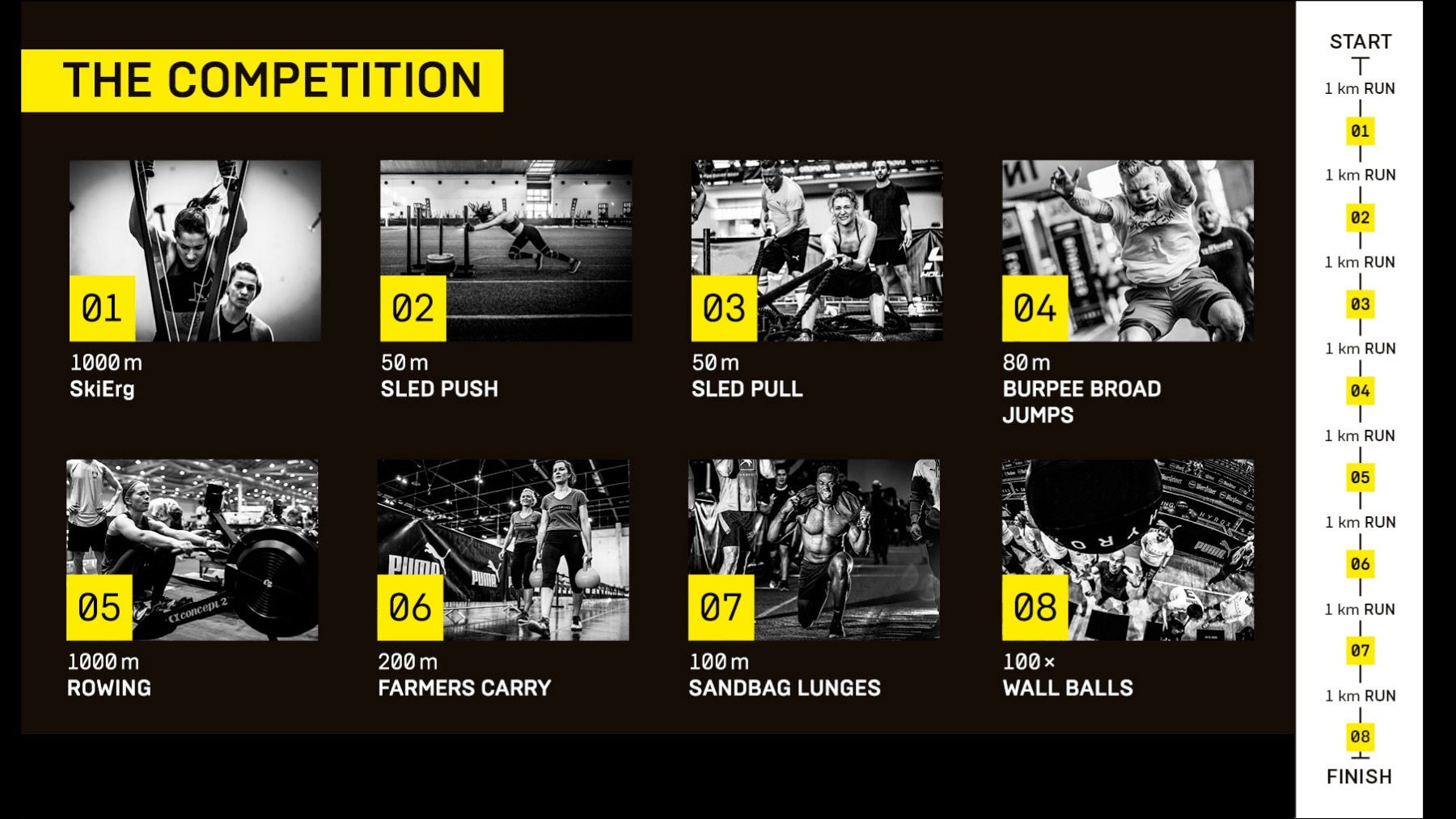
HYROX is a standardised fitness race: eight one-kilometre runs, each followed by a functional station, in the same format worldwide. It rewards people who can do two things well. You need an aerobic engine that holds up across eight kilometres of running, and you need functional strength that does not fall apart once that running has tired you out. Your timeline depends on how much of each you already have.
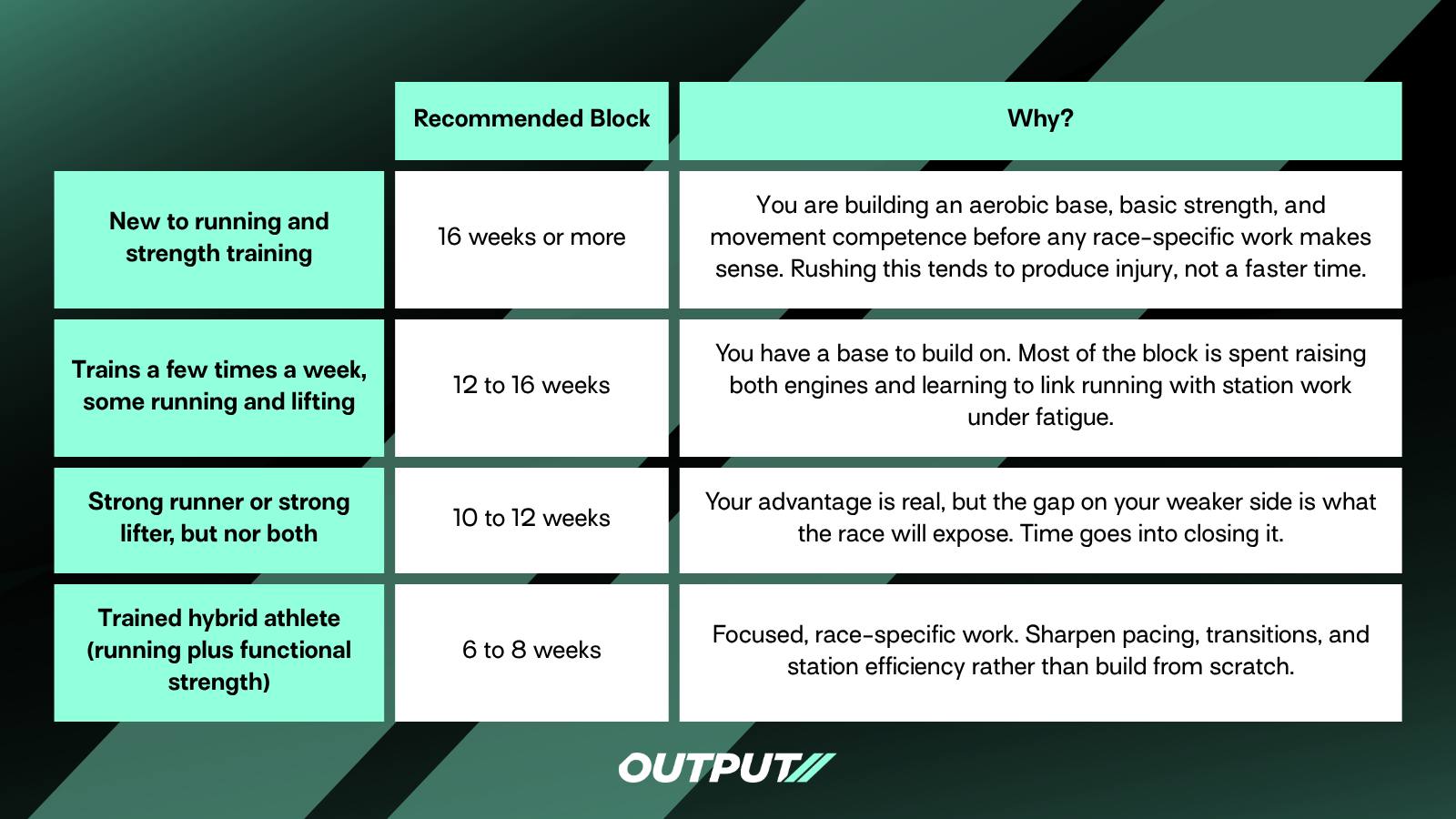
Here is a realistic starting point by level. Treat it as a planning guide, not a rule.Notice the pattern. The fitter and more balanced you already are, the shorter the runway. The further you are from the demands of the race, the longer it takes, mostly because building an aerobic base and durable strength cannot be hurried safely.

The honest version of this question is not "how many weeks." It is "how many weeks do I need to close the gap between where I am now and what the race demands."
That reframe changes how you plan. Two people can both sign up for the same race twelve weeks out and need completely different things. The strong runner who never lifts needs strength and station practice. The strong lifter who avoids running needs aerobic volume and pacing. Same race, same countdown, different work.
It also explains why some people get more out of eight focused weeks than others get out of twenty vague ones. Preparation time and preparation quality are not the same thing. A block built around the actual demands of the race will beat a longer block of general fitness every time.
So before you count weeks, get honest about your starting point. The clearest way to do that is to measure it rather than guess. The HYROX Conditioning Test is built for this: a standardised, race-specific benchmark that scores your conditioning and breaks it down station by station, so you can see exactly which parts of the race are holding you back and put your weeks there rather than guessing. That station-by-station picture is what turns a generic plan into a targeted one. It is also why sporadic testing is outdated: a baseline before the block and a retest at the end beats testing once or never.
Whatever your level, a sensible block follows the same logic. The difference between an eight-week plan and a sixteen-week plan is mostly how long you spend in each phase, not the phases themselves.
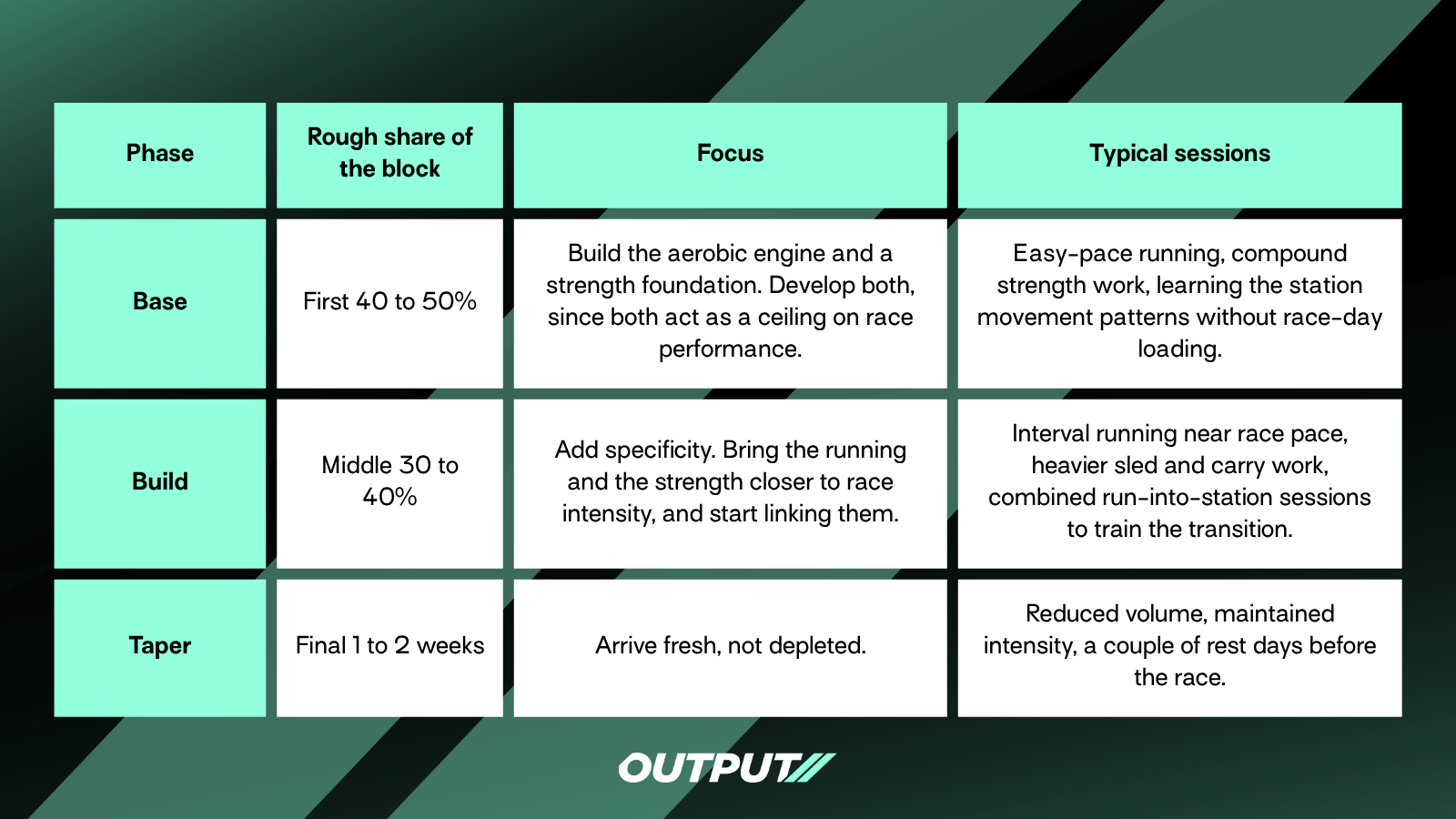
The build phase is where HYROX preparation earns its money. Running one kilometre and then immediately pushing a sled is a different skill to doing either on its own. Training that transition, the leg-burn-into-strength feeling, is what stops the race surprising you.
One number worth keeping in mind while you plan. In the first peer-reviewed study on the demands of the race, Brandt and colleagues (2025) found that running accounted for roughly 51 of about 86 minutes of total race time. The same study found strong correlations between aerobic capacity (VO2max) and overall performance, pointing to the aerobic engine as a key determinant of how you place. Running is more than half the clock, so if you only have time to fix one thing, your aerobic base usually gives the biggest return. That is why so much of the base and build phases sit there.

Three to five sessions a week covers almost everyone.
Beginners do well on three to four days, building to four or five as recovery allows. More is not automatically better. The training stacks running and strength on top of each other, and the limiting factor is usually recovery, not enthusiasm. Consistency across the whole block beats a heroic fortnight followed by burnout.
A common weekly shape looks like two to three running sessions, two strength sessions, and one combined or simulation session as race day gets closer. The exact split depends on which engine is behind.

Yes, if you already have a base. Eight weeks is enough to take a regular runner who also lifts, or a regular lifter who also runs, and get them race-ready with focused work.
What eight weeks cannot do is build an aerobic engine and a strength foundation from a standing start. If you cannot yet run five kilometres without stopping, spend the first few weeks building that before you start a HYROX-specific block. Four weeks is enough to learn the movements and survive a first race, but it is preparation for finishing, not for a time you will be proud of.
The same honesty applies at the other end. The research classifies HYROX as endurance-focused with moderate to low maximal strength demands. You do not need a huge squat. You need strength that holds up rep after rep, late in the race, when you are already tired. That distinction matters for how you train, which brings us to the part most plans skim over.
Most HYROX plans tell you what to do. Fewer tell you how to know when you are doing too much.
Concurrent training, building endurance and strength at the same time, is demanding by design. The research on training two qualities together is clear that the adaptations can interfere with each other and that fatigue accumulates quickly. Across a twelve or sixteen-week block, the people who get to race day in good shape are rarely the ones who trained hardest. They are the ones who managed the load so it kept building instead of breaking down.
This is where objective monitoring earns its place. Running volume and pace are easy to track with a watch. The harder thing to see is your neuromuscular state, whether your legs are genuinely recovered or just feel fine. A quick daily jump test is one of the simplest ways to read this. A drop in jump performance, measured rather than felt, is an early signal that fatigue is outpacing recovery, and a prompt to adjust before a poor session becomes a poor fortnight.
Output is built for exactly this kind of decision support. A few seconds on a countermovement jump, captured objectively, lets you monitor load and assess readiness across the block, flagging fatigue before it turns into a poor session or a niggle. It does not make the call for you. It gives you the information to make it, which is the point. Output measures the strength, power, jump, and readiness side of preparation; your watch handles the running.

Because the strength demand in HYROX is durability rather than a one-rep maximum, the way you train the strength stations should reflect that. A review in the Strength and Conditioning Journal frames it well: aerobic capacity is the foundation, while strength and power underpin the heavier stations such as the sled and support running economy. The two qualities work together rather than competing for your attention.
The goal is to raise your strength ceiling so that each sled push, each wall ball, each lunge, sits at a lower percentage of what you are capable of. The same effort then costs you less, and you have more left for the run. That is a more useful target than chasing a heavier lift for its own sake.
Velocity-based training is well suited to this. Tracking bar speed lets you train at the right intensity without grinding yourself into the ground, and watching velocity drop across a set tells you when a set has done its job and when it is just adding fatigue you will pay for on the run. For a HYROX athlete, managing that velocity drop-off is the difference between strength work that supports the race and strength work that sabotages it. The practical side of this lives in the velocity-based training tools, where bar speed sets the intensity and the velocity drop-off flags fatigue as it happens.
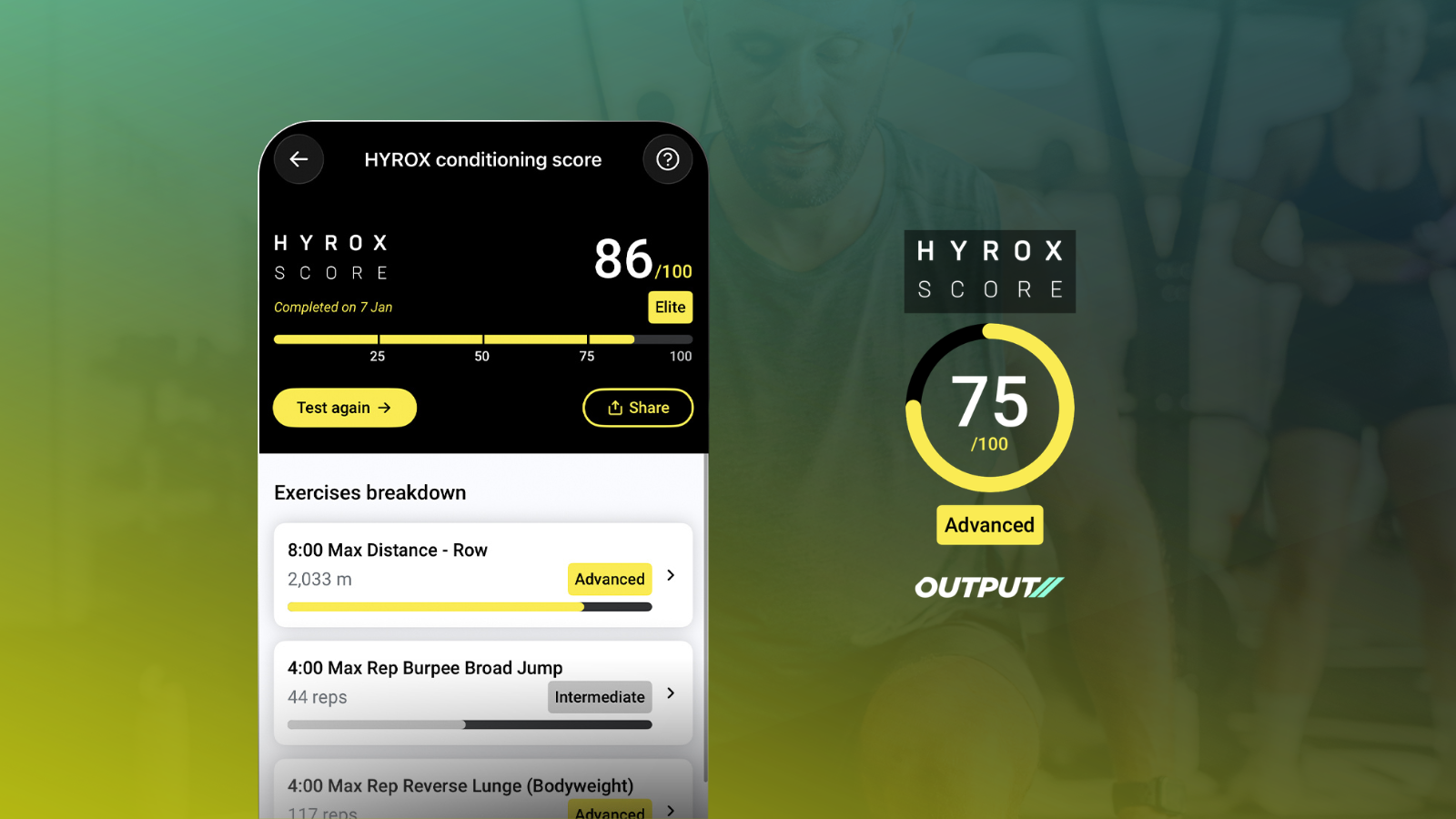
The honest test is whether the things you measured at the start have moved.
This is the case for retesting. If you benchmarked your running, a strength lift, and a jump at the beginning of the block, repeating them near the end tells you what actually changed. Strength up, jump holding under accumulated fatigue, running economy improved: the block worked. If a marker has stalled, you know where the next block needs to focus. In the Red Bull Road to HYROX programme, athletes who tested at the start and end of their block recorded an average ten percent improvement in their HYROX conditioning scores, the kind of change that only shows up when you measure it. Testing is most useful when it is built into training rather than treated as a one-off event, so you are always working from current information rather than a number from twelve weeks ago.
How long do you need to train for your first HYROX? Most first-timers do well with twelve to sixteen weeks. If you already run and lift regularly, eight to twelve weeks of focused work is enough. The main variable is your starting point, not your goal.
Can a beginner do HYROX? Yes. The race is designed to be accessible, with no qualifying standard and no time cut. A beginner with a sensible twelve to sixteen-week block can comfortably complete a first race.
Can you train for HYROX in 8 weeks? Yes, if you have an existing base in both running and strength. Eight weeks is a sharpening block, not a build-from-scratch block. If you cannot yet run five kilometres, build that first.
Do you need to be a good runner to do HYROX? You do not need to be fast, but running is more than half the race, so running fitness has the largest single effect on your time. You can build it during your block with steady runs and intervals.
How many days a week should you train? Three to five. Beginners start at three to four and build to four or five as recovery allows. Consistency across the full block matters more than any single session.
How long does it take to get faster at HYROX after your first race? A focused twelve to sixteen-week block between races, built around your weaker engine, is usually enough to make a meaningful improvement on your previous time.
If you coach a HYROX gym or a squad of athletes preparing for the same race, the timeline question gets harder, because everyone is starting somewhere different. The honest answer for a group is to set the block length by the least-prepared athletes and individualise the work inside it.
That is a scalability problem, and it is where objective baselines and shared readiness data are worth the setup. Knowing each athlete's starting point, and tracking how they are coping with the load week to week, lets you keep a group on the same calendar without breaking the people who recover slowest. If that is the problem you are solving, see how Output supports HYROX gyms and training clubs with testing and monitoring across a group.
Whatever your level, the principle holds. Count back from race day, be honest about where you are starting, and spend the weeks on the work that actually closes the gap.

.png)
Monthly performance insights, product updates, and sports science — straight to your inbox.
No spam, ever. Unsubscribe anytime.
No thanks, I'm not interested