.png)

BE THE FIRST TO GET PRODUCT UPDATES
Get notified about new features & special offers......


A good workout program is not a list of exercises. It is a structure built around a specific goal, with enough detail to guide you week to week and enough flexibility to adapt as you improve. Most people who struggle to see results are not training badly, they are training without a plan that matches what they actually want to achieve.
This guide walks through how to create a workout program from the ground up: setting the right goal, structuring sessions, building in progression, and knowing when the plan needs to change.
Every workout program should start with a goal, not an exercise list. Strength, muscle growth, fat loss, general fitness, and sport-specific performance all call for different training structures, and a plan built for one goal will underperform for another.
Goal-setting research consistently shows that specific, measurable goals produce better outcomes than vague ones, since a specific goal gives you something concrete to structure a plan around and measure progress against [1]. "Get fit" is not a goal a training plan can be built from. "Add 10kg to my squat in 12 weeks" or "train four days a week for three months without missing a session" is.
Before writing a single exercise into a plan, get clear on:
Regardless of the specific goal, every effective workout program needs to define five variables. This is essentially the FITT framework (frequency, intensity, time, type) that underpins most evidence-based exercise prescription guidance [2], applied practically:
A plan missing any one of these five is incomplete, even if it looks detailed on paper.

The best workout program is the one you can actually stick to. Training frequency should be set by the realistic number of sessions you can commit to consistently, not by what looks optimal in a magazine article.
A useful reference point: research on training frequency and muscle growth has found that hitting a muscle group at least twice a week tends to produce better results than once a week, provided the total weekly volume is comparable [4]. This is useful for structuring a schedule, but it is a secondary consideration to consistency. A 3-day-a-week program followed every week beats a 6-day-a-week program that gets skipped down to two sessions by week three.
Practical guidance for fitting a program to a schedule:
Whatever the frequency, build in at least one full rest day, and treat rest days as part of the program rather than something that happens by default when life gets busy.
With the goal and schedule set, exercise selection is where the plan actually takes shape. A few principles apply regardless of the training split chosen:

A single training session should follow a consistent structure, regardless of the day's focus:
This structure applies whether the session is a push day, a leg day, or a full-body session, the specific exercises change, the order of demand does not.
A workout program that stays the same week after week stops producing results once the body adapts to the initial stimulus. Progression is what keeps a plan effective over months rather than weeks.
Progressive overload, gradually increasing the demand placed on the body through more weight, more reps, more sets, or better technique, is the mechanism most consistently linked to continued strength and muscle gains [3]. Practical ways to apply it:
Without a plan for progression, even a well-designed program plateaus. This is also where objective tracking earns its place: strength testing at regular intervals gives a clear read on whether the main lifts in a program are actually improving, rather than relying on a felt sense of "it's getting easier."
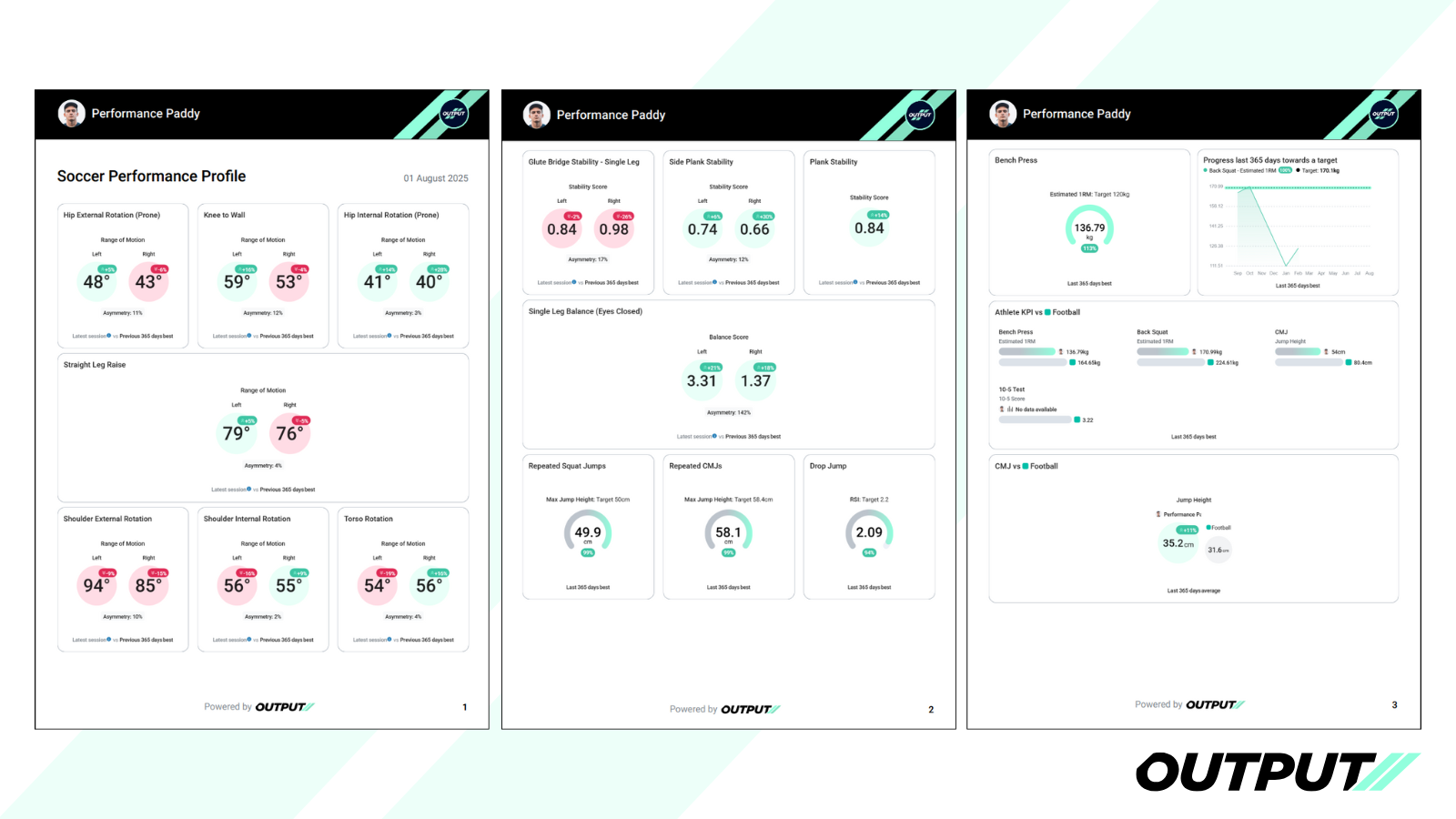
A program is working if it is producing measurable change against the goal it was built for, not simply if sessions feel hard. Signs to check, depending on the goal:
For a fuller breakdown of which metrics to track and how often, see how to track fitness progress.
Where possible, tracking the actual training stimulus rather than just the outcome gives an earlier signal that something needs to change. Set-by-set bar speed is one such signal: how much velocity drops within a set is a well-established indicator of the fatigue that set produced [6], which is the basis of velocity based training. Rather than waiting weeks to see whether a program is producing strength gains, this gives session-by-session feedback on whether the load and volume in the plan are actually driving the intended adaptation, tracked through a performance hub rather than reconstructed from memory after the fact.
If none of the relevant signals are moving after 4-6 weeks of consistent training, the program, not the effort, is usually the thing that needs adjusting.
A few mistakes show up repeatedly in self-built programs:
How do I create my own workout routine?
Start with a specific goal, choose a training frequency you can realistically sustain, select exercises that match the goal (compound lifts first), and build in a plan for progression. Review and adjust every 4-6 weeks based on whether the relevant metrics are actually moving.
How do I plan a workout?
Structure each session the same way: a brief warm-up, the main compound lift while fatigue is lowest, secondary or accessory work, isolation exercises, then a cool-down. The specific exercises change by day, the structure stays consistent.
How long should a workout program last?
Most programs run in 4-8 week blocks before being reassessed and adjusted. This gives enough time for progressive overload to produce measurable change without running so long that the plan stops matching current fitness level.
Can beginners create their own workout plan?
Yes, provided the plan stays simple. A beginner program built around a handful of compound lifts, trained 3 days a week with straightforward progression (adding small amounts of weight or reps each week), covers most of what is needed without the complexity of an advanced split.
[1] E. A. Locke and G. P. Latham, "Building a practically useful theory of goal setting and task motivation: a 35-year odyssey," American Psychologist, vol. 57, no. 9, pp. 705-717, 2002.
[2] C. E. Garber, B. Blissmer, M. R. Deschenes, B. A. Franklin, M. J. Lamonte, I. Lee, D. C. Nieman, and D. P. Swain, "Quantity and quality of exercise for developing and maintaining cardiorespiratory, musculoskeletal, and neuromotor fitness in apparently healthy adults: guidance for prescribing exercise," Medicine & Science in Sports & Exercise, vol. 43, no. 7, pp. 1334-1359, 2011.
[3] N. A. Ratamess, B. A. Alvar, T. K. Evetoch, T. J. Housh, W. B. Kibler, W. J. Kraemer, and N. T. Triplett, "Progression models in resistance training for healthy adults," Medicine & Science in Sports & Exercise, vol. 41, no. 3, pp. 687-708, 2009.
[4] B. J. Schoenfeld, D. Ogborn, and J. W. Krieger, "Effects of resistance training frequency on measures of muscle hypertrophy: a systematic review and meta-analysis," Sports Medicine, vol. 46, no. 11, pp. 1689-1697, 2016.
[5] C. J. McGowan, D. B. Pyne, K. G. Thompson, and B. Rattray, "Warm-up strategies for sport and exercise: mechanisms and applications," Sports Medicine, vol. 45, no. 11, pp. 1523-1546, 2015.
[6] L. Sánchez-Medina and J. J. González-Badillo, "Velocity loss as an indicator of neuromuscular fatigue during resistance training," Medicine & Science in Sports & Exercise, vol. 43, no. 9, pp. 1725-1734, 2011.

.png)
Monthly performance insights, product updates, and sports science — straight to your inbox.
No spam, ever. Unsubscribe anytime.
No thanks, I'm not interested