
.png)
BE THE FIRST TO GET PRODUCT UPDATES
Get notified about new features & special offers......


Quick summary: Performance evaluation tests are structured physical assessments used to measure an athlete's strength, power, speed, mobility, and neuromuscular readiness. They provide objective baseline data, expose individual strengths and weaknesses, guide program design, and help coaches monitor progress, manage fatigue, and inform return-to-play decisions. Done well, testing makes coaching decisions sharper, faster, and more accountable.
Coaches do not test athletes to collect numbers for the sake of it. They test to make better decisions. Performance evaluation tests are the bridge between what a coach sees on the floor and the objective data that explains why.
Tested well, training stops being a guess and starts being a trajectory you can prove. Used well, testing turns hunches into decisions. It tells you who is ready, who is fatigued, who is progressing, and who needs a closer look. Used poorly, it is a time sink that produces data nobody acts on.
This article breaks down what performance testing is, why it matters, the categories of tests most teams use, and how to build a battery that actually informs your week-to-week coaching. It is written for strength and conditioning coaches, sport scientists, physiotherapists, personal trainers and any performance practitioner who wants testing to drive training, not sit next to it in a spreadsheet.
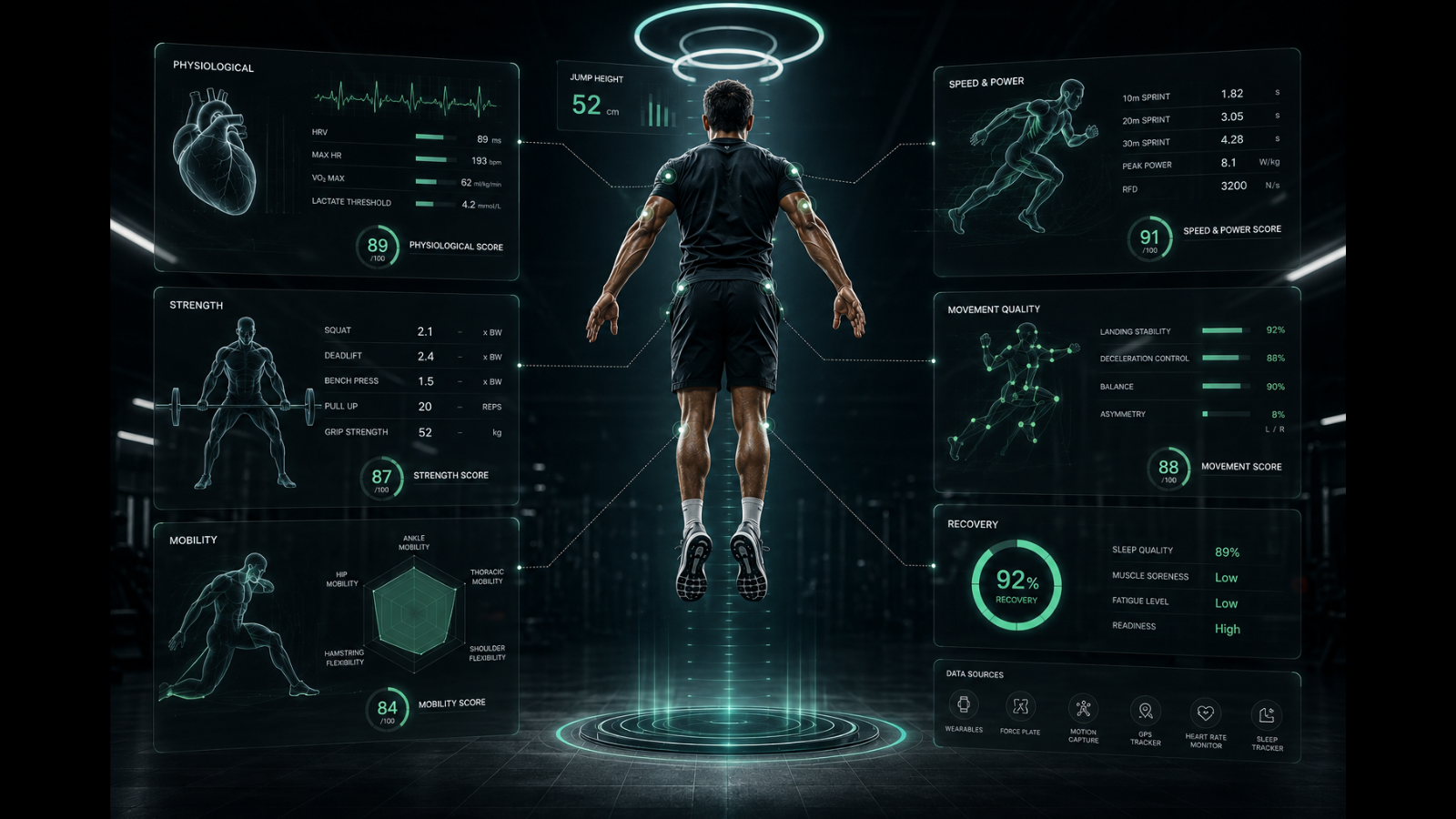
Performance evaluation tests are standardized physical assessments designed to measure specific qualities relevant to sport. Common categories include strength, power, speed, reactive strength, mobility, balance, and aerobic capacity.
Each test is selected to give a valid, reliable, and repeatable read on a quality that influences performance. The data forms a baseline, exposes asymmetries, and creates the reference points used to evaluate every training block that follows.
In practical terms, a testing session might include a countermovement jump for lower-body power, a load-velocity profile for strength prescription, a sprint for speed, and a mobility screen for joint range. The exact battery depends on the sport, the squad, the time available, and the questions the coach needs answered.
Subjective observation has its place. An experienced coach sees things data cannot. But observation alone has limits, and those limits show up most clearly when squads are large, schedules are tight, and decisions need to be defensible. Objective data adds the layer of evidence that supports decisions when “feel” alone is not enough.
Testing gives coaches five things that are difficult to get any other way.
Without a baseline, there is no benchmark to measure progress against. Performance tests establish where each athlete sits across the qualities that matter for their sport, creating the reference point every future test, training block, and intervention is judged against.
A baseline also protects the coach. When training decisions are challenged, by an athlete, a head coach, or a medical team, the test data is the evidence that supports them.
A well-constructed battery exposes the gap between an athlete's strongest and weakest qualities. A sprinter with strong peak velocity but poor reactive strength has a different training priority to one with the opposite profile. Without testing, those distinctions are easy to miss.
This is where individualisation actually happens. Programming for the group is necessary at squad level. Programming for the individual is only possible when individual profiles exist.
Re-testing across a season tells the coach whether the programme is producing the adaptations it was designed to produce. If strength is improving but reactive strength is flat, the training emphasis can be adjusted. The decision is no longer based on feel.
This also protects against the opposite problem: assuming progress where there is none. Without data, it is easy to confuse activity with adaptation.
Returning an athlete from injury without objective data is one of the higher-risk decisions in sport. Testing gives coaches the ability to compare current output against pre-injury baselines, identify residual asymmetries, and progress athletes back to full availability with greater confidence.
Bilateral symmetry on a force or power test, ground contact time on a reactive jump, or velocity on a submaximal strength lift can all give a clearer picture of readiness than visual observation alone.
Athletes engage more with training when they can see their own progress. Visible test data, shared back to the athlete with context, builds accountability and motivation. It also gives the coach a clearer way to explain why specific training choices are being made.

Testing matters because it makes change visible. Across a pre-season block, a strength phase, or a return-to-play progression, these are the kinds of markers coaches typically track:
None of these are visible by eye. All of them are visible by test.

Most testing batteries are built from a small number of well-validated test categories. The right mix depends on the sport and the question being asked, but the following list covers the qualities most teams assess.
Strength testing measures an athlete's ability to produce force against an external load. Common methods include one-repetition maximum (1RM) testing in the squat, bench press, and deadlift, isometric mid-thigh pull (IMTP), and load-velocity profiling to predict 1RM without lifting maximal loads.
Typical protocol: A 1RM test progresses through a structured warm-up to a single maximal lift, with adequate rest between attempts. A load-velocity profile uses three to five submaximal loads, measuring bar velocity at each, to build a linear relationship that predicts 1RM.
What good looks like: Reliable strength data depends on consistent technique, range of motion, and equipment. Load-velocity profiling has become particularly popular because it offers a fast, low-fatigue alternative to traditional 1RM testing, and allows coaches to update 1RM estimates regularly without exposing athletes to maximal loads.
What progress looks like: A rising predicted 1RM. A faster bar velocity at the same load. A higher load moved at the same velocity. Each is a different lens on the same underlying improvement.
Common error: Testing 1RM when the athlete is not in a position to express it. Fatigue, poor warm-up, or technical breakdown produce data that misleads rather than informs.
Jump testing is one of the most widely used categories in sport. The countermovement jump (CMJ) and squat jump (SJ) provide a fast, reliable measure of lower-body power and are commonly used to monitor neuromuscular readiness across a training week.
Typical protocol: Three CMJs with 30 to 60 seconds rest between efforts, with the best score used depending on the question being asked. Squat jumps use the same structure but start from a paused position to remove the stretch-shortening cycle.
What good looks like: The CMJ is one of the most studied tests in sport science, with strong reliability when protocols are controlled. It can act as a daily monitoring tool, a periodic performance test, or a return-to-play criterion, depending on how it is used.
What progress looks like: Jump height climbing across a pre-season block. A widening gap between SJ and CMJ height, indicating improved use of the stretch-shortening cycle. A return-to-play athlete closing the gap between their injured and uninjured side.
Common error: Using a single CMJ on a single day to make a decision. Jump performance fluctuates, and meaningful change should be evaluated against an athlete's own typical range, not against a fixed threshold.
Linear sprint tests, typically over distances of 10m, 20m, or 40m, measure acceleration and maximum velocity. Split times allow coaches to differentiate between an athlete's start, acceleration phase, and top-end speed.
Typical protocol: A standardized warm-up followed by two to three maximal sprints with full recovery between efforts. Timing gates or laser-based systems are the standard for reliability.
What good looks like: Sprint testing is highly sensitive to fatigue, surface, footwear, and starting position. Controlling those variables is the difference between data you can trust and data that tells you nothing.
What progress looks like: Faster 10m and 20m splits without a corresponding gain at 40m points to an acceleration adaptation. Faster 40m without splits moving indicates top-end speed development. The split data shows where the change is.
Reactive Strength Index (RSI) is a measure of how efficiently an athlete uses the stretch-shortening cycle. It is calculated by dividing jump height by ground contact time and is widely used to monitor neuromuscular status across periods of high training load.
Typical protocol: Repeated jump protocols such as the drop jump (from a 30cm or 40cm box) or the 10-5 repeated jump test. The drop jump provides a single RSI value per drop height; the 10-5 test gives an average across multiple ground contacts.
What good looks like: The 10-5 repeated jump test has shown good reliability in elite athlete populations, with ICC values of 0.87 to 0.95 reported in recent research, and is sensitive to changes in training load and stress.
Common error: Confusing RSI with vertical jump height. A high jumper with a long ground contact time can have a lower RSI than a smaller athlete who reattacks the ground quickly.
Mobility and balance assessments identify joint range of motion, asymmetries, and stability profiles. Tools like movement screening, single-leg balance, and range-of-motion assessments are particularly relevant for injury risk management and return-to-play workflows.
Typical protocol: Movement screens evaluate ranges of motion across key joints and patterns. Balance is assessed through eyes-open and eyes-closed protocols on stable and unstable surfaces. Range-of-motion measurements use goniometers, inclinometers, or sensor-based equivalents.
What good looks like: Mobility data is most valuable when tracked longitudinally against the athlete's own baseline rather than benchmarked against a population norm.
Common error: Treating movement screening as a pass-fail injury predictor. Research suggests the relationship between low screen scores and injury is weak when used in isolation, and screening is most valuable as one input among several.
Aerobic and intermittent fitness tests, such as the Yo-Yo Intermittent Recovery Test or sport-specific conditioning scores, assess an athlete's capacity to sustain or repeat efforts. Sport-specific testing protocols increasingly bridge the gap between general fitness measures and the actual demands of competition.
Typical protocol: Field-based intermittent recovery tests progress through standardized intervals until volitional failure. Sport-specific protocols simulate the work-to-rest demands of competition.
What good looks like: The closer the test mirrors the actual demands of the sport, the more useful the data is for shaping conditioning prescription.
The value of any test depends on whether it is valid, reliable, and applied with discipline. Without those three things, the numbers are noise.
A valid test measures what it is supposed to measure, and what it measures matters for the sport in question. A vertical jump is a valid measure of lower-body power. It is a poor measure of aerobic capacity.
A reliable test produces consistent results when repeated under the same conditions. Reliability depends on the technology used, the protocol followed, and the consistency of the person running the test. Coefficient of variation (CV) below 10% and intraclass correlation coefficients (ICC) above 0.75 are commonly used reliability benchmarks in sport science research.
Even the best test loses meaning if the protocol changes between sessions. Warm-up, time of day, recovery status, technique standards, and equipment all need to be controlled. A 5% improvement in a jump test means nothing if the athlete tested fatigued the first time and fresh the second.
A less discussed but equally important consideration is whether the test actually informs a decision. A perfectly valid, perfectly reliable test that does not change what the coach does on Monday morning is a poor use of testing time. Every test in a battery should map to a specific decision: a prescription, a program adjustment, a return-to-play criterion, a conversation with the athlete.
There is no universal testing battery. There is only a testing battery that suits your sport, your athletes, your time, and the decisions you are trying to make.
Four questions help frame the build.
Test order also matters. Tests most affected by fatigue, such as balance, power, speed, and reactive strength, should be scheduled early. Strength and muscular endurance follow. Aerobic and conditioning tests come last.
A typical pre-season testing day for a team sport squad might look like this:
The same battery, or a reduced version of it, is then repeated at mid-season and end-of-season to track adaptation. Lower-fatigue elements (CMJ, RSI, mobility) can be monitored more frequently within the training week.
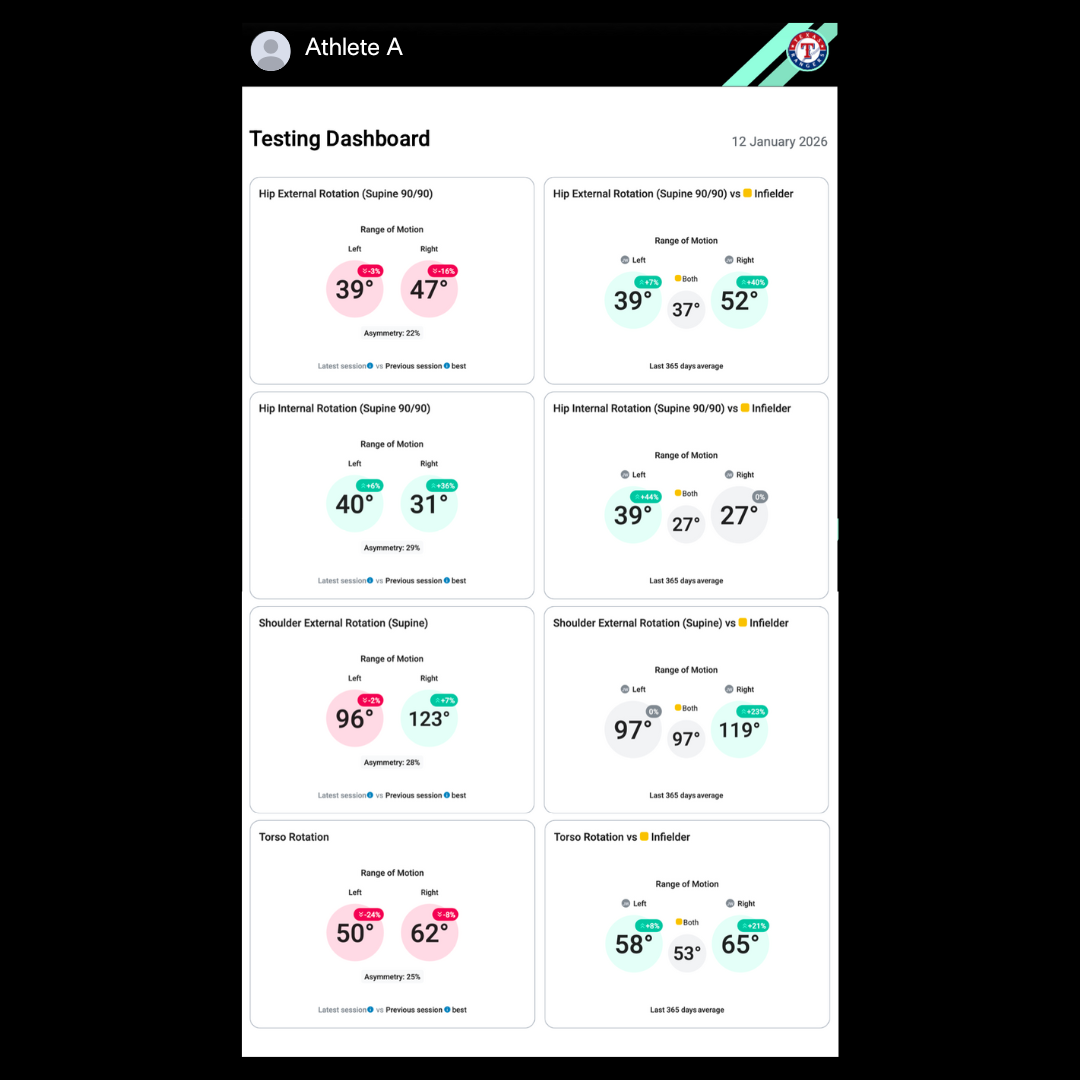
The point of testing is not the test. It is the decision the test informs.
Good practice ties every test result back to program design, monitoring, or return-to-play workflows. Without that link, testing becomes administrative overhead. With it, testing becomes one of the most efficient sources of coaching information available.
Some of the most common decisions test data should drive:
A simple test is whether the data changes anything. If the answer is no, the test is either redundant or being underused.
Testing and monitoring are not the same thing, and conflating them leads to poor decisions.
Testing is periodic. It involves maximal or near-maximal efforts under controlled conditions, typically at key time points across a season. Pre-season, mid-season, end-of-season, and post-injury are the most common windows.
Monitoring is continuous. It uses submaximal, low-fatigue measures, often captured during training itself, to track readiness and adaptation week to week or day to day. Jump testing, velocity loss, and short readiness checks are common monitoring tools.
Both have a place. The error is using a monitoring measure to make a decision it cannot support, or building a testing battery so heavy it cannot be repeated frequently enough to be useful.

Output is built around three core functions: testing, programming, and monitoring. The system uses a wearable IMU sensor and software platform to deliver objective performance data across more than 300 exercises, including jump tests, strength tests, mobility screens, sprint and agility measures, and velocity-based training.
For coaches running performance evaluation tests, Output condenses a process that traditionally lives across multiple tools, a force plate for jumps, a separate device for VBT, a stopwatch for sprints, a goniometer for mobility, and a spreadsheet to hold it all, into one workflow on a single sensor.
The practical implications:
The result is a connected workflow rather than four disconnected ones, which means more time coaching and less time wrangling data.
Performance testing in sport is the use of structured, standardized assessments to measure physical qualities relevant to athletic performance, including strength, power, speed, reactive strength, mobility, and conditioning. The results are used to set baselines, guide training, monitor progress, and inform return-to-play decisions.
Testing gives coaches and athletes objective data on physical capability. It identifies strengths and weaknesses, evidences whether training is working, supports return-to-play decisions, and builds athlete buy-in by making progress visible.
Traditional testing batteries are typically run every 8 to 12 weeks, aligned with training blocks and key season time points. Best practice now leans towards integrating testing into training itself, allowing coaches to evaluate improvement continuously rather than only at set intervals.
Testing is periodic and uses maximal or near-maximal efforts under controlled conditions. Monitoring is continuous and uses submaximal, low-fatigue measures, often embedded within training, to track readiness and adaptation week to week.
Common tests include the countermovement jump, squat jump, drop jump, reactive strength index assessments, 1RM and load-velocity profile testing, linear sprint testing, mobility and balance screens, and sport-specific conditioning tests such as intermittent recovery protocols.
Reliability is typically evaluated using intraclass correlation coefficients (ICC) and coefficient of variation (CV). ICC values above 0.75 and CV below 10% are commonly used benchmarks. Protocol consistency, calibrated equipment, and a standardized warm-up are essential for reliable results.
Yes. Wearable sensors, particularly IMU-based systems, have made it possible to capture objective performance data outside lab settings. Field-based testing now covers jumps, strength via load-velocity profiling, sprints, mobility, and balance, with reliability comparable to traditional lab equipment in many cases.
A full testing day for a team sport squad typically runs between two and four hours depending on group size and the number of stations. Multiple testing stations, prepared athlete profiles, and automated data capture significantly reduce the time required.
Large squad testing depends on three things: a streamlined battery focused on the highest-value tests, multiple testing stations running in parallel, and technology that captures data automatically rather than requiring manual entry. Without those, testing time scales linearly with squad size and becomes impractical.
Performance evaluation tests are not a checklist exercise. Done well, they are one of the most valuable inputs to coaching decisions: a way to base training on what athletes can actually do, not what the coach assumes.
The goal is not more data. It is better decisions, and the visible improvement those decisions produce. Build a battery that answers the questions your environment needs answered, run it with discipline, and tie every test back to a coaching action.

.png)
Monthly performance insights, product updates, and sports science — straight to your inbox.
No spam, ever. Unsubscribe anytime.
No thanks, I'm not interested