.jpg)
BE THE FIRST TO GET PRODUCT UPDATES
Get notified about new features & special offers......


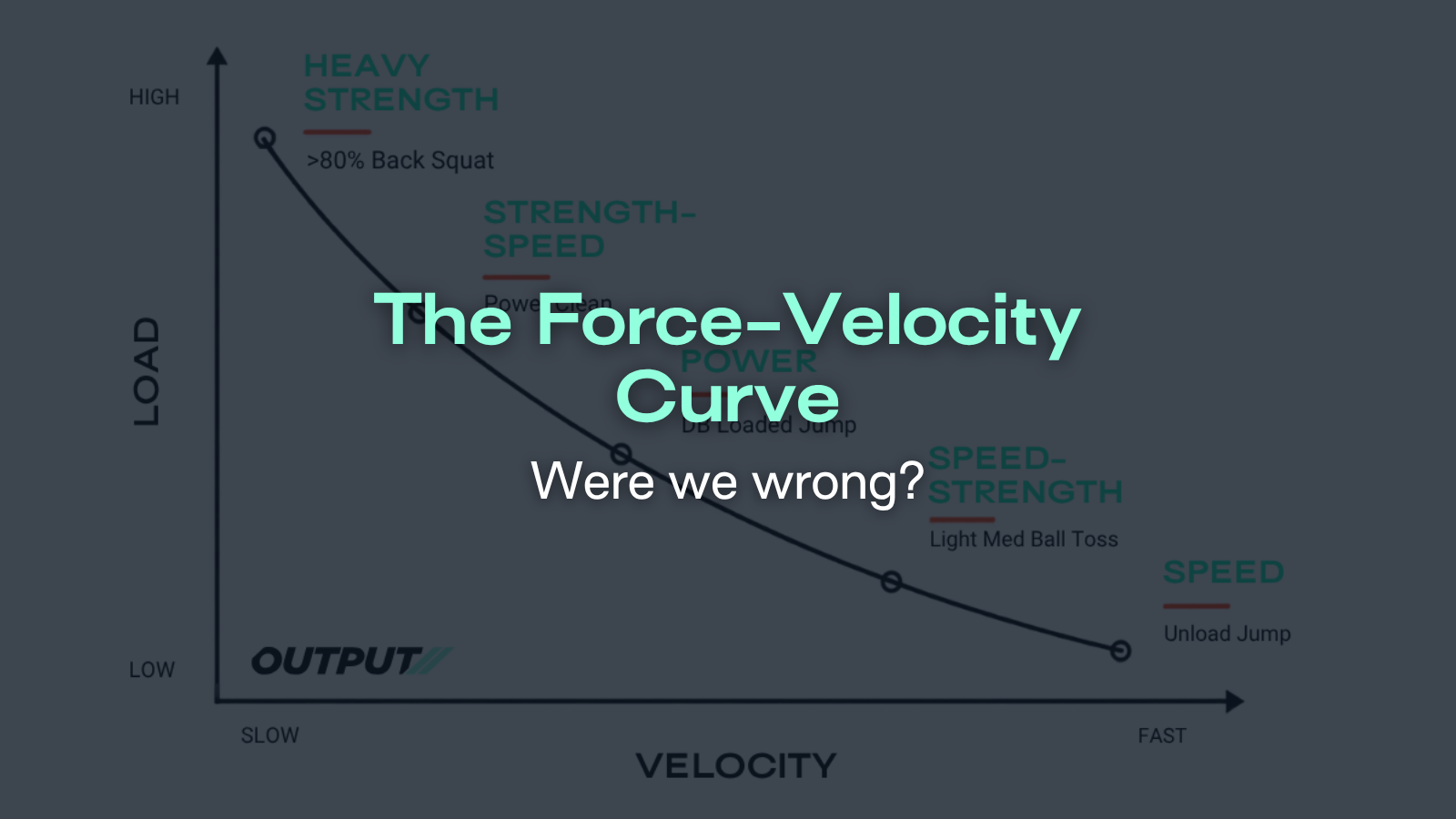
A force-velocity profile tells you how fast your athlete moves different loads, from heavy strength work to explosive power movements. It reveals where an athlete currently sits on the strength-speed spectrum, which tells you what to prioritise based on the demands they face.
You test your athletes' jump height. You know their estimated 1RM. But you don't know whether their current training history has made them strong at slow movements or explosive at lighter loads. Load-velocity profiling fills that gap.
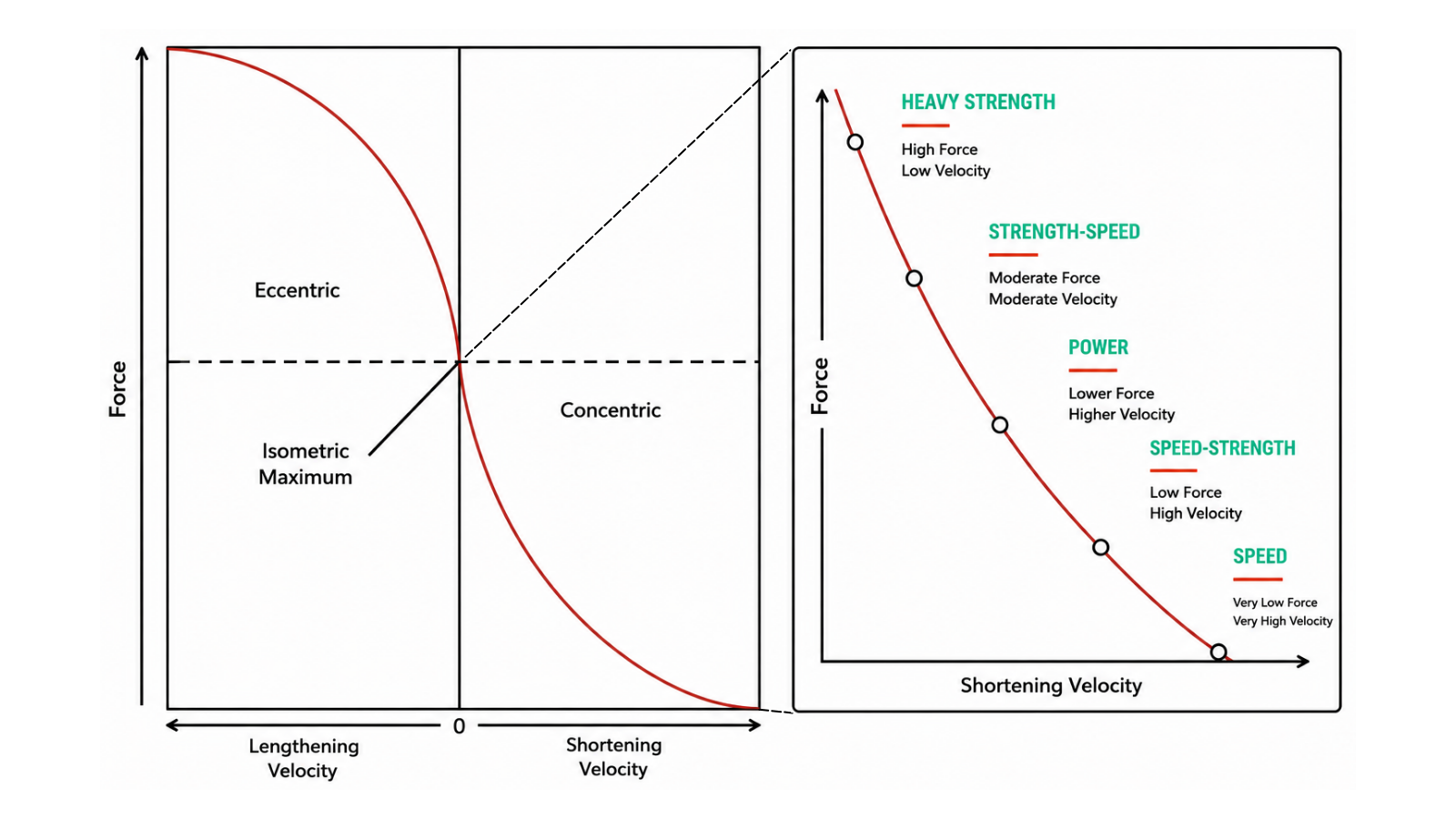
On terminology: The term "force-velocity profiling" is commonly used, but it's worth understanding what's actually happening. The force-velocity curve is a muscle physiology concept describing how isolated muscle behaves. What coaches measure in the gym is load-velocity relationships, how fast a given load moves. These aren't the same thing, and conflating them has led to misapplied programming. This article focuses on the practical coaching tool: load-velocity profiling.
A load-velocity profile is a snapshot of how your athlete produces force and velocity across a range of loads. It maps the relationship between the load lifted and the speed at which they move it.
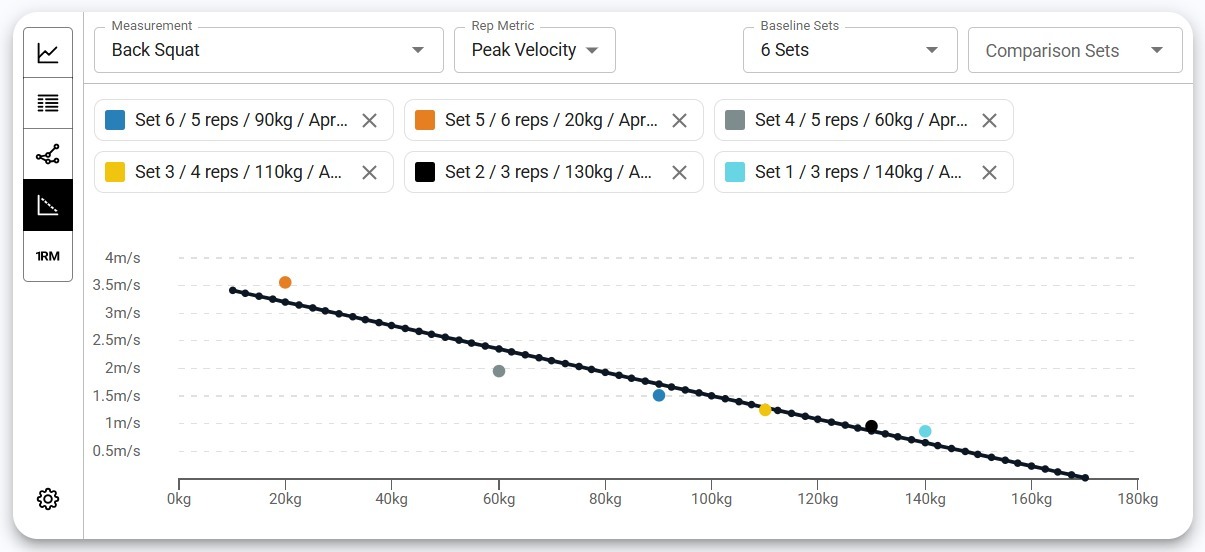
In practical terms: test multiple loads at light, medium, and heavy ranges. Measure how fast your athlete moves each one. Plot those points, draw the line, and you have a profile. That line tells you whether your athlete is strong at heavy loads but slower at light ones, or fast at light loads but slower at heavy ones.
This is different from testing a single 1RM. You're not measuring peak performance at one point. You're mapping production capabilities across the entire spectrum, which reveals an athlete's mechanical profile and where they sit on the strength-speed continuum.
Load-velocity profiling works consistently across barbell exercises. An example comprehensive data capture protocol is outlined in more detail in this article we wrote earlier, but here it is in short:
The methodology works in three steps:
Step 1: Prepare and warm up
Ensure your athlete has completed a consistent warm-up protocol. Use the same warm-up before repeat testing sessions for maximum reliability. You'll need an Output Sensor to capture bar speed data and access to progressively heavier loads.
Step 2: Test across a spread of loads with maximum intent
Research typically recommends 4-6 sets of increasing load intensity which capture a "spread" of lighter loads (mean velocity greater than 1 m/s), moderate loads (mean velocity 0.65-1 m/s) and heavy loads (mean velocity less than 0.65 m/s).
On every single repetition, the athlete must move with maximal intent. This is critical. Real-time velocity feedback can drive this intent. Take sufficient and consistent rest between sets to ensure maximum intent can be achieved on each load tested.
Coaching cue for back squat profiling: When loads are light, drive to stand up tall. Stay grounded through the entire movement. Do not leave the floor. Control the bar throughout the range and drive hard out of the bottom. This maintains consistent movement patterns across all loads and ensures data quality.
Step 3: Extract the best repetition from each load
Identify the "best" repetition from each set. For mean-velocity this is the fastest mean velocity from each load. Create a table of Load (kg or lbs) and the best mean-velocity from each set, then use a least-squares linear fit to allow for load-velocity profiling across all feasible loads.
The athlete does not need to complete reps to failure. One rep at true maximum intent per load is sufficient and is less fatiguing than traditional 1RM testing protocols.
A load-velocity profile is a sloped line showing the relationship between load and velocity. The practical value comes from understanding where your athlete sits on that spectrum:
Force-strong athletes move heavy loads well but velocity drops significantly at light loads. They're naturally strong at heavier loads, less quick at light ones. Common in powerlifters and heavy strength athletes.
Velocity-strong athletes move light loads quickly but lose output at heavier loads. They're fast at light velocities but lack absolute strength. Common in explosive athletes.
Balanced athletes show proportional change across loads.
None of these is wrong. They're normal human variation shaped by genetics, training history, and sport demands. Knowing which your athlete is tells you where you might have gaps worth addressing.
Important caveat: Having a particular load-velocity profile does not mean you must train to change it. The key is establishing a useful load-velocity profile to start with and then monitoring adaptation over time. Recent meta-analytical evidence suggests training specifically aimed at correcting load-velocity imbalances can shift the profile on paper but rarely improves jump height, power, or performance more than well-designed ordinary programming. Use the profile to understand the athlete, not to prescribe a fix.
Whilst the concept of a load-velocity profile can be applied to almost any exercise, the three most commonly used and researched lifts are:
Back squat
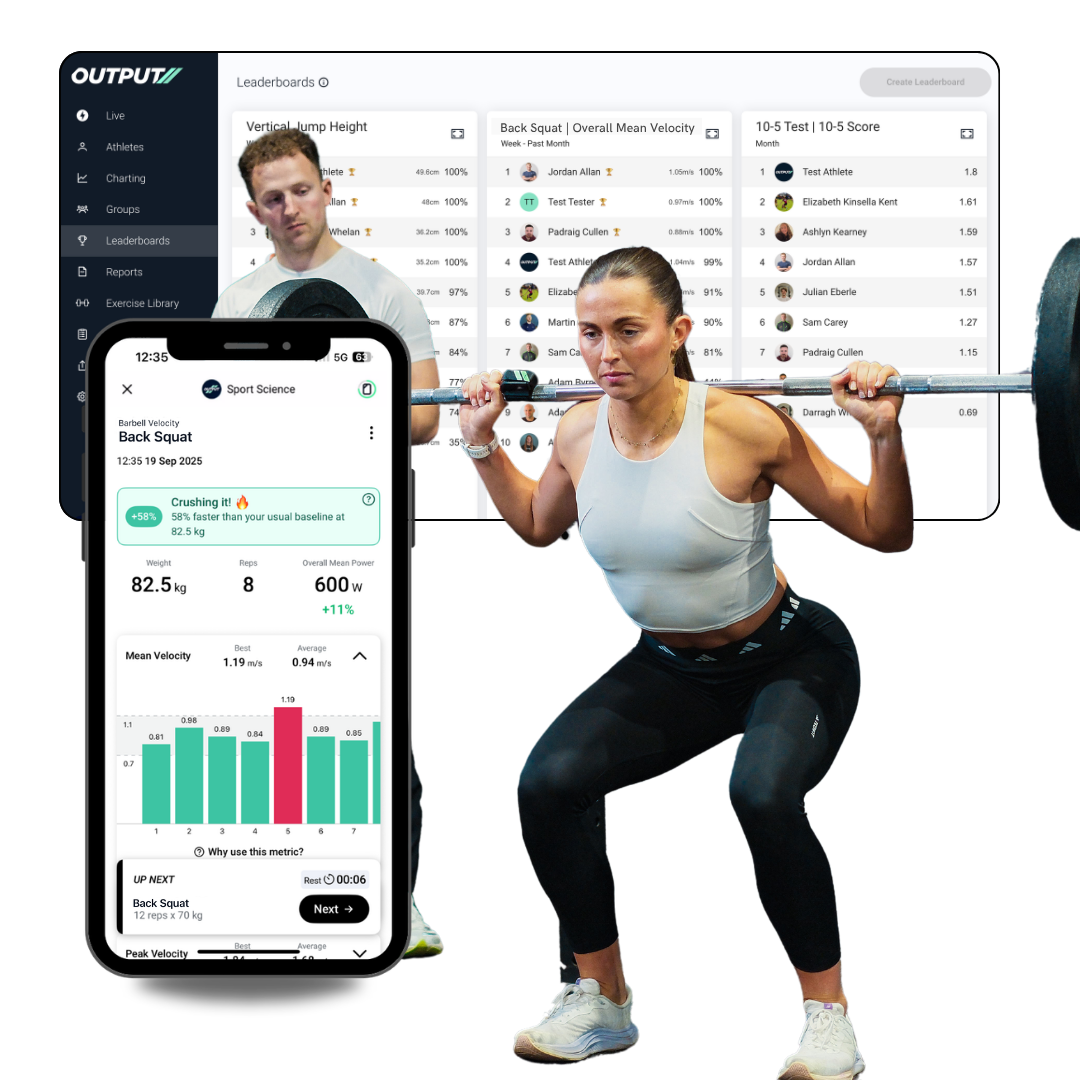
The foundational lower body profile. Tests the ability to produce force and velocity in knee extension and hip drive. Load-velocity relationships in the squat show high linearity (r = 0.832 in men, r = 0.806 in women).
Bench press
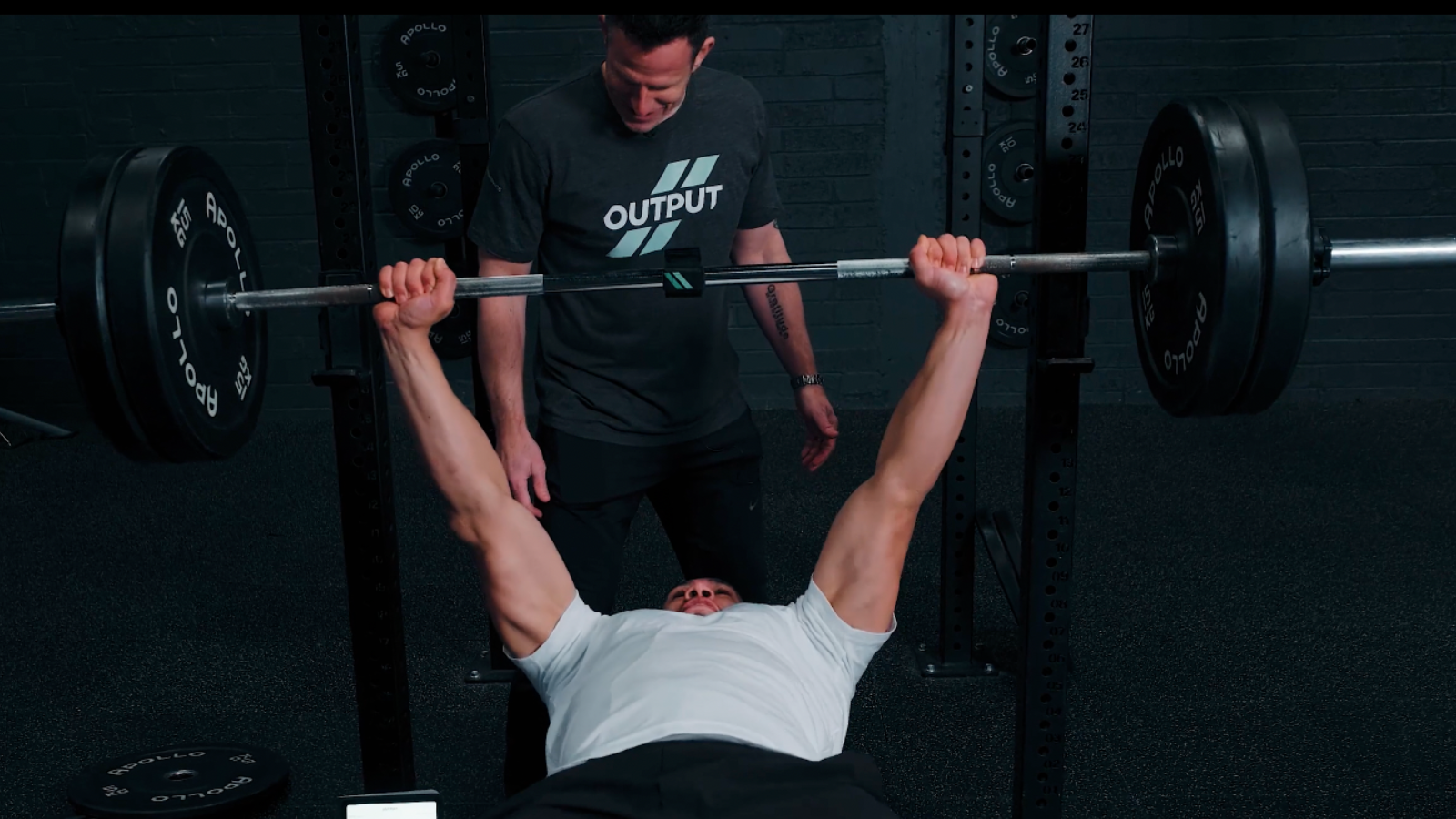
The upper body equivalent. Good for any athlete where pressing power matters. Bench press shows highly linear load-velocity relationships (r = 0.880 in men, r = 0.872 in women). Often shows different profiles than lower body work because the mechanics of upper body pressing differ significantly.
Deadlift
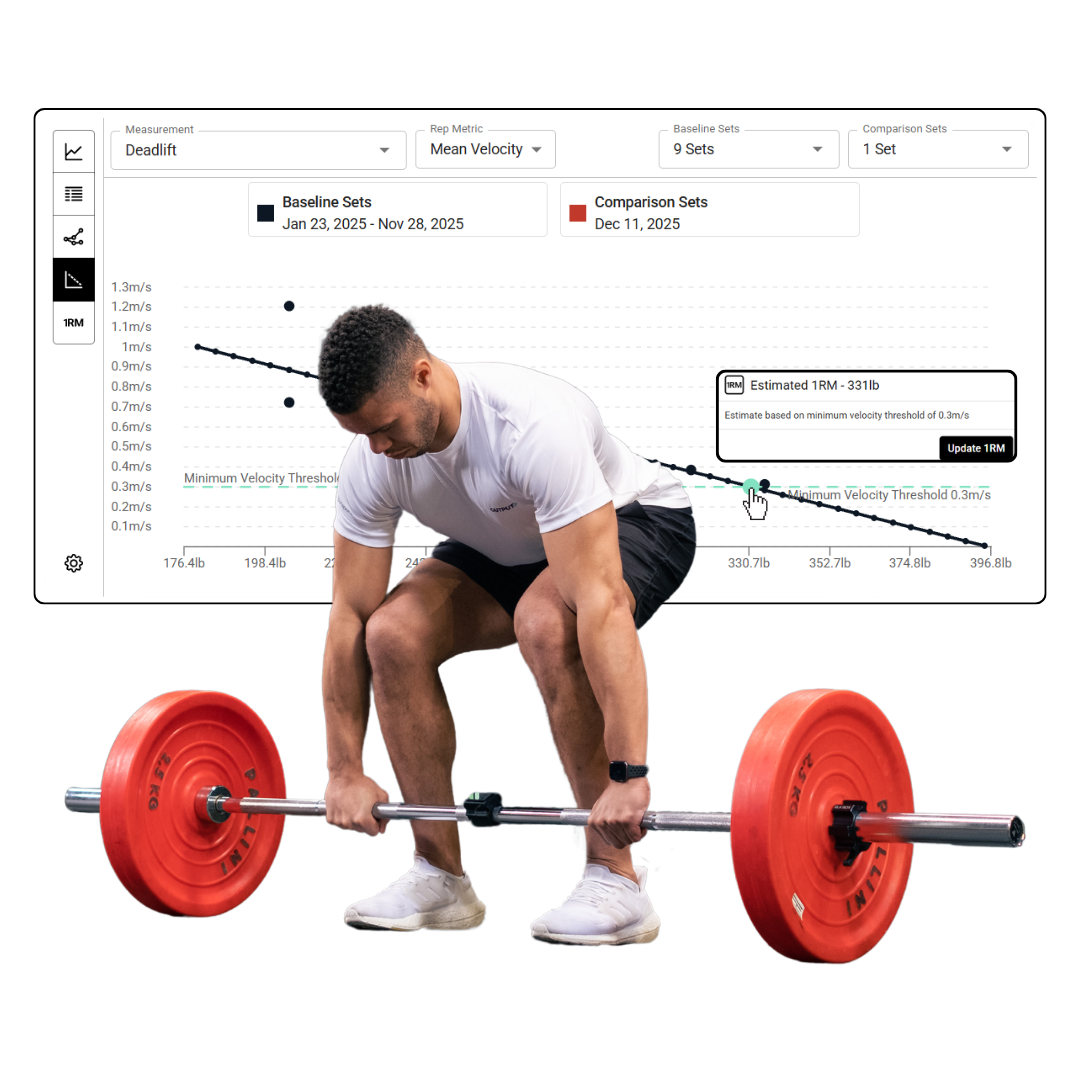
Captures pulling load-velocity patterns. Often shows different profile characteristics than squat because range of motion changes minimally with load. Useful for understanding posterior chain load-velocity capacity.
Test the same movement every time you profile the same athlete. This ensures your data is comparable across time.
Research note: Research has also explored the use of load-velocity profiling with machine-based exercises, demonstrating that velocity relationships hold across different exercise modalities. Output's portability and versatility offers coaches the perfect solution for profiling across barbell, dumbbell, and machine-based movements in any training environment.
Once you've established an athlete's load-velocity profile, you can use it to prescribe specific training zones across the load-velocity spectrum. Research has identified exercise-specific velocity zones for optimal training prescription. Below is a practical framework organized by training effect and body region:
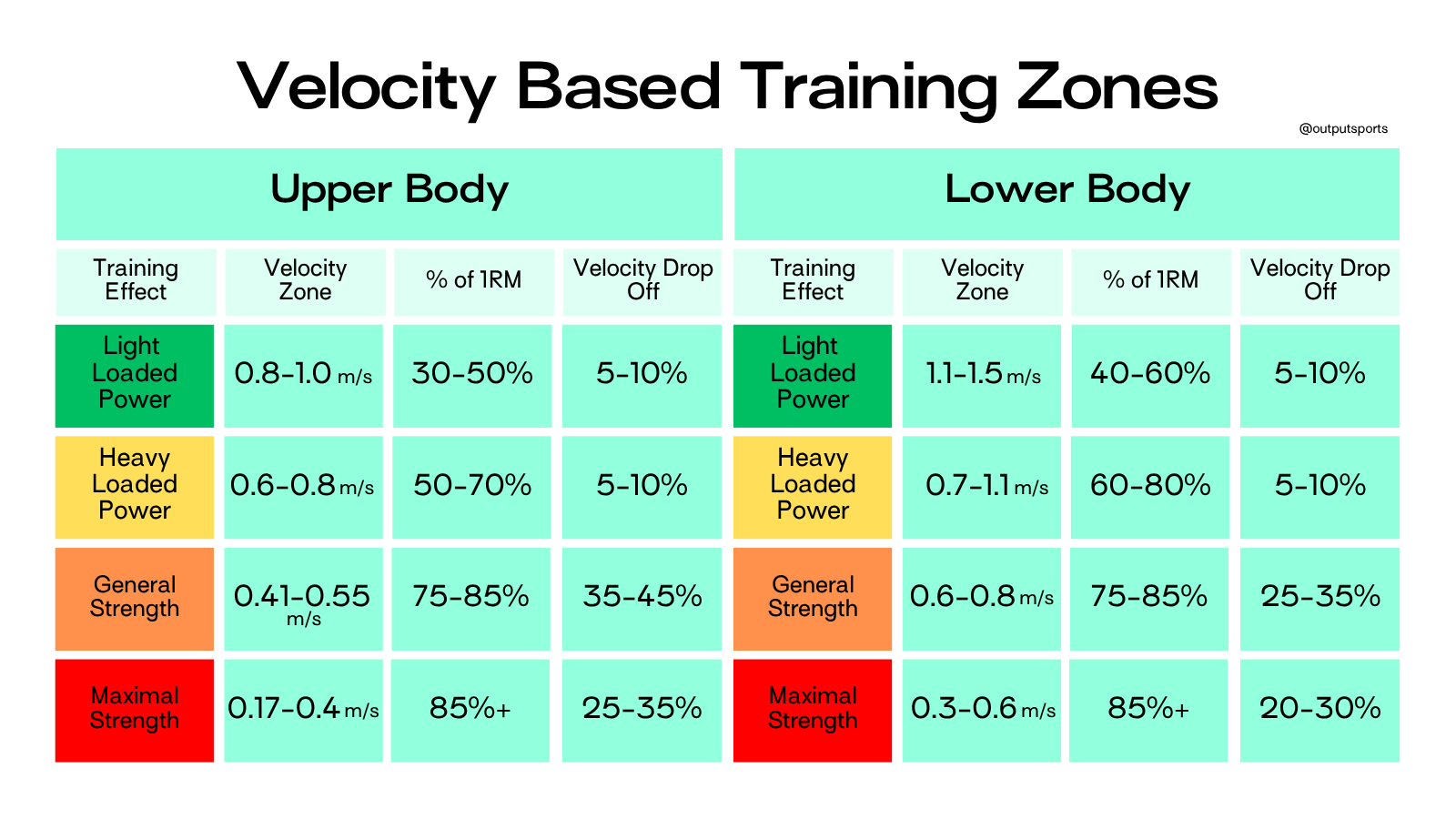
*Note: These zones are derived from research on exercise-specific velocity thresholds and organised here by training effect for practical application. Actual velocity thresholds may vary slightly between athletes and exercises
If an athlete is force-strong, they might benefit from more velocity and power-focused work: lighter loads, explosive intent, Olympic lift variants. They have the strength base; they need to express it faster.
If an athlete is velocity-strong, they might benefit from heavier, slower work: strength accumulation, lower rep ranges, heavy doubles and triples. They have the speed; they need to build absolute force capacity.
If an athlete is balanced, they likely need a concurrent approach.
Training history, injury status, sport demands, current fatigue, age, and sex all influence what an athlete actually needs. The profile identifies capacity. Context determines application. The coach decides.
A practical guideline for individualised load-velocity prescription: a change in mean velocity of plus or minus 0.06 m/s should prompt an increase or decrease of absolute load of approximately 5%. This allows for flexible manipulation of training intensities based on daily readiness and athlete adaptation.
One practical application of load-velocity profiling is 1RM estimation without maximal testing. The linearly-fitted line in the load-velocity profile can predict an athlete's 1RM by identifying the estimated load at which an athlete's profile intercepts with an exercise's minimum velocity threshold. The minimal velocity threshold is unique to each exercise but represents the velocity of a true 1RM, also known as V1RM.
Population-derived minimum velocity thresholds stem from academic research and are useful and efficient to use, though there is some variance in V1RM from athlete to athlete. Reported values include:
Bench Press: 0.17 m/s
Squat: 0.3 m/s
Deadlift: 0.15 m/s
Mean propulsive velocity during the bench press was shown to be closely related to percent 1RM, with a relationship that remained stable even after increases in 1RM following training periods (González-Badillo & Sánchez-Medina, 2010).
Load-velocity relationships provide reliable 1RM predictions when using submaximal loads, allowing coaches to estimate 1RM without the fatigue and risk associated with traditional 1RM testing.
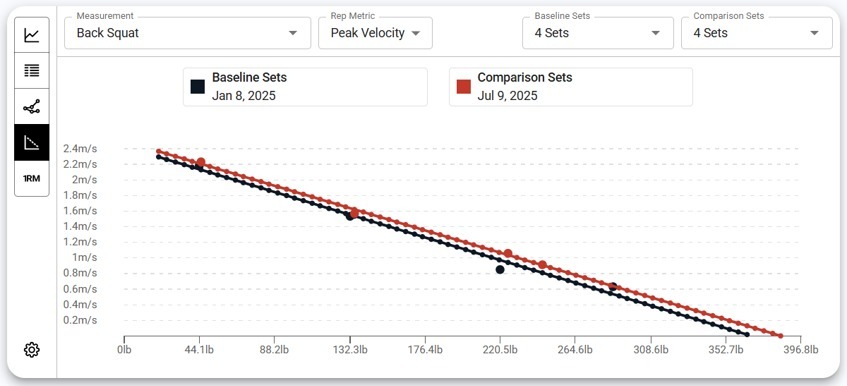
Athletes' profiles shift over time. Strength training shifts the profile toward heavier loads and slower velocity. Speed and power training shifts it toward lighter loads and higher velocity. Fatigue can flatten profiles temporarily; velocity drops while absolute force stays steady, or both decline.
Testing the same profile every 4 to 8 weeks gives you a trend. You can see whether your programme is working, whether an athlete is overreached, or whether a return-to-play athlete is getting back to baseline. Individualised profiling is more effective than group-based approaches for dictating training loads and producing adaptations in strength and power over 6-week training blocks.
For highly-trained athletes you may only see certain portions of their profile improve—for example, velocity production increases at lower loads for a previously strength-dominant athlete.
One test is a snapshot. Repeated profiles over time tell the story of whether your training stimulus is moving the athlete in the direction you intended.
Velocity-based training gives you real-time feedback on every rep. Load-velocity profiling gives you the bigger picture: it shows you the athlete's production capabilities across the entire load-velocity spectrum in one test.
Together, they reduce guesswork. You know how strong your athlete is in absolute terms. You know how fast they can move across different loads. You know whether you're building in the direction you intended. It's not a replacement for experienced coaching, it's a tool that makes assessment faster and more objective for large squads.
The data is objective. The interpretation is contextual. The decision is always the coach's.
If you're new to testing athletes' load-velocity profiles, start simple. Pick one or two exercises: back squat and bench press work best. Administer the protocol outlined above. You don't need software; a spreadsheet works fine.
How often you complete a formal load-velocity profile depends largely on who you're working with. A good rule of thumb is to coincide with the start and end of a training block. But the strength of Output is different: velocity tracking becomes part of every gym session. Your dataset continues to grow week on week, session on session. You're continuously monitoring whether your programme is working and whether your athlete's profile is shifting in the direction you intended.
The data is only useful if you act on it. Test purposefully, then programme with intention.
Banyard HG, Nosaka K, Vernon AD, Haff GG. The Reliability of Individualized Load–Velocity Profiles. International Journal of Sports Physiology and Performance. 2018;13(6):763-771.
Balsalobre-Fernández C, Cardiel-García M, Jiménez SL. Bilateral and unilateral load-velocity profiling in a machine-based, single-joint, lower body exercise. PLOS ONE. 2019;14(9):e0222632.
Dorrell HF, Moore JM, Gee TI. Comparison of individual and group-based load-velocity profiling as a means to dictate training load over a 6-week strength and power intervention. Journal of Sports Sciences. 2020;38(11-12):1329-1337.
Fernandez Ortega JA, Mendoza Romero D, Sarmento H, Prieto Mondragón L. Bar Load-Velocity Profile of Full Squat and Bench Press Exercises in Young Recreational Athletes. International Journal of Environmental Research and Public Health. 2022;19(11):6756.
González-Badillo JJ, Sánchez-Medina L. Movement Velocity as a Measure of Loading Intensity in Resistance Training. International Journal of Sports Medicine. 2010;31(5):347-352.
Jovanović M, Flanagan EP. Researched applications of velocity based strength training. Journal of Australian Strength and Conditioning. 2014;22(2):58-69.
Weakley JJS, Morrison M, García-Ramos A, Johnston R, James LP, Cole MH. The load-velocity profiles and exercise-specific velocity zones for seven commonly used weightlifting exercises. PLOS ONE. 2026;21(3):e0352209.
Weakley JJS, McLaren S, García-Ramos A, Johnston R, Cole MH, Kawamori N, Read DB, Jones B. Load-velocity relationships and predicted maximal strength: a systematic review of the validity and reliability of current methods. PLOS ONE. 2022;17(10):e0267937.

.png)
Monthly performance insights, product updates, and sports science — straight to your inbox.
No spam, ever. Unsubscribe anytime.
No thanks, I'm not interested