BE THE FIRST TO GET PRODUCT UPDATES
Get notified about new features & special offers......


Members who walk into a gym today are rarely training for just one thing. A weekend rugby player wants to be quicker, a HYROX entrant needs strength and conditioning together, and someone in their forties wants to stay strong without picking up injuries. Performance training speaks to all of them. It takes the methods used to prepare athletes and applies them to everyday members, with testing and tracking to show that it is working. This article explains how to introduce it in a gym, starting with personal training and moving through small group sessions to group fitness classes.
Performance training develops the physical qualities that sport and daily life depend on, including strength, power, speed, agility, and endurance, through structured progression and regular measurement. To introduce it in a gym, start with personal training clients, add small group sessions once the process works, then bring simple performance elements into classes, using testing to set baselines and track progress.
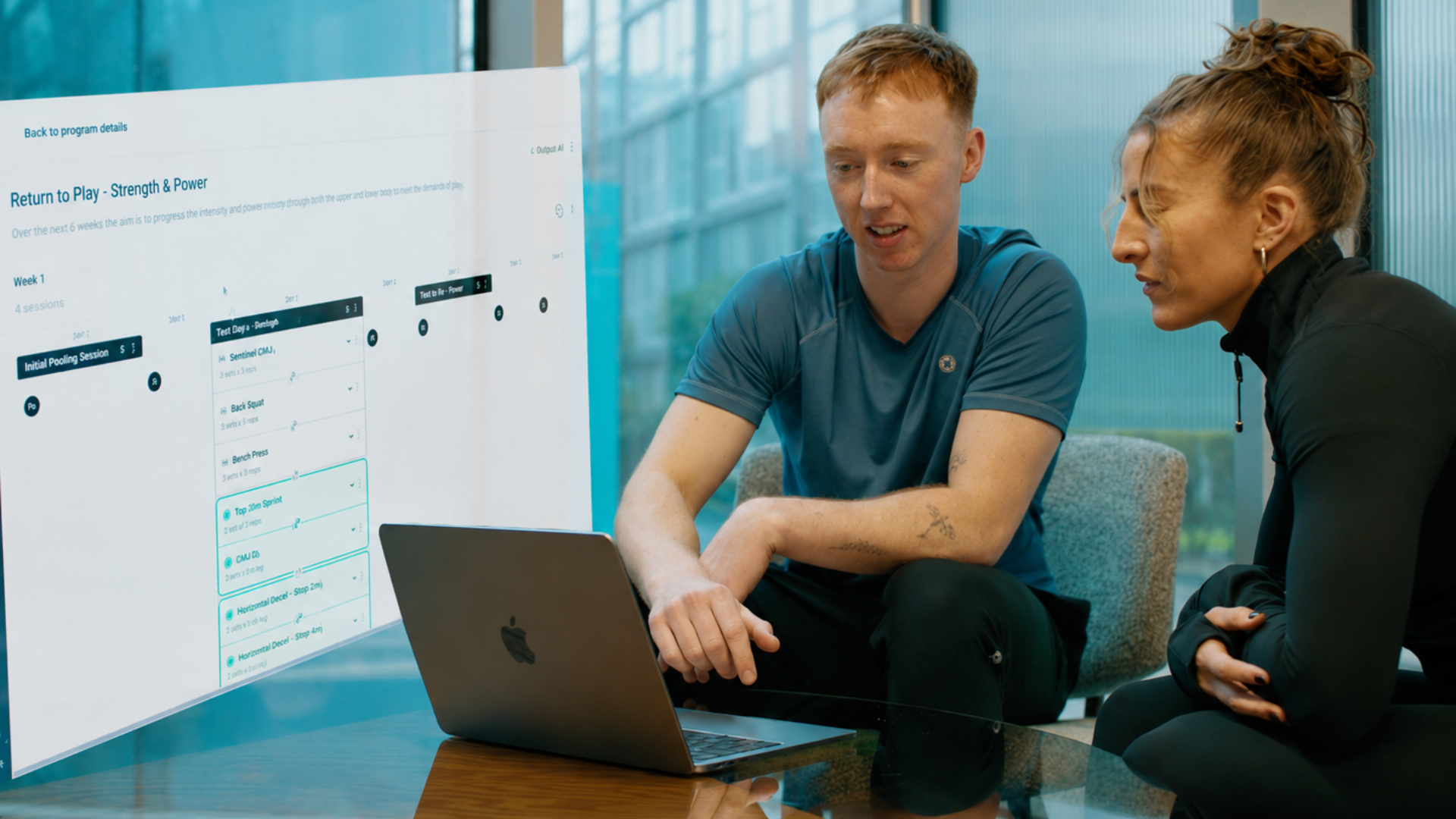
Performance training is structured training that develops the physical qualities behind athletic performance: strength, power, speed and acceleration, agility, endurance, and movement quality. It is also called sports performance training or athletic performance training. What separates it from general fitness is the method. Sessions follow a plan that builds progressively, and results are measured against a starting point instead of judged by feel.
Strength sits at the centre of it. Greater muscular strength is strongly associated with better jumping, sprinting, and change of direction performance, which is why most sport-specific training starts there [1]. Performance training does not require members to be athletes. It suits any member whose goal involves moving better, faster, or with more force.
Clear goals and visible progress. Performance training gives members a target they can see, such as a faster sprint time, a higher jump, or more load moved at the same speed. That is easier to stay motivated by than a general aim to get fitter.
Transferable results. The qualities trained, such as strength and power, carry over into sport, hybrid events, and everyday tasks [1].
Lower injury risk. A systematic review and meta-analysis of randomised controlled trials found that strength training reduced sports injuries to less than a third of their expected rate, with a pooled risk ratio of 0.315 [2]. The review noted a tendency towards an increasing effect and some outlying studies, so this supports strength work as part of a programme rather than as a guarantee.
Variety with purpose. Mixing strength, power, speed, and conditioning keeps sessions interesting, while the progression behind it keeps them productive.
A sports performance training programme starts with a baseline, sets a clear goal, and then progresses load and complexity over time.
For a wider look at programme design, see how to create a workout program.
Different qualities are trained in different ways, and most programmes combine several of them.
Plyometric and jump work builds power and explosive movement, and sprint and change of direction drills build speed, acceleration, and agility. A good programme weaves these together with strength work rather than treating them as separate sessions.
The simplest route is to start narrow and widen it as the process proves itself.
Personal training is the natural starting point because the coach can individualise everything. A member’s assessment sets their baseline, the programme reflects their goal, and each session produces data that guides the next one.
This is where systemised tracking helps most. In many gyms, programmes sit on paper or in each coach’s own app, which makes it hard to see a member’s history. With a connected system, the coach selects the member’s profile and starts the exercise in their programme, and the results are stored in that member’s profile and held in the performance hub. Everything the coach needs is in one place the next time the member walks in.
Small group training keeps much of the individual detail while spreading coaching time. Station-based formats work well: each member has their own targets and tracks their own numbers, while the group shares the same session structure. Keep the group small enough that the coach can see everyone’s technique.
Group fitness classes cannot individualise to the same degree, so the aim shifts. Bring in performance elements that suit a class, such as a power or speed block, a strength-focused segment, or a shared benchmark that members can repeat. Members who want deeper individual work can then move into small group or personal training, which gives the gym a natural progression path.
Measurement is what makes performance training credible to members. Standardised test batteries for strength, power, speed, mobility, and body composition are set out in NSCA guidance [6].
Output covers the main physical qualities. Strength testing and jump and power testing give strength and power baselines, speed and explosiveness testing covers sprint and acceleration, and movement, mobility and balance testing covers movement quality. Output measurement is validated against gold-standard methods.
Rather than retesting every set number of weeks, embed testing in normal training. Track bar speed at a fixed load, use a warm-up jump, and record session RPE, an effort rating multiplied by session duration, which has been found valid across a wide variety of exercise types [7]. Then run a focused test under controlled conditions when a block ends, when the embedded data drifts beyond typical error [8], when a member returns from a layoff, or when a new member joins. A change only counts if it is larger than the typical error of the test that produced it.
A wellness questionnaire covering soreness, mood, and readiness adds the member-reported side, and Output includes one. Heart rate, GPS, and sleep scores come from separate wearable systems, which sit outside the Output platform.
One caution for marketing and coaching conversations: testing shows where a member is and how they are changing, but it does not predict injury. A critical review found no screening test with adequate predictive properties [9].
The strongest marketing is the member’s own progress, shared with their permission. A faster sprint, a higher jump, or a heavier lift at the same bar speed is easier to understand than a general claim about results.
Show the process. Let members see how the testing works, because a clear process explains why the service differs from a standard session.
Use the data in conversations. Coaches who show a member their numbers have something specific to talk about, which supports personal training and small group sign-ups.
Build a clear path. Describe how a member moves from classes to small group to personal training, so each step is easy to understand.
Speak to the goals members already have. HYROX and other hybrid events draw members who need both strength and conditioning, which is covered in more detail in gym and HYROX training. Keep the language factual and avoid promising specific outcomes.
To go further on measuring progress, read how to track fitness progress and how to measure training effectiveness.
[1] T. J. Suchomel, S. Nimphius, and M. H. Stone, “The importance of muscular strength in athletic performance,” Sports Medicine, vol. 46, no. 10, pp. 1419-1449, 2016. DOI
[2] J. B. Lauersen, D. M. Bertelsen, and L. B. Andersen, “The effectiveness of exercise interventions to prevent sports injuries: a systematic review and meta-analysis of randomised controlled trials,” British Journal of Sports Medicine, vol. 48, no. 11, pp. 871-877, 2014. DOI
[3] American College of Sports Medicine, “American College of Sports Medicine position stand. Progression models in resistance training for healthy adults,” Medicine & Science in Sports & Exercise, vol. 41, no. 3, pp. 687-708, 2009. DOI
[4] T. D. Williams, D. V. Tolusso, M. V. Fedewa, and M. R. Esco, “Comparison of periodized and non-periodized resistance training on maximal strength: a meta-analysis,” Sports Medicine, vol. 47, no. 10, pp. 2083-2100, 2017. DOI
[5] J. Weakley, B. Mann, H. Banyard, S. McLaren, T. Scott, and A. Garcia-Ramos, “Velocity-based training: from theory to application,” Strength and Conditioning Journal, vol. 43, no. 2, pp. 31-49, 2021. DOI
[6] T. Miller, Ed., NSCA’s Guide to Tests and Assessments. Champaign, IL, USA: Human Kinetics, 2012. Publisher
[7] C. Foster, J. A. Florhaug, J. Franklin, L. Gottschall, L. A. Hrovatin, S. Parker, P. Doleshal, and C. Dodge, “A new approach to monitoring exercise training,” Journal of Strength and Conditioning Research, vol. 15, no. 1, pp. 109-115, 2001. DOI
[8] W. G. Hopkins, “Measures of reliability in sports medicine and science,” Sports Medicine, vol. 30, no. 1, pp. 1-15, 2000. DOI
[9] R. Bahr, “Why screening tests to predict injury do not work, and probably never will: a critical review,” British Journal of Sports Medicine, vol. 50, no. 13, pp. 776-780, 2016. DOI


Monthly performance insights, product updates, and sports science — straight to your inbox.
No spam, ever. Unsubscribe anytime.
No thanks, I'm not interested