BE THE FIRST TO GET PRODUCT UPDATES
Get notified about new features & special offers......


Every coach collects numbers. Fewer are clear on which numbers actually describe performance, how reliable they are, and what to do with them once they are on a screen. Sports evaluation metrics are the measurable indicators used to describe an athlete’s performance, from what happens in the match to the physical condition behind it. Performance analysis is the process of turning that data into decisions.
Performance analysis is the objective recording of performance, so that key elements can be quantified in a valid and consistent manner and fed back to athletes and coaches. Used before an event, it shows opportunities to exploit. Used afterwards, it shows whether the objectives and strategy worked, where they fell short, and what to change next time.
This article covers what performance analysis is, the technical, tactical, and physical metrics it draws on, how physical testing can help explain what the analysis shows, and how to measure athlete performance without making the data misleading.
Sports evaluation metrics are quantified measures of athlete performance. They are the raw material of performance analysis, which the Australian Sports Commission describes as an objective way of recording performance, where key elements of that performance can be quantified in a valid and consistent manner. It provides systematic and objective feedback to athletes and coaches, built on observation and analysis of visual and statistical data [1].
In practice the work runs in two directions. Before an event, analysis of an athlete, team, or opponent shows opportunities that can be exploited. After it, the same data shows whether the objectives and strategy worked, where they fell down, and how they can be improved next time. A survey of analysts at elite football clubs found they provide both pre-match and post-match feedback, and concluded that they play an important role in improving how teams observe, analyse, and feedback on performance [2]. Analysts and coaches combine objective data with subjective observation and athlete feedback to do this.
Most people picture the technical side: chances created, assists, tries or touchdowns scored, passes completed. Event data like this is collected on every match. Evaluation covers three areas:
Researchers describe a performance indicator as a selection, or combination, of action variables that describes some or all aspects of a performance [3]. Counts alone can mislead. Winners and errors, for example, are powerful indicators of technical competence, but they need to be normalised against total actions to mean much [3].
A metric is only useful if it is measured well. Sport science judges a performance test on three properties: validity (does it reflect the performance of interest), reliability (does it give the same result when repeated), and sensitivity (can it detect small but important changes) [4]. A metric that fails any one of these can look precise while telling you very little.
Technical and tactical data describes what happened in the game. Physical data describes the capacity and condition the athlete brought to it, and it is the part a coach can most directly train.
Strength and power. Greater muscular strength is strongly associated with better jumping, sprinting, and change of direction performance, which is why strength sits at the core of almost every sport [5]. Bar velocity adds detail, and velocity-based frameworks use it for objective feedback, strength estimation, and load-velocity profiling [6]. For more on how this works, see velocity based training, the Output ebook on velocity based training, and eccentric vs concentric exercises.
Speed and agility. Acceleration and top speed are the core sprint metrics, and measurement method matters as much as the athlete. Fully automatic timing, dual-beam photocells, laser guns, and high-speed video are the most accurate tools for sprint monitoring, while manual timing and single-beam photocells should be avoided over short sprints of 10 to 20 metres because of large absolute errors [7].
Training load. External load is the work performed, and internal load is the athlete’s psychophysiological response to that work [8]. Total distance, sprint distance, work rate, and heart rate come from separate wearable tracking systems, which sit outside the Output platform. Session RPE, an effort rating multiplied by session duration, has been found valid across a wide variety of exercise types [9], and when internal and external load diverge, the gap may reveal an athlete’s state of fatigue [10].
Recovery and readiness. Sleep scores are widely collected from wearables and also sit outside the Output platform. A wellness questionnaire covering soreness, mood, and readiness captures the athlete-reported side.
Endurance, body composition, and movement quality. Use one consistent method for body composition, and treat movement quality as coach-observed context rather than a single score. For hybrid sports where strength and conditioning both matter, see how the metrics combine in gym and HYROX training.

Metrics become performance analysis when they are compared against something. Three reference points are useful:
Every comparison needs an estimate of noise. Reliability research uses typical error to describe trial-to-trial variation in a measure [11], so a change only counts if it is larger than the typical error of the test that produced it.
Performance on game day is the product of many attributes, and only some are visible in the match. A drop in chances created means something different after a heavy load week and a poor wellness response than after a quiet one. Reading physical data alongside technical and tactical output is what turns performance data into analysis, and the coach still interprets it.
Match analysis is good at showing what is happening. It is less able to show why. Physical testing can help fill in that second part, by checking whether a physical quality sits behind what the analysis has already flagged.
Take a rugby player who is not making enough line breaks. The analysis shows the pattern, but the cause could be tactical (role and support lines), technical (footwork and carry), or physical. Testing can check the physical possibility. Strength testing shows low lower limb strength, while a countermovement jump and a 10-5 repeated jump test for reactive strength index (RSI), both part of jump and power testing, show limited power and reactivity. Acceleration data from timing gates shows the player is slow to get up to speed. Together, those results support a physical explanation for what the match data showed, because a player who cannot accelerate or produce force quickly will find it harder to beat a defender.
That does not prove the cause, and the coach still weighs it against the tactical and technical picture. What it does is turn an observation into something that can be trained. The coach can programme strength and power work for that player, then retest to see whether the physical quality changed and whether the line breaks followed.
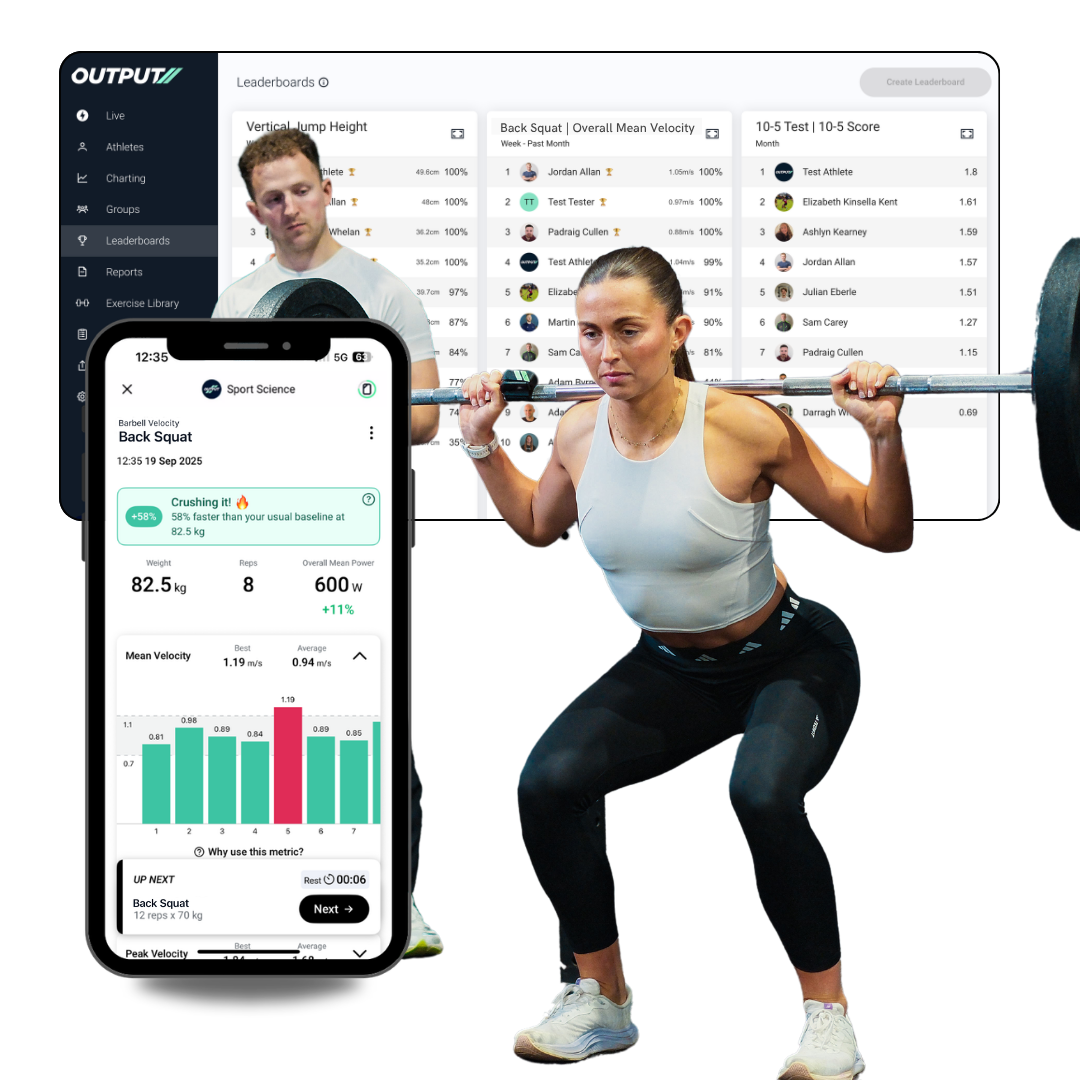
This is where Output fits. It maps onto the Output Loop: Test, Program, Train, Monitor. Testing sets the baseline, programming applies the findings, training produces in-session data, and monitoring shows how the athlete is responding, which informs the next round of testing. It is a decision-support layer for the coach, not automation. Output measurement is validated against gold-standard methods, connected coaching software keeps the stages in one workflow, and the performance platform holds the trends. For other qualities, Output also covers speed and explosiveness testing and movement, mobility and balance testing.
To build these metrics into a plan, see how to create a workout program. For a wider tracking approach, see how to track fitness progress, and to judge whether the programme itself is working, see how to measure training effectiveness.
What are sports evaluation metrics?
They are measurable indicators of athlete performance across technical, tactical, and physical areas. Good metrics are valid, reliable, and sensitive enough to detect meaningful change.
What is performance analysis in sport?
Performance analysis is the objective recording of performance, so that key elements can be quantified in a valid and consistent manner and fed back to athletes and coaches [1]. It is used before an event to find opportunities and afterwards to review whether the objectives and strategy worked.
What are the three areas of sports evaluation?
Technical (skill execution), tactical (use of space, pace, and decisions), and physical (strength, power, speed, endurance, load, and recovery). Performance analysis works best when all three are read together.
Can physical testing help explain match performance?
Yes. If match analysis flags a problem, such as too few line breaks in rugby, testing strength, jump power, and acceleration can show whether a physical quality sits behind it. It supports the explanation rather than proving it, and the coach weighs it against the technical and tactical picture.
How often should you test athlete performance?
Rather than a fixed schedule, record simple measures such as bar speed at a fixed load, a warm-up jump, and session RPE in every session. Then run a focused test under controlled conditions when a block ends, when the data drifts beyond typical error, or when an athlete returns from injury or a layoff.
Can sports metrics predict injury?
No. A critical review found no screening test with adequate predictive properties for sports injury [13]. Metrics are best used to inform training decisions.
[1] Australian Sports Commission, “Performance analysis,” Clearinghouse for Sport. Updated Sep. 4, 2025. [Online]. Available: https://www.ausport.gov.au/clearinghouse/evidence/performance-analysis
[2] C. Wright, S. Atkins, B. Jones, and J. Todd, “The role of performance analysts within the coaching process: Performance Analysts Survey ‘The role of performance analysts in elite football club settings,’” International Journal of Performance Analysis in Sport, vol. 13, no. 1, pp. 240-261, 2013. DOI
[3] M. D. Hughes and R. M. Bartlett, “The use of performance indicators in performance analysis,” Journal of Sports Sciences, vol. 20, no. 10, pp. 739-754, 2002. DOI
[4] K. Currell and A. E. Jeukendrup, “Validity, reliability and sensitivity of measures of sporting performance,” Sports Medicine, vol. 38, no. 4, pp. 297-316, 2008. DOI
[5] T. J. Suchomel, S. Nimphius, and M. H. Stone, “The importance of muscular strength in athletic performance,” Sports Medicine, vol. 46, no. 10, pp. 1419-1449, 2016. DOI
[6] J. Weakley, B. Mann, H. Banyard, S. McLaren, T. Scott, and A. Garcia-Ramos, “Velocity-based training: from theory to application,” Strength and Conditioning Journal, vol. 43, no. 2, pp. 31-49, 2021. DOI
[7] T. Haugen and M. Buchheit, “Sprint running performance monitoring: methodological and practical considerations,” Sports Medicine, vol. 46, no. 5, pp. 641-656, 2016. DOI
[8] F. M. Impellizzeri, S. M. Marcora, and A. J. Coutts, “Internal and external training load: 15 years on,” International Journal of Sports Physiology and Performance, vol. 14, no. 2, pp. 270-273, 2019. DOI
[9] C. Foster, J. A. Florhaug, J. Franklin, L. Gottschall, L. A. Hrovatin, S. Parker, P. Doleshal, and C. Dodge, “A new approach to monitoring exercise training,” Journal of Strength and Conditioning Research, vol. 15, no. 1, pp. 109-115, 2001. DOI
[10] S. L. Halson, “Monitoring training load to understand fatigue in athletes,” Sports Medicine, vol. 44, suppl. 2, pp. S139-S147, 2014. PubMed
[11] W. G. Hopkins, “Measures of reliability in sports medicine and science,” Sports Medicine, vol. 30, no. 1, pp. 1-15, 2000. DOI
[12] T. Miller, Ed., NSCA’s Guide to Tests and Assessments. Champaign, IL, USA: Human Kinetics, 2012. Publisher
[13] R. Bahr, “Why screening tests to predict injury do not work, and probably never will: a critical review,” British Journal of Sports Medicine, vol. 50, no. 13, pp. 776-780, 2016. DOI


Monthly performance insights, product updates, and sports science — straight to your inbox.
No spam, ever. Unsubscribe anytime.
No thanks, I'm not interested