BE THE FIRST TO GET PRODUCT UPDATES
Get notified about new features & special offers......


Most commercial gyms already know how much their members lift. Far fewer know how well it was lifted. Velocity-based training (VBT) closes that gap by measuring how fast the bar moves on every repetition, which turns a training log into something a coach can act on in real time. For gym owners, it also opens up a service that is hard to copy with a clipboard and a stopwatch.
Velocity-based training measures bar speed on every repetition and uses it to set loads, track fatigue, and monitor progress. For commercial gyms, it also replaces manual logging in separate apps and paper programmes with one systemised record per member, which supports premium personal training, small group strength programmes, and clearer progress tracking.
This article explains what VBT is, how it works, how it compares with traditional strength training, the equipment options, and how a commercial gym can put it into practice.
Velocity-based training is a method of resistance training that uses the speed of the barbell to guide the session. A device measures how fast each repetition moves, and the coach uses that number to adjust load, volume, or rest.
The method rests on a consistent relationship between load and speed. In a study of 120 strength-trained men, mean propulsive velocity in the bench press and the load lifted (as a percentage of one-repetition maximum, or 1RM) were very closely related, with an R-squared of 0.98 [1]. Mean velocity at 1RM was around 0.16 m/s, and the relationship between velocity and relative load held even as the lifters got stronger over six weeks [1]. That stability is what lets velocity act as a reliable guide to intensity.
One point matters for how coaches talk about VBT. Heavy loads move slowly as a consequence of the load, not because the lifter is trying to go slowly. The intent is always to move the bar as fast as possible, and the speed that results tells the coach what is happening.
A VBT session follows a simple loop. The lifter performs a repetition with maximal intent, the device reports the speed straight away, and the coach or the lifter uses it to decide what to do next. Applied frameworks use velocity for three things: objective feedback, strength estimation, and load-velocity profiling [2].
Real-time feedback. Seeing bar speed after each repetition gives members something concrete to chase, and gives coaches a way to check that effort and technique match the plan.
The load-velocity profile. Plotting velocity against load across several lifts produces a load-velocity profile. From it, a coach can estimate 1RM without testing a true maximum [1]. Two cautions apply. Profiles need loads above 80% of 1RM to be reliable, and an estimated 1RM is a ballpark, not an exact figure. Interpreting the profile remains the coach’s call.
Velocity zones. Coaches group loads into velocity zones according to the quality they want to train, such as strength, power, or speed. The member lifts within the zone for the day’s goal instead of chasing a percentage written weeks earlier.
Velocity loss. Within a set, bar speed drops as fatigue builds. Many coaches set a velocity loss threshold and end the set once it is reached. In strength-trained men, velocity loss across a set correlated strongly with blood lactate and with the loss in countermovement jump height, which supports using it to quantify neuromuscular fatigue [3].
Autoregulation. Because the same weight can feel and move differently from one day to the next, velocity lets the coach adjust the load to the member’s state on the day. A heavy day with fast bar speed can go ahead as planned. A day where the first repetitions are noticeably slower may call for a lighter load or less volume.
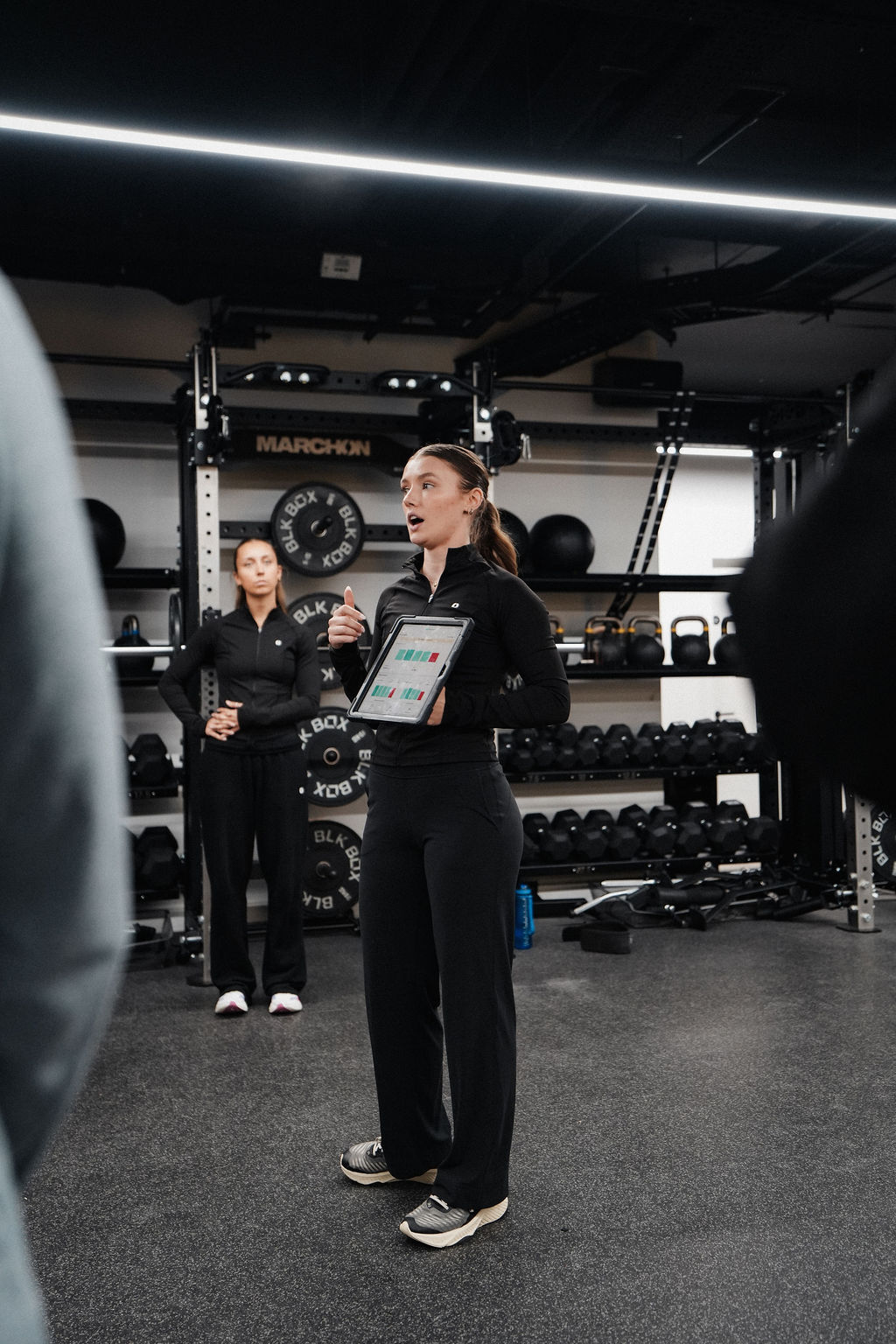
Objective feedback. Coaches and members both see the same number. Instead of relying on a feeling that a set was hard, there is a measure that shows it.
Systemised tracking. In many gyms, training is recorded by hand: paper programmes, notes on a phone, or each coach’s own app. That makes it hard to compare members, coaches, or blocks, and the information often stays with whoever wrote it down. With a connected system, the coach selects the member’s profile and starts the exercise in their programme, and the speed of each repetition is stored in that member’s profile and held in the performance hub. The record builds as a by-product of training instead of an extra task, and every coach in the gym is working from the same data.
Training that adapts to the day. Velocity-based loading lets the session respond to how the member is moving, which is difficult to do with fixed percentages. In a six-week randomised trial of 16 trained men, a velocity-based group gained strength comparably to a percentage-based group while using significantly less training volume, and also improved countermovement jump height by 5%, which the percentage-based group did not [4]. The sample was small, so this is encouraging rather than conclusive.
A clearer view of fatigue. Velocity loss gives coaches an early signal that a set or a session has gone far enough [3], which helps protect the quality of work in each session.
Progress members can see. Faster bar speed at the same load is a visible sign of improvement. For members who care about progress but do not hit a new one-repetition maximum every month, it gives them something to measure between milestones.
A stronger coaching offer. The data gives coaches more to talk about with members, and gives the gym something specific to describe when explaining how its strength coaching works.
Traditional programmes prescribe load as a percentage of a tested or estimated 1RM, set weeks in advance. VBT keeps the same structure of exercises, sets, and repetitions, but uses bar speed to decide the load and when to stop.
The two are not opposites. Most coaches keep the same programme structure and add velocity as another layer of information. For a broader look at how programmes are built, see how to create a workout program.
Equipment for measuring bar speed falls into three broad groups: linear position transducers, wearable accelerometers, and mobile or camera-based apps.
A systematic review of commercially available resistance training monitoring devices found that linear position transducers were generally more accurate and reproducible than other technologies, while accelerometer-based devices looked promising but their accuracy remained questionable [5]. The review also noted that many studies did not use gold-standard criterion measures [5]. For a gym, that makes validation the first question to ask of any device.
Beyond accuracy, a commercial gym should look at four practical things:
Output measurement is validated against gold-standard methods, and the velocity based training page covers how it works in practice.
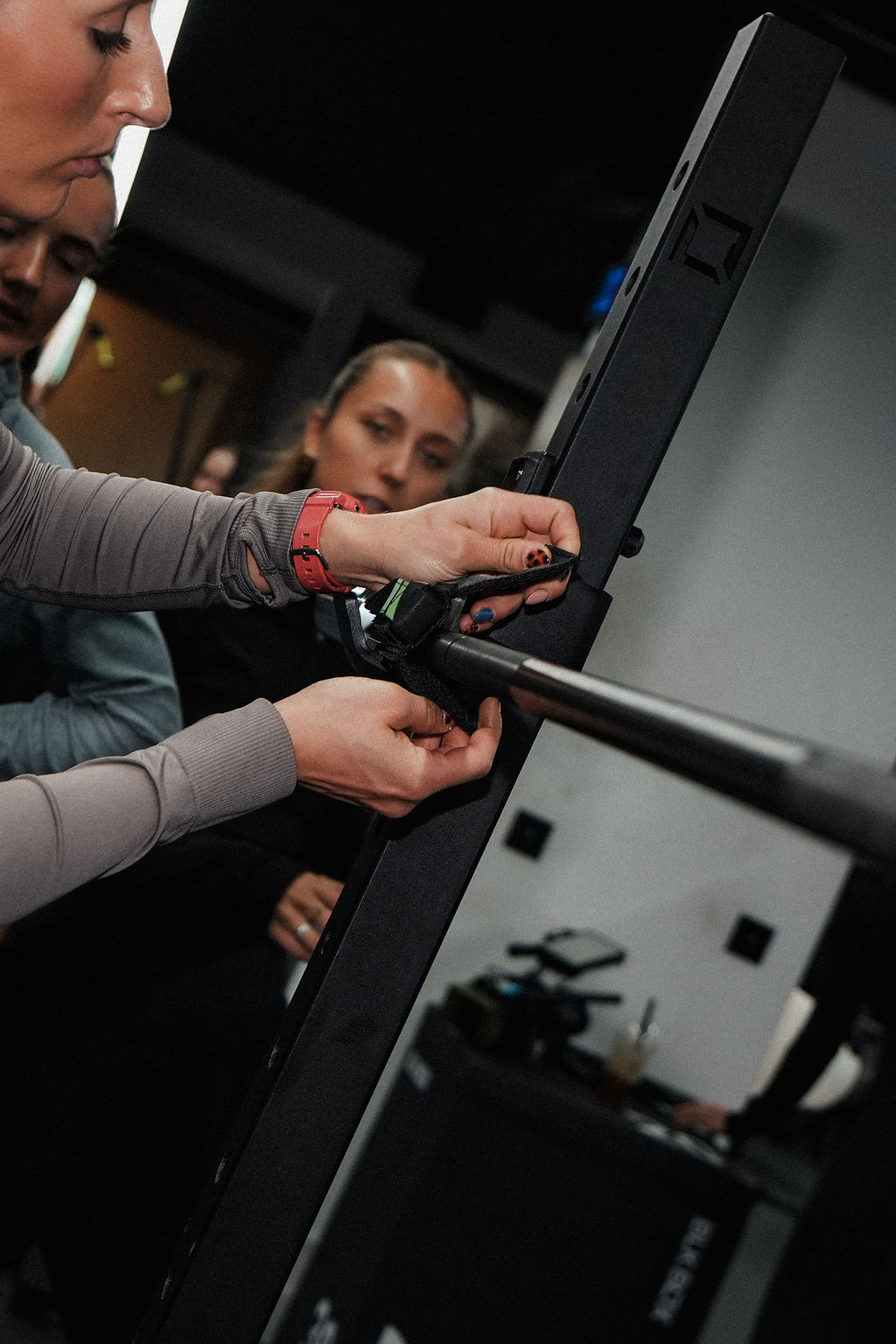
This follows the Output Loop: Test, Program, Train, Monitor. It is a decision-support system, so the data informs the coach’s decision and the coach still makes it. To see how progress tracking fits into a wider approach, read how to track fitness progress and how to measure training effectiveness.
For a commercial gym, VBT is a coaching tool first and a business opportunity second. The opportunities follow from the coaching value.
Premium personal training. Objective data gives trainers something to show members, such as bar speed trends and strength estimates. That supports a more specific service than general strength coaching and can justify a distinct price point.
Less admin and more consistent data. When a member’s profile is selected and the exercise is started in their programme, results are stored in their profile and held in the performance hub. Coaches spend less time copying numbers into paper programmes or separate apps, and the gym ends up with a consistent record for every member. That record can make progress reviews and coaching conversations easier to run.
Small group and performance programmes. Velocity-based sessions can sit alongside group formats where members still benefit from individual feedback on speed and effort.
Retention and engagement. Visible progress between big lifts gives members more to work towards. Members who can see their own improvement may have more reasons to keep coming back, although the effect will depend on how well coaches use the data.
A clearer point of difference. Measured strength coaching gives the gym something concrete to point to when it describes its approach.
Hybrid and performance-focused members. Members training for events that combine strength and conditioning can use the same data. See how this works in gym and HYROX training.
None of this is a guaranteed return. The revenue potential depends on pricing, how many coaches use it consistently, and how well the service is communicated to members.
For gyms with coaches who actively work with members on strength, yes. The value comes from the coaching conversation the data makes possible, so it pays off most where trainers, small group instructors, or performance coaches are already using strength work as part of their offer.
It is a weaker fit for a gym where members train alone and nobody is available to interpret the data. A device on its own does not change training. A coach who uses it to adjust loads, protect quality, and show progress is what turns it into a service.
A sensible way to start is small. Choose one group of coaches, one area of the gym, and one or two lifts, then build from there once it is working. Explore velocity based training to see how it fits your floor, or read the Output ebook on velocity based training for more detail.
[1] J. J. González-Badillo and L. Sánchez-Medina, “Movement velocity as a measure of loading intensity in resistance training,” International Journal of Sports Medicine, vol. 31, no. 5, pp. 347-352, 2010. DOI
[2] J. Weakley, B. Mann, H. Banyard, S. McLaren, T. Scott, and A. Garcia-Ramos, “Velocity-based training: from theory to application,” Strength and Conditioning Journal, vol. 43, no. 2, pp. 31-49, 2021. DOI
[3] L. Sánchez-Medina and J. J. González-Badillo, “Velocity loss as an indicator of neuromuscular fatigue during resistance training,” Medicine & Science in Sports & Exercise, vol. 43, no. 9, pp. 1725-1734, 2011. PubMed
[4] H. F. Dorrell, M. F. Smith, and T. I. Gee, “Comparison of velocity-based and traditional percentage-based loading methods on maximal strength and power adaptations,” Journal of Strength and Conditioning Research, vol. 34, no. 1, pp. 46-53, 2020. PubMed
[5] J. Weakley et al., “The validity and reliability of commercially available resistance training monitoring devices: a systematic review,” Sports Medicine, vol. 51, pp. 443-502, 2021. PubMed Central


Monthly performance insights, product updates, and sports science — straight to your inbox.
No spam, ever. Unsubscribe anytime.
No thanks, I'm not interested